
The Week Ahead : August 3-7, 2026
By Manish T. · BreakoutBulletin Weekly Preview
The Macro Question of the Week
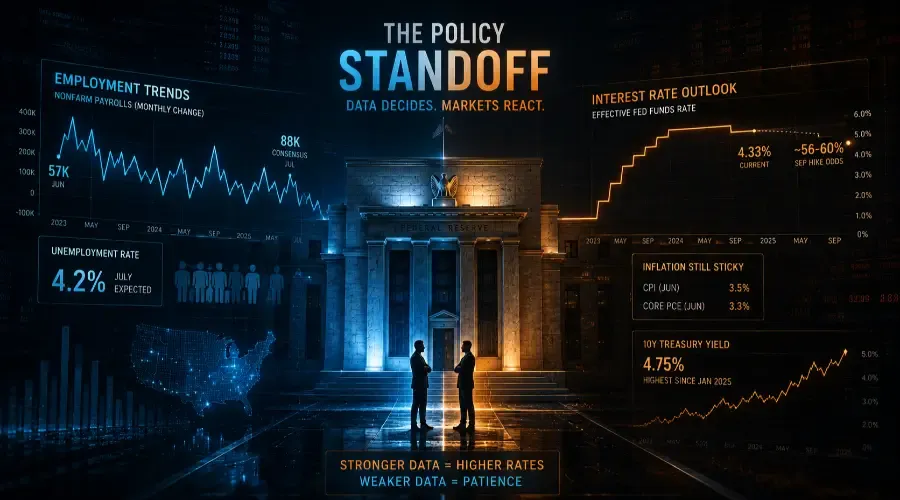
Heading into this week, the market is wrestling with a single question: will the incoming data force the Fed toward the September rate hike the bond market is already leaning on, or will a cooling labour market give policymakers room to wait?
It is, in effect, a stagflation-lite standoff. Inflation is still running hot – June headline CPI at 3.5% year-over-year and June core PCE at 3.3% – which is why three FOMC members dissented last week in favour of an immediate hike and why futures price roughly 56-60% odds of a September increase. Yet the labour side is softening, with June payrolls landing well below expectations.
If this week’s data stays weak, the “higher-for-longer, maybe higher-still” narrative loses its footing and the pressure to hike eases.
If the labour market re-firms while inflation stays sticky, the hike case hardens – and the long end of the curve, already at multi-year highs, has further to run.
Economic Calendar Breakdown
The week is a labour-market and activity story from front to back, building to Friday’s payrolls.
Note that July CPI does not arrive until August 12, so the jobs report carries the inflation-and-rates debate largely on its own this week.
Monday · ISM Manufacturing PMI (July), 10:00 AM ET – Measures factory-sector activity, where a reading above 50 signals expansion. Manufacturing has been the economy’s soft underbelly, so this sets the week’s growth tone. Consensus: 54.0 vs. prior 53.3. If/then: a sub-50 print reinforces the cooling-growth case; a surprise back above 50 complicates any argument for the Fed to ease off.
Tuesday · JOLTS Job Openings (June), 10:00 AM ET – A gauge of labour demand; openings are expected to slip slightly from the prior month. With June payrolls already weak, a further drop would corroborate a genuine hiring slowdown two days before the main event. If/then: a sharp fall stokes slowdown fears; a surprise jump keeps the labour market – and the hawks – in play.
Wednesday · ISM Services PMI (July), 10:00 AM ET – Services are roughly 70% of the economy and the stickier source of inflation. Consensus: 54.3 vs. prior 54.0. If/then: a hot print with firm prices-paid supports the hawkish, hike-considering case; a soft one tilts the balance toward patience.
Thursday · Weekly Initial Jobless Claims, 8:30 AM ET – The highest-frequency labour read. Prior: 197K. A jump the day before payrolls would amplify slowdown anxiety and set a nervous tone into Friday.
Friday · July Employment Situation / Nonfarm Payrolls, 8:30 AM ET – The week’s fulcrum. Consensus: 88K jobs added vs. 57K in June; unemployment rate expected to hold at 4.2%. If/then: a weak number – soft payrolls, rising unemployment, cooling wages – undercuts September-hike odds and could relieve the long end of the curve; a strong number with firm wage growth hardens the hike case and pressures rate-sensitive assets.
Earnings Calendar
With the mega-cap cloud names now reported, the focus shifts to the AI-hardware layer and the consumer.
Palantir (Monday, after the close) sets the tone for AI-software sentiment.
The pivotal report is AMD (Tuesday, after the close): after chip stocks fell roughly 22% in July and the market spent last week debating AI-capex returns, AMD’s data-center numbers are the cleanest test of whether the hardware side of the AI trade can follow the hyperscalers’ cloud beats – with direct read-through to the whole semiconductor complex.
Caterpillar (Tuesday, before the open) is the global industrial bellwether, a read on real-economy and construction demand.
McDonald’s, Disney, Uber, Airbnb, Booking and MercadoLibre test consumer resilience after Amazon’s blowout; Eli Lilly anchors healthcare and the GLP-1 theme; ConocoPhillips and Vistra speak to energy and power demand.
Most macro-relevant: AMD – it decides whether the AI-infrastructure narrative extends beyond the cloud giants into the chips that feed them.
Fed Events This Week
There is no FOMC meeting this week – the next decision is September 16 – but the post-meeting communications blackout has lifted, so Fed officials return to the podium, and that matters more than usual.
Three members dissented last week in favour of a hike, and Governor Lisa Cook (scheduled for Wednesday) and Vice-Chair for Supervision Michelle Bowman are among those on the August calendar.
Markets will parse every remark for how firmly the committee is leaning toward a September move.
With futures pricing roughly 56-60% odds of a 25-basis-point hike – down from about 80% before last week’s meeting – any hawkish emphasis on sticky inflation, or any dovish nod to labour-market cracks, can reprice the front end and the dollar before Friday’s jobs data even lands.
Technical Landscape
The S&P 500 enters the week near 7,490, just beneath the round-number 7,500 hurdle it has been wrestling with.
If it holds above roughly 7,400, the uptrend stays intact; a break below would put the recent breakout in question.
The Nasdaq Composite (~25,375) is the more fragile chart after July’s roughly 3.2% decline and contracting breadth – watch whether it can hold the ~25,000 shelf.
The 10-year Treasury yield at 4.75% is the level that matters most for equities: a push above ~4.80% toward 5% would tighten financial conditions and pressure rate-sensitive sectors, while a retreat back under ~4.60% on soft data would relieve them.
Conditional, not predictive – the data will decide which way these levels resolve.
Sector Focus of the Week
Technology – and semiconductors specifically – is the most event-driven corner this week, sitting at the intersection of heavy earnings and the live macro debate.
AMD, Arista, Astera Labs, Western Digital, Palantir, AppLovin and Datadog all report, and they land directly on the question that has whipsawed the tape: whether AI capital-expenditure returns justify the spending after chip stocks corrected roughly 22% in July.
AMD’s data-center guidance is the fulcrum.
A strong set of reports would validate last week’s hyperscaler-led rebound and broaden it into hardware; disappointment would reopen the capex-doubt trade that pressured the group all month.
Global Events on the Radar
No major G10 central-bank rate decision lands this week – the Fed, Bank of England and Bank of Japan all met last week, and the Reserve Bank of Australia is next week (August 10–11).
The calendar’s international highlight is euro-area flash inflation, a read on whether disinflation is holding across the Atlantic.
The persistent wildcard remains the US-Iran conflict: any escalation around the Strait of Hormuz can spike oil and, through it, the very inflation data the Fed is watching.
Weekly Planning Resources
How Professionals Plan Around Data Weeks
Disclaimer
BreakoutBulletin publishes educational and analytical content only. Nothing in this article constitutes investment, financial, legal, or tax advice, a recommendation, or an offer or solicitation to buy or sell any security. Calendar dates, consensus estimates, and market data reflect information available as of the publication date and are drawn from public sources; schedules and figures may change or be revised. Past performance does not indicate future results. Readers should conduct their own research and consult a qualified, registered financial adviser before making any investment decision.