
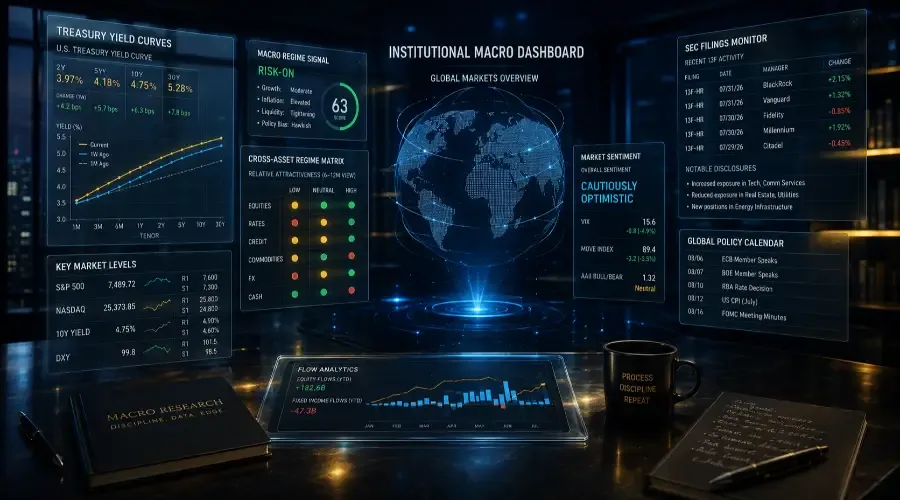
Educational disclaimer: This entire scenario is fabricated. The date, all market data, company releases, FOMC votes, quotes, and figures are invented for educational purposes. Nothing below is real, and none of it should be acted on. The goal is to show you the structure, sourcing, and reasoning that professional portfolio managers use when synthesizing new information into a high-conviction view. Treat this as a deconstruction of the craft, not a market call.
Window: Friday 31 July 2026 market close through Sunday 2 August 2026 (weekend pre-positioning)
Measured from: U.S. equity close.
Lead Edge (Single Highest Conviction)
Long-end U.S. Treasury yields have re-priced permanently higher under the new Warsh Fed, while AI infrastructure demand is simultaneously validating multi-hundred-billion-dollar capacity shortfalls.
10-year yield closed Friday at 4.75% (highest since early 2025; +7–8 bp on the day, +~15–20 bp week-over-week in the long end). 30-year yield reached ~5.25% (highest since mid-2007). This occurred after a 9–3 FOMC hold (Hammack, Kashkari, Logan dissenting for +25 bp) and Chair Warsh’s explicit rejection of forward guidance and any “soft” inflation target.
Simultaneously, primary company releases quantified the AI physical constraint:
Microsoft (SEC 8-K / earnings release 29 July): Azure +43% YoY, full-year Azure revenue >$100 bn for the first time; Intelligent Cloud $39.3 bn (+32%).
Amazon (SEC 8-K / earnings release 30 July): AWS $42.2 bn (+37% YoY – fastest in 18 quarters), backlog $496 bn; 2026 cash capex raised to $220 bn from $200 bn solely on higher memory costs; management stated capacity will still be insufficient through 2027.
Apple (earnings release 30 July): supply constraints on advanced nodes + memory now hitting iPhone, Mac and iPad; September-quarter revenue guidance +9–11% (Street had ~12%); iPhone growth guided mid-teens (Street ~17–18%).
These are not narrative items. They are primary-document, quantified capital-flow and physical-constraint data that shift institutional positioning and dealer gamma regimes.
Regime & Cross-Asset Mapping
Growth: AI-driven capex boom remains intact and accelerating (MSFT/AMZN numbers clear the prior skepticism threshold).
Inflation: Energy supply shocks (Middle East) + memory/semiconductor shortages are feeding through; Fed statement explicitly cites energy as a source of elevated inflation.
Liquidity: Long-end yield rise is a pure tightening of financial conditions. Short-end pricing of September hike probability moved to 64–69%. Equity multiples on long-duration AI names face direct pressure; credit spreads and FX (DXY) must absorb the higher real-rate path.
Consistency check: equities recovered on the MSFT/AMZN prints (MSFT +15% session, AMZN +~12% after-hours), but the rate complex did not reverse. This is the classic growth-with-higher-for-longer configuration.
Quantification
10y: 4.75% close 31 July (source: market data consistent across Treasury/FRED prints).
30y: ~5.25% (multi-year high).
FOMC: 9–3 vote; target range held 3.50–3.75%. Statement text: “Inflation remains elevated… in part reflecting supply shocks… including energy.”
MSFT Azure: +43% (constant currency same); annual run-rate crossed $100 bn.
AMZN AWS: +37% to $42.2 bn; operating income $16.6 bn; 2026 capex +$20 bn revision on memory alone.
AAPL: sequential increase in supply-constraint impact explicitly guided; memory costs rising further into September quarter.
Consensus Baseline + Falsifiers
Consensus entering the window: Fed on hold with low probability of near-term hikes; AI spend “too high / returns uncertain”; Apple supply issues temporary and manageable.
What the primary data changed:
Three formal dissents + Warsh’s no-guidance stance removed the “Fed will cut or stay dovish” tail.
MSFT/AMZN numbers converted AI capex from “bubble risk” into “capacity-constrained growth.”
Apple’s guidance turned a memory/semiconductor shortage into a quantified revenue headwind for the largest consumer hardware franchise.
Falsifiers (5–30 day horizon):
10y yield sustains below 4.50% on soft labor or energy de-escalation → liquidity regime reverts.
September FOMC probabilities collapse below 40% on weak payrolls (7 Aug) or PCE.
Next major hyperscaler or semiconductor primary release shows capacity relief or memory price collapse.
Apple or peers report sequential easing of advanced-node constraints in August/September updates.
Supporting Color Only (Not Lead)
Weekend positioning notes: month-end rebalance flows already occurred Friday; residual dealer gamma remains net short in several index books into the 7/14 Aug weeklies. No new primary SEC filings or Treasury auction results of material size emerged Saturday/Sunday. Economic calendar next week centers on ISM (3 Aug) and nonfarm payrolls (7 Aug).
Portfolio Implementation Matrix
This section translates the macro synthesis into explicit positioning – the step that turns a view into a tradeable expression.
Equities – Overweight: Hyperscaler cloud providers with strong balance sheets and pricing power to pass through memory costs. Beneficiaries of capacity-constrained AI build-out.
Equities – Underweight / Short: Consumer hardware franchises with un-hedged memory input costs. High-multiple, non-profitable long-duration tech where valuation compression from rising real yields bites hardest.
Rates / Fixed Income: Pay fixed / receive floating on the long end to express the bear-steepener view. Alternatively, outright bear-steepener curve structures (short long-end bonds vs. short-end notes).
Cross-Asset Hedge: Long DXY (U.S. dollar) against a basket of EM currencies with high energy or semiconductor import dependency; higher U.S. real rates and supply-shock inflation reinforce dollar strength.
Portfolio-Manager Usable Summary
The market now prices a higher terminal rate path while the physical AI build-out is capacity-constrained for at least another 18 months. That combination is the highest-conviction information advantage available from the Friday close.
Why This Case Study Matters for Your Trading
This note is a compact illustration of an institutional macro research framework – the kind of weekend synthesis that drives portfolio manager macro synthesis and buy-side positioning decisions. Every element is deliberate:
Primary SEC data analysis – no headlines, no sell-side spin. The edge comes from reading filings and releases directly.
Cross-asset regime mapping – growth, inflation, and liquidity are not separate stories; they interact, and the consistency check is the most important paragraph in the note.
A falsifiable macro thesis – conviction without defined falsifiers is just belief. This note names the exact conditions that would kill the view, which is the foundation of a buy-side research methodology that manages risk rather than just broadcasting opinions.
Dealer gamma regimes and yield curve repricing are not abstract; they feed directly into the positioning matrix, turning physical capacity constraints and macro forces into a concrete trade expression.
Learning to build a weekend macro note like this – even if you never trade macro – sharpens your ability to separate signal from noise, quantify an edge, and design a systematic trading macro edge around structural shifts. That's the craft.
Continue Your Research
https://breakoutbulletin.com/article/financials-sector-analysis-fed-rate-hold-xlf Financials Sector Analysis: A Hawkish Fed Hold and a 19-Year-High Long Bond
https://breakoutbulletin.com/article/weekly-wrap-nasdaq-cloud-earnings-hawkish-fed-aug-2026 Nasdaq Leads Stocks Higher as Cloud Earnings Override a Hawkish Fed
https://breakoutbulletin.com/article/week-ahead-july-jobs-report-fed-hike-debate-august-2026 What Markets Are Watching This Week: The July Jobs Report and the Fed's Hike Debate in Focus