
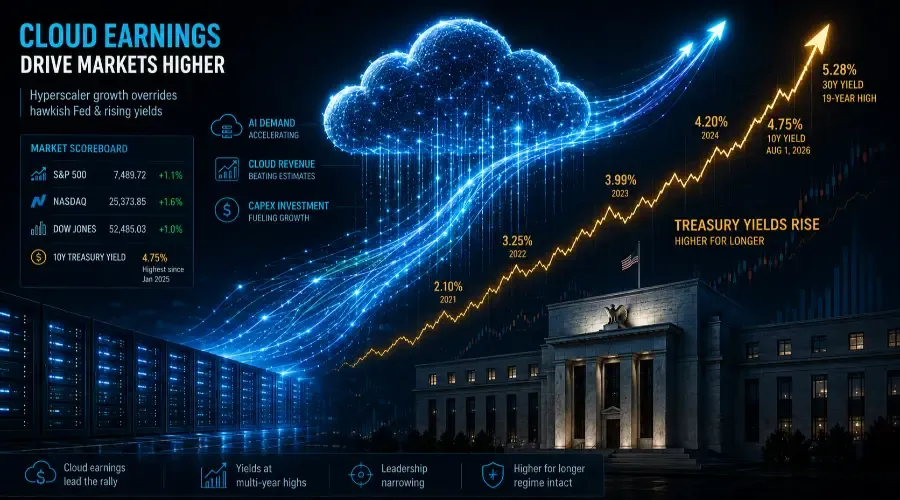
The Weekly Wrap - Week Ending Friday, August 1, 2026
By Manish T. · BreakoutBulletin Weekly Wrap
| Asset | Week Open | Fri Close | Weekly | Key Driver |
|---|---|---|---|---|
| S&P 500 | ~7,408 | 7,489.72 | +1.1% | Cloud earnings offset rising yields |
| Nasdaq Comp. | ~24,975 | 25,373.85 | +1.6% | Megacap-growth / AI rebound led the tape |
| Dow Jones | ~51,965 | 52,485.03 | +1.0% | 4th straight monthly gain |
| Russell 2000 | ~2,928 | 2,931.34 | +0.1% | Small caps flat – no cyclical follow-through |
| 10Y Treasury | – | 4.75% | Rose | 30Y at a 19-year high; 3 FOMC dissents for a hike |
| DXY (Dollar) | – | ~99.8 | ~Flat | Held near 100 |
| Gold | – | ~$4,107 (futures) | Lower | Higher yields + risk-on drained the safe-haven bid |
| WTI Crude | – | ~$84.67 | Choppy | Whipsawed on Strait of Hormuz / Iran headlines |
| Bitcoin | ~65,333 | ~63,650 | ~−2.6% | Profit-taking after a strong July |
| Ethereum | ~1,953 | ~1,877 | ~−3.9% | Rejected at the ~$2,000 resistance zone |
In practical terms, this week: the market climbed even as the Fed leaned hawkish and long-term yields hit multi-year highs – because a wave of hyperscaler (mega-cloud providers like Microsoft, Amazon, and Google) earnings kept the AI-growth trade alive, while gold and small caps quietly signalled a narrower, more defensive tape underneath.
The Week's Dominant Narrative
Monday's open framed the week's central tension: a bond market bracing for a hawkish Federal Reserve against an equity market that needed proof the AI capital-expenditure boom still pays.
Early in the week, that tension broke against growth – AI-linked shares came under pressure on questions about the scale, financing, and competitive returns of hyperscaler spending, oil slid, and investors rotated out of chip stocks.
The Federal Reserve then held rates steady on Wednesday, but the hold was hawkish: three FOMC members (Beth Hammack, Neel Kashkari, and Lorie Logan) dissented in favour of a 25-basis-point hike, and long-end yields pushed higher, with the 30-year Treasury reaching a 19-year high (5.28% – its highest since 2007). On paper, that is an environment built to punish long-duration growth.
The resolution came from earnings, not the Fed.
On Thursday, Microsoft reported stronger-than-expected Azure cloud growth (43% year-over-year, versus 40.4% expected) and a confident outlook; the Nasdaq surged roughly 2.8%, breaking a six-day losing streak, and semiconductors rebounded alongside it.
Friday extended the move as Amazon jumped 15.18% on its own cloud beat, carrying Consumer Discretionary to the top of the sector table – even as Apple fell around 7.35% on chip-shortage-driven production cuts.
The week's message was clear: the market would climb a wall of rising rates so long as the hyperscalers kept validating the cloud-and-AI earnings thesis. Growth over duration, cloud over caution.
The week also closed the book on July, and the monthly tape captured the same tension in miniature: the S&P 500 finished the month essentially flat, the Nasdaq fell roughly 3.2% as the AI cohort corrected, and the Dow edged up about 0.3% to log a fourth straight monthly gain – old-economy blue chips grinding higher while high-multiple tech digested its excesses.
Sector Report Card
The leaderboard looks unambiguously risk-on: Consumer Discretionary led at +6.07% and Communication Services followed at +4.60%, while Materials brought up the rear at -2.71% and the rate-sensitive bond proxies – Utilities (-0.74%) and Real Estate (-0.68%) – lagged as yields climbed.
Read quickly, that pattern reads as an offensive rotation into cyclicals.
Read carefully, it says something narrower.
Consumer Discretionary's gain was overwhelmingly Amazon's single-stock earnings pop, and Communication Services leaned on Alphabet and Meta – mega-cap growth names sitting inside "cyclical" and "consumer" buckets, not evidence of broad cyclical demand.
The genuinely cyclical corners stayed soft: Industrials managed only +0.79%, Materials fell hard, and Financials finished roughly flat at -0.13%.
When the sectors that should confirm a real growth acceleration stay quiet while a handful of platform giants do the heavy lifting, leadership is offensive in name but concentrated in substance – and that is the difference between a rally that is broadening and one that is narrowing.
The single-stock dispersion made the point plainly: Amazon's roughly 15% surge and Apple's roughly 7% slide landed in the same week and the same broad complex, a reminder that at the mega-cap level, index direction increasingly turns on individual earnings verdicts rather than a unified macro tide.
Cross-Asset Report
The cross-asset tape refused to line up neatly behind the equity rally.
Stocks rose while the 10-year Treasury yield climbed to 4.75% – its highest since January 2025 – and the 30-year reached a 19-year high; equities advancing into rising long-end yields is unusual, and it happened only because cloud earnings overrode the rate signal.
The dollar held near 100, little changed.
Gold slipped (roughly -1.3% on Friday to about $4,107** on futures, with spot gold near **$4,050) as higher real yields and firmer risk appetite drained the safe-haven bid – a textbook risk-on confirmation.
Crude whipsawed on Middle East headlines, sliding early as Strait of Hormuz traffic eased supply fears, then firming into Friday at approximately $84.67/barrel.
The VIX remained subdued near ~15-16, reflecting complacency that is often associated with concentrated, low-breadth rallies – a signal worth monitoring for a potential volatility snapback if earnings momentum falters.
The takeaway: within equities the week read risk-on, but bonds and gold together described a higher-for-longer backdrop that stocks chose to look past rather than one they were being rewarded by.
The Story Mainstream Media Missed
The under-covered development sat beneath the index prints: breadth quietly narrowed even as the tape rose.
Market breadth on the S&P 500 – the share of members trading above their 50-day moving average – declined from roughly 70% earlier in the week to about 64% by Friday.
On the Nasdaq and the Russell 2000 it was little changed and has been contracting for roughly three weeks, reflecting the correction still working through the tech-and-momentum cohort.
Approximately two-thirds of stocks remain above their 200-day average, but only about 49% are above their 20-day average, and just 37% are above their 5-day average.
In plain terms, the week's gains leaned on fewer and fewer names.
That matters structurally because narrow leadership is more fragile than broad participation: when an index climbs on a shrinking set of shoulders, it becomes increasingly hostage to a handful of earnings reports – the exact dynamic Thursday and Friday put on display.
Crypto Weekly
Bitcoin and Ethereum pulled back modestly on the week – Bitcoin easing roughly 2-3% to hold around $63,600**, and Ethereum sliding about 4% to near **$1,877 after failing at the $1,980-$2,030 resistance zone.
The pullback followed a standout July in which Ethereum (up roughly 20%) and Bitcoin (up about 9%) sharply outperformed a falling Nasdaq and a sinking chip complex – one of the widest crypto-versus-AI-equity decouplings in about two years.
This week the divergence ran the other way: crypto consolidated while equities rebounded, underlining that digital assets are trading on their own cycle rather than as a leveraged proxy for the AI trade.
The decoupling likely reflects crypto's growing role as a liquidity and regulatory play rather than a pure growth proxy – with the Bitcoin halving now behind us and ETF flows stabilizing, the asset is trading increasingly on its own supply-demand dynamics.
What This Week Tells Us About the Macro Regime
This week reinforces, rather than challenges, a higher-for-longer regime with narrow growth leadership.
The bond market is doing the talking: a 30-year yield at a 19-year high (5.28%, highest since 2007) , three FOMC members dissenting toward a hike, and roughly 56-60% odds of a September increase priced in all describe a Fed the market believes is not finished being restrictive.
Equities, meanwhile, chose to price the cloud-earnings cycle over the rate cycle.
The result is a tape that looks risk-on at the index level but defensive underneath – small caps flat, materials falling, breadth thinning, and leadership concentrated in a few mega-cap platforms.
That is the signature of a late-cycle, growth-over-value environment: participation is narrow, the marginal buyer is chasing a shrinking set of winners, and the market is leaning on earnings to justify multiples while the macro backdrop stays tight.
Looking ahead: Next week's earnings from Nvidia, Salesforce, and Broadcom will provide the next test of whether the AI/cloud thesis can continue to override the hawkish rate backdrop – or whether earnings fatigue sets in and the narrowing breadth finally catches up with the index.
A structural observation – not a forecast.
Weekly Analysis Learning Path
Story Media Missed (breadth) → Volume & Market Breadth with AI
https://www.breakoutbulletin.com/article/analyze-volume-market-breadth-ai
anchor: "breadth quietly narrowed"
Dominant Narrative (the Fed) → Interpret Fed Statements & Macro News with AI
https://www.breakoutbulletin.com/article/ai-fed-statement-macro-analysis
anchor: "the hold was hawkish"
Cross-Asset Report (yields ↔ sectors) → Yield Curve Moves & Sector Impact with AI
https://www.breakoutbulletin.com/article/analyze-yield-curve-sector-impact-ai
anchor: "rising long-end yields"
Sector Report Card → Sector Rotation Analysis with AI
https://www.breakoutbulletin.com/article/how-to-run-sector-rotation-analysis-with-ai
anchor: "an offensive rotation into cyclicals"
Macro Regime → Identify Macro Regimes with AI
https://www.breakoutbulletin.com/article/how-to-identify-macro-regimes-ai
anchor: "a higher-for-longer regime"
Narrative (earnings drove the week) → Analyze Earnings Reports with AI
https://www.breakoutbulletin.com/article/how-to-analyze-earnings-reports-ai
anchor: "Microsoft reported stronger-than-expected Azure"
Disclaimer
BreakoutBulletin publishes educational and analytical content only. Nothing in this article constitutes investment, financial, legal, or tax advice, a recommendation, or an offer or solicitation to buy or sell any security. Market data reflects conditions as of the publication date and is drawn from public sources; figures may be revised. Past performance does not indicate future results. Readers should conduct their own research and consult a qualified, registered financial adviser before making any investment decision.