
If you have ever added a moving average crossover to your chart, waited for a perfect RSI oversold signal, or bought a MACD green bar–only to watch the market instantly reverse and stop you out–you are not alone.
You are just caught in the Retail Indicator Trap.
Most retail traders suffer from what professionals call "Indicator Soup". They plaster their screens with four different colored lines, hoping that if enough lagging mathematical formulas line up, a magical, risk-free buy signal will appear.
It won’t.
Today, we are stripping away the fluff. We will unpack exactly why traditional retail indicators fail you in real market conditions and introduce the institutional 3-Tier Trading Framework–the exact system used to find high-probability setups without relying on lagging signals.
The Brutal Truth About Lagging Indicators
The core issue with standard indicators like the Relative Strength Index (RSI), Moving Averages, or Bollinger Bands isn't that they are broken. It’s that they are lagging.
Every traditional indicator is simply a visual representation of historical data. They look at where the price was over the last 14, 50, or 200 candles, run a basic mathematical calculation, and draw a line.
The Windshield Analogy: Driving a car solely by looking through your rearview mirror will inevitably cause a crash. Trading your capital solely by looking at lagging indicator lines does the exact same thing.
When you treat an indicator as a definitive "Buy" or "Sell" signal in isolation, you are entering the market late. By the time a moving average crosses over or an RSI line crawls out of the oversold zone, smart money institutions have already accumulated their positions and are preparing to distribute their shares right into your late entry.
To graduate from a struggling retail trader to a consistent market operator, you must stop chasing lagging signals and start analyzing live market mechanics.
Paradigm Shift: Stop Chasing Signals, Start Reading Context
Professional algorithmic models and institutional desk traders don't trade "signals". They trade liquidity, volume, and market structure. They use indicators not as crystal balls, but as filters to verify what the structural tape is already telling them.
To do this successfully, you need to organize your trading charts into an objective, repeatable filter. Instead of looking at your chart and asking, "Is the indicator green?" you must follow a systematic framework that addresses three specific structural questions in a strict order:
Where is the market likely to move next based on historical order flow?
Is there actual institutional presence confirming that level?
What is the precise execution trigger that minimizes my capital risk?
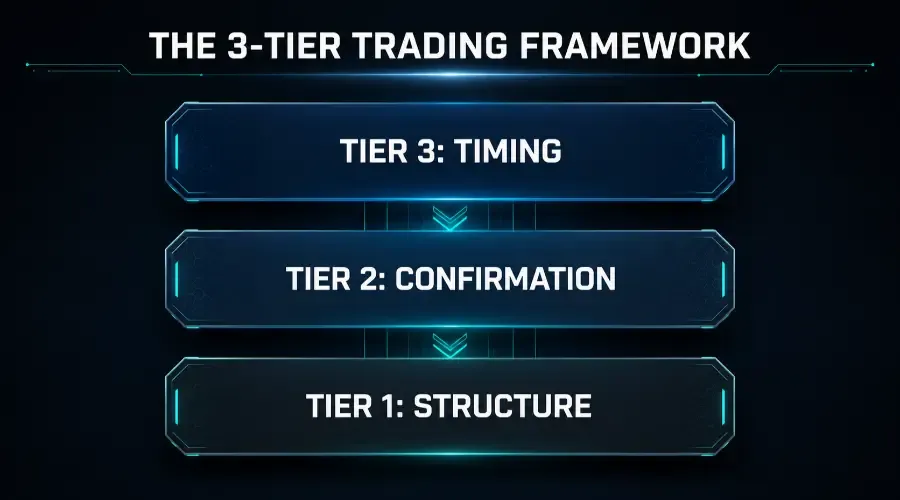
To answer these questions flawlessly, we use the 3-Tier Trading Framework.
Introducing the 3-Tier Trading Framework
Instead of letting a single indicator dictate your financial decisions, this system uses a layered approach. A trade is only valid if it passes through all three distinct filters sequentially. If a setup fails Tier 1 or Tier 2, you walk away–saving your capital for high-probability environments.
The 3-Tier System Blueprint
(Pro Tip: Bookmark this matrix or save it to your desktop. This is the visual checklist you should run through before every single trade execution.)
| Tier Level | System Function | Core Trading Tools & Concepts | Objective Goal |
|---|---|---|---|
| Tier 1: Structure | The Anchor | Market Structure Shifts, Volume Profile POC, Order Blocks | Identify high-probability institutional supply and demand zones. |
| Tier 2: Confirmation | The Filter | Money Flow Index (MFI), TTM Squeeze, Fair Value Gaps (FVGs) | Verify that smart money is actively defending the structural zone. |
| Tier 3: Timing | The Trigger | VWAP Standard Deviation Bands, Low-Timeframe Market Structure Shifts | Pinpoint the exact entry price to maximize risk-to-reward metrics. |
Tier 1: Market Structure (The Anchor)
Before you look at momentum, volatility, or timing tools, you must map out the market architecture. Tier 1 asks a simple question: Who is in control of the trend, and where are the primary institutional resting orders?
Instead of standard trendlines, we look for Market Structure Shifts (MSS) and major high-volume anchors like the Volume Profile Point of Control (POC). These zones show you exactly where institutions heavily accumulated or distributed shares in the past. If the asset price isn't interacting with a major Tier 1 structural zone, you do absolutely nothing.
Tier 2: Confirmation (The Filter)
Once the price arrives at your Tier 1 structural zone, you do not just blindly place a market order. You wait for Tier 2 to confirm that the level is actively holding.
This is where advanced contextual indicators shine. Instead of regular RSI, we use tools like the Money Flow Index (MFI) to spot institutional volume divergences, or look for unmitigated Fair Value Gaps (FVGs) that indicate aggressive buying or selling pressure. If the price hits a support zone but volume momentum continues to bleed downward, Tier 2 filters you out of a losing trade.
Tier 3: Timing (The Trigger)
Tier 3 is all about operational precision. Once structure is established (Tier 1) and institutional momentum is confirmed (Tier 2), Tier 3 provides the exact execution trigger.
To eliminate guesswork and emotional hesitation, we utilize algorithmic benchmarks like VWAP Standard Deviation Bands. When price stretches outside these bands and hits our structural zone, it signals a mathematical extremity. This allows you to place incredibly tight stop-losses right below structural invalidation points, vastly improving your risk-to-reward ratios.
Why This System Protects Your Capital
The power of the 3-Tier system lies entirely in its strict sequencing. Most retail traders skip straight to Tier 3–they see a timing trigger or a basic indicator crossover and jump into a position without checking if the underlying market structure or institutional volume supports the move.
By forcing every setup to clear all three tiers, you protect your account from chop, reduce overtrading, and align your capital directly with institutional order flow.
In our upcoming posts, we will dive deep into the specific tools within this ecosystem–starting with how to track institutional footprints using Volume Profile.
Advanced Trading Framework Q&A
Q: Why do technical indicators fail so heavily during highly volatile markets?
Traditional retail indicators rely on fixed mathematical periods (e.g., a 14-day average). During highly volatile regimes or macro news events, institutional order flow shifts faster than lagging mathematical calculations can adjust. This causes standard indicators to produce endless "whipsaws" or false breakouts. The 3-Tier system fixes this by relying primarily on volume and raw structural shifts rather than time-delayed averages.
Q: What is the functional difference between leading and lagging indicators?
Lagging indicators (like moving averages) require a price move to fully occur before they change direction, making them late execution tools. Leading indicators or structural tools (like Volume Profile or Order Blocks) map out historical areas of heavy capital commitment before price returns to them. This allows you to anticipate structural reactions rather than react late to historic price changes.
Q: How many indicators should a trader actually use on a clean chart?
Less is more. Plastering your charts with multiple indicators that calculate the exact same data points (like running RSI, Stochastic, and MACD simultaneously) creates analysis paralysis. A professional setup typically features one structural anchor (Tier 1), one momentum/volume filter (Tier 2), and one execution boundary tool (Tier 3).
Q: What exactly constitutes a true "Market Structure Shift"?
A Market Structure Shift (MSS) occurs when an asset stops printing a continuous, clean sequence of swing highs and swing lows. For instance, in an aggressive downtrend, a true MSS is confirmed when price breaks violently above the last lower high on significant volume. This structural break signals that institutions are actively stepping in to reverse the primary trend.
Next Step in the Masterclass:
Now that you know why standard indicators fail, it’s time to see how professional money sets up its safety net using institutional baselines. Read our next case study: Tracking the Macro Trend: Navigating the 3-Tier Structure with NVDA.