
Earnings Analysis · SpaceX (SPCX), Q2 2026
By Manish T. · BreakoutBulletin
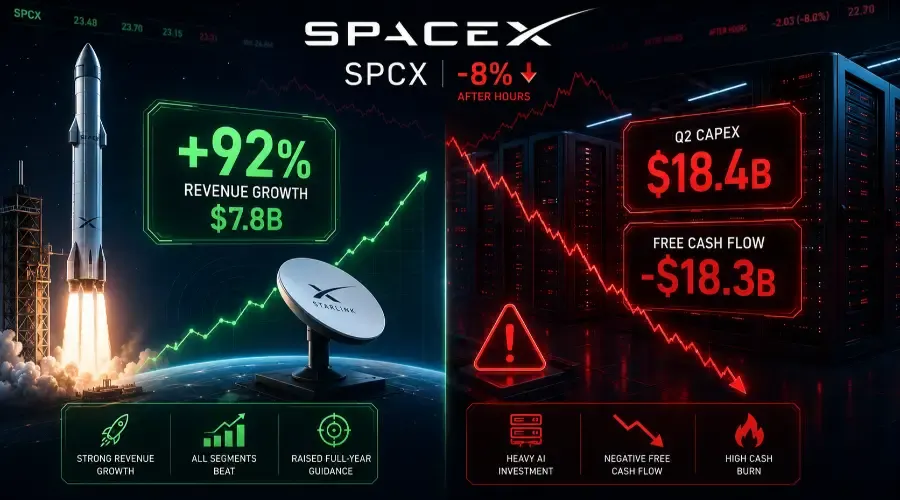
SpaceX's first quarter as a public company, reported after the close on August 4, looked like an unambiguous triumph. Revenue jumped 92% from a year earlier to $7.8 billion, beating Wall Street by roughly a billion dollars. All three business segments beat. The net loss, which had been $4.28 billion just one quarter earlier, narrowed to $541 million. Adjusted EBITDA of $3.5 billion came in about 75% above the $2 billion consensus. And for the first time in the company's 24-year history, management raised its full-year guidance.
Then the stock fell as much as 8% after hours. The stock had climbed roughly 10% during Tuesday's regular session before reversing once the results hit. That gap between a headline that reads like a blowout and a market that sold it–is the entire story. And it says something important about how investors are now pricing the whole AI-infrastructure boom.
The Beat Was Real
None of the good news was an illusion. At $7.8 billion, revenue cleared the roughly $6.81 billion Bloomberg consensus comfortably. Adjusted EBITDA of $3.5 billion came in about 75% above estimates and up 191% year-over-year. The per-share loss of $0.09 was a fraction of the $0.26 loss analysts expected–an EPS surprise of +65.39%. The company ended the quarter with roughly $100 billion in cash and marketable securities and a backlog of $47.5 billion.
The company raised $85.7 billion in its June IPO and issued $25 billion in senior notes, giving it the firepower for this spending spree. Perhaps most striking was the swing in the bottom line: cutting the quarterly net loss by more than $3.7 billion in three months, alongside the first guidance raise in the company's history, is the kind of operating leverage that usually sends a stock higher, not lower. On the scorecard investors normally use, this was a win.
Why the Market Sold It: One Number
The reason sits in a single line of the release: capital expenditure. SpaceX spent $18.4 billion** on capex in the quarter ("That's 235% of quarterly revenue an historically extreme ratio. Even high-growth hyperscalers typically run at 50-80%), more than double the $10.1 billion it spent in the prior three months and well above the roughly $13.22 billion analysts had penciled in. Of that, **$15.8 billion went to the AI segment–well over 80% of total capex. To put it in perspective, the company spent more than twice its quarterly revenue on capex, and the annualized run rate of that spending dwarfs its expected full-year revenue.
Free cash flow, as a result, is deeply negative. SpaceX's spending was up more than 550% to $18.3 billion, on top of a net loss of $2 billion during the first six months of the year. The market's message was direct: it did not sell the growth, which was excellent; it sold the burn. In the current climate, investors have shown little patience for enormous spending that has not yet converted into free cash flow, no matter how fast the top line is climbing. A 92% revenue beat could not outweigh a capex figure that came in billions above expectations.
Only One Segment Makes Money
Strip the consolidated numbers apart and the structure of the business comes into focus. Connectivity, the Starlink satellite-internet unit, is the engine and the sole profit center: $4.29 billion in revenue (up 66%) and $1.66 billion in operating income, with subscribers reaching 12 million, double a year ago, across 167 countries. Connectivity revenue slightly beat the $3.88 billion consensus on B2B and government strength.
The other two segments lose money, and not by a little. The Space segment, which houses the launch business and the Starship program, generated $962 million in revenue (beating the $835 million StreetAccount estimate) but posted a $542 million operating loss as research spending on Starship climbed. The AI segment, which includes the xAI business, the X platform, and cloud services, grew revenue an eye-catching 247% to $2.56 billion, driven by new cloud contracts and beating the $2.08 billion consensus by nearly $500 million. But it lost $1.26 billion at the operating line–though that was well inside the forecast $2.39 billion loss. AI segment gross margins were roughly 57%, and operating margins improved from -115% expected to -49% actual.
In plain terms, SpaceX is one highly profitable cash cow funding two enormous, money-losing growth bets, and the market is in the middle of deciding how much that structure is worth.
Even the Cash Cow Has a Wrinkle
The profitable segment is not without its own question. Starlink's average revenue per user has been falling, to about $66from roughly $85 a year earlier and near $99 back in 2023, as the service expands aggressively into lower-income international markets. Subscriber growth, in other words, has come partly by lowering the average price. That is a reasonable way to build a global network, but it means the headline subscriber doubling flatters the revenue picture.
Management introduced a price increase in June, adding a monthly kit fee and raising subscription tiers, and the effect will begin showing up in the third-quarter numbers. Whether Starlink can grow subscribers and revenue per user at the same time is the first real test of the cash cow's pricing power, and it arrives next quarter.
A Supply Wave, 48 Hours Later
Timing sharpened the reaction. Two days after this report, on August 6, roughly 911.5 million insider shares come unlocked in the largest lock-up expiry tied to the June IPO, releasing a wave of potential new supply into the market. That's more than the roughly 639 million shares that have been trading since the IPO. The lockup expiration expands the eligible pool of tradeable shares significantly beyond the original IPO size.
That matters because the stock was already fragile going in: it had fallen roughly 49% from its post-IPO intraday high and still traded near 39 times estimated 2026 sales. An earnings report landing immediately before a large unlock is a difficult setup no matter how strong the numbers, because holders weighing whether to sell into the unlock now have a fresh, mixed data point to act on. Some of the after-hours weakness is almost certainly the market pricing that overhang rather than the quarter itself.
The Bull Case: Management's Counterargument
CFO Bret Johnsen didn't let the capex number speak for itself. He argued on the call that SpaceX is able to recoup its AI compute investments in less than a year–a remarkably quick payback period. The company has already secured $14.1 billion in new AI cloud contracts this quarter alone, with management citing billions more signed in the first few weeks of the third quarter. Johnsen said the AI segment "meaningfully narrowed" its net operating loss to $1.3 billion, resulting in positive adjusted EBITDA for the segment. Management reaffirmed a target of $100 billion in annualized recurring revenue by December–which would represent a roughly 13x increase from Q2's annualized run rate.
The bull case rests entirely on this spending being investment rather than waste. If the AI cloud contracts convert to profit rather than perpetual losses, and if Starship delivers on its goal of slashing the cost to reach orbit, the capex math looks very different in 18 months. Johnsen noted that capex levels for Q3 and Q4 "will look similar" to the $18.1 billion spent in Q2, suggesting the burn is not a one-off but a sustained investment wave.
The Bigger Signal Behind the Sell-Off
Zoom out and SpaceX's debut is a vivid, single-company version of a question the entire market is now asking. That $15.8 billion of AI capital spending makes SpaceX one more giant pouring money into AI infrastructure–the same wave already showing up as memory shortages and strained power grids elsewhere in the build-out. And the market's reaction here mirrors what it has started doing across the board: rewarding the growth, then immediately demanding to know when the spending turns into cash.
It is the same discipline the bond market has begun imposing on hyperscaler borrowers, where lenders are charging more to finance AI capacity. A year ago, a 92%-growth story would have been bought on the headline. The fact that it was sold instead tells you the mood has shifted from rewarding growth to interrogating the cost of it.
What Would Change the Read
The bull case rests entirely on the spending being investment rather than waste. That means Starship delivering on its goal of slashing the cost to reach orbit, the AI cloud contracts converting into profit rather than perpetual losses, and the company reaching its stated target of $100 billion in annualized recurring revenue by year-end.
The read improves if:
- Capex growth decelerates while revenue keeps compounding
- Free cash flow turns less negative for two consecutive quarters
- The AI segment's operating loss narrows further toward breakeven
- Starlink ARPU stabilizes or rises following the June price increase
- The August 6 lockup passes without a flood of selling
The read worsens if:
- Spending keeps outrunning revenue
- Starlink's revenue per user keeps sliding
- The two loss-making segments stay in the red
- The lockup expiry triggers significant insider selling
In the immediate term, the August 6 unlock is the wildcard that could matter more than any line in the release.
The Bigger Picture
SpaceX's first public quarter is a clean case study in the market's new temperament. The company did almost everything investors say they want–growing fast, beating estimates, cutting losses, and raising guidance–and still got sold, because the cash burn was large enough and the free cash flow far enough away to override the good news. That trade-off–growth in one hand and the cost of financing it in the other–is the defining tension of the AI-infrastructure era, and SpaceX just put it on vivid display.
The headline number was never the story. The story was what investors were willing to pay for it, and the answer, for now, was less than the growth alone would suggest.
Related Reading
The AI Boom Is Now Running on Debt, and the Bond Market Is Starting to Charge More
The AI Build-Out's Deepest Bottleneck Isn't Chips or Memory. It's Getting Power to the Building.
The Memory Shortage Behind the AI Boom: How HBM Demand Is Draining Conventional DRAM
Disclaimer
BreakoutBulletin publishes educational and analytical content only. Nothing here is investment, financial, legal, or tax advice, or a recommendation or solicitation to buy, sell, or hold any security. Figures are drawn from SpaceX's Q2 2026 earnings release and public reporting as of the publication date and may be revised. Past performance does not indicate future results. Readers should conduct their own research and consult a qualified, registered financial adviser before making any decision.
Data Sources
- SpaceX Q2 2026 Earnings Release & Conference Call (August 4, 2026)
- Bloomberg Consensus – Revenue $6.81B, Capex $13.22B
- FactSet Consensus – EPS -$0.26
- CNBC – SpaceX AI spending coverage
- Wall Street Journal – SpaceX spending spree
- New York Times – SpaceX first earnings after IPO
- MarketBeat – SpaceX EPS and revenue details
- KuCoin – SpaceX after-hours trading and segment data
- TipRanks – Lockup expiry details
- Yahoo Finance – SpaceX earnings transcript
- Engadget – AI segment revenue and loss