
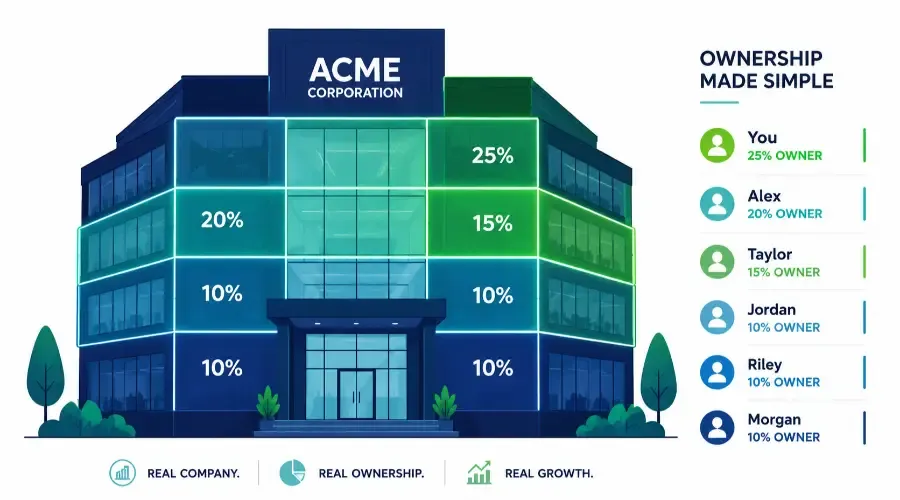
Most people in their late teens and early twenties have spent years buying products from companies like Apple, Nike, and Starbucks. Fewer realize they could own a piece of those same businesses.
That's the core idea behind stocks.
Ownership, Not Just an Investment
A stock is a unit of ownership in a company. When a business wants to raise capital without taking on debt, it divides itself into millions of equal shares and sells them to the public. Each share represents a proportional claim on the company's assets and earnings.
Buy one share of Nike, and you own a fraction of the business that designs the shoes, signs the athletes, and collects the revenue.
Why Companies Issue Shares
A company expanding into new markets, building new facilities, or funding a product line needs capital. Selling equity – shares – is one way to raise it. In exchange, investors become partial owners. If the company grows in value, the shares typically reflect that.
Nike's stock price at its 1980 IPO was around $0.09 (split-adjusted). By mid-2024, it traded above $90. That return profile reflects four decades of compounding brand value and global distribution growth.
Past performance doesn't predict future results, but the example illustrates how long-term ownership in a growing business can generate returns well above a standard savings account.
How Prices Move
Stock prices reflect the balance between buyers and sellers at any given moment. More demand than supply pushes prices up. More supply than demand pulls them down.
Short-term price swings are driven by earnings reports, economic data, news events, and market sentiment – most of which resolve quickly. Long-term price direction tends to track the actual performance of the underlying business.
A 5% drop on a single day doesn't mean a company became 5% less valuable. It usually means sentiment shifted.
The Compounding Advantage of Starting Early
At 18 or 22, time is the most valuable input in any investment strategy.
A $1,000 investment growing at 8% annually reaches roughly $10,600 after 30 years, without adding another dollar. Wait 10 years to start, and that same $1,000 at the same rate reaches about $5,000 over 20 years.
The math on starting early is structural, not motivational. Compounding requires time above all else.
Opening Your First Account
At 18, you can open a brokerage account independently. Most major platforms – Fidelity, Schwab, and others – offer accounts with no minimum balance and fractional shares, meaning $20 buys you a partial share of any stock regardless of its per-share price.
Common patterns among first-year investors:
-
Buying a stock because a social media account called it a guaranteed win. No one can guarantee stock returns.
-
Selling after a short-term drop before the position has had time to develop.
-
Checking prices daily and treating normal volatility as a crisis.
What to Remember
A stock is partial ownership in a real business. Its value moves with market conditions in the short term and with business fundamentals over longer periods. Starting early gives compounding more time to work. Starting small is fine – the account balance matters less than building the habit.
This content is for educational purposes only and does not constitute investment, legal, or tax advice. Investing in securities involves risk, including possible loss of principal. Always conduct your own research and consult a licensed financial professional before making investment decisions.
Now that you understand what a stock is, the next natural questions are: what rights does owning a stock give you, and how do different types of stock compare? The pages below take those questions further.
→ What Stocks Actually Are → The complete picture of ownership, rights, and how equity works - www.breakoutbulletin.com/article/what-is-a-stock-ownership-explained
→ Common vs. Preferred Stock → Two classes of share with very different risk and return profiles - www.breakoutbulletin.com/article/common-vs-preferred-stock-for-teens
→ Understanding Shareholders → Voting rights, dividend claims, and what partial ownership entitles you to - www.breakoutbulletin.com/article/shareholders-explained-what-it-means-to-own-stock