
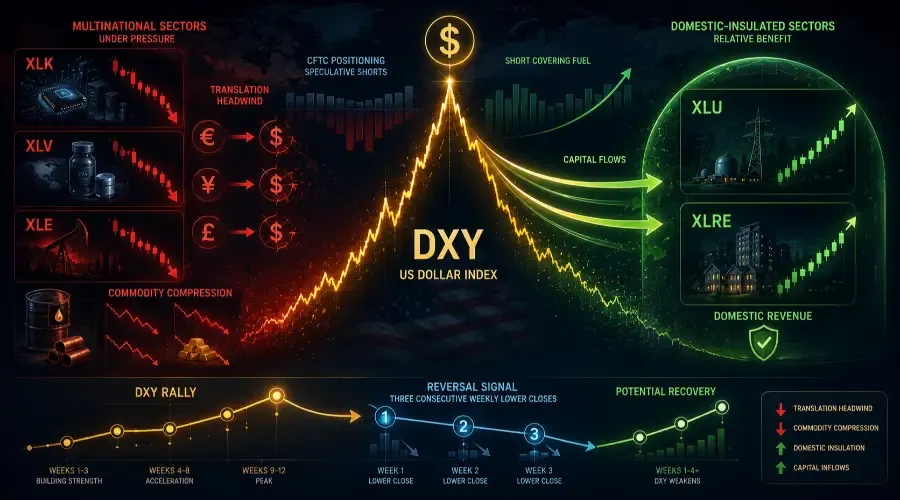
Most traders treat a dollar rally as a vague headwind for “stocks.” In reality, it’s a precise sector rotation signal–if you know where 40% of S&P 500 revenues actually come from.
Morgan Stanley's 2024 analysis of dollar strength and investing risks identified the mechanism precisely: a stronger US dollar creates systematic headwinds for the 40% of S&P 500 revenues generated outside the United States. CNN tracked the April 2024 dollar rally and its global economy implications in real time. Morningstar's 2026 research noted what a weaker dollar would mean for investors – implicitly documenting what the prior period of dollar strength had done. Every source correctly identifies that a stronger dollar helps importers and hurts exporters. None of them converts that observation into the sector-by-sector scorecard that tells you which specific ETFs to buy, which to sell, and how quickly the translation from dollar move to equity price move occurs. That is the gap this post fills – because the dollar rally is not a binary good-or-bad event. It is a systematic earnings tax on every multinational in the S&P 500, applied at a predictable rate, with a predictable sector sequence.
Why This Matters More Than Most Traders Realize
The US Dollar Index (DXY) is one of the most powerful but least traded macro signals in retail investor analysis. Most retail traders watch the Fed, watch the 10-year yield, watch commodity prices – and treat the dollar as a derivative output of those signals rather than a primary driver of equity earnings and sector rotation.
The quantitative foundation changes that perspective. Approximately 40% of S&P 500 revenues are generated outside the United States. When those revenues are translated back into dollars for earnings reporting, the exchange rate at the time of conversion determines how many dollars the company receives for each euro, yen, or pound of foreign sales. A 10% dollar rally – equivalent to DXY moving from 100 to 110 – creates an approximately 4% headwind to total S&P 500 earnings simply from the translation effect, before any operational or competitive impact is considered and before accounting for hedging programs that can offset part of the initial hit. Goldman Sachs research has estimated the rule of thumb at approximately 0.5% reduction in S&P 500 EPS for every 1% dollar appreciation – a systematic, mechanical, and predictable earnings tax, though in practice individual companies’ hedging profiles can buffer the first few quarters of impact.
The sector distribution of this earnings tax is highly uneven. Technology, Healthcare, and Consumer Staples multinationals with 50–70% international revenue face a headwind that is 3–5x larger than the index average. Utilities, domestic Consumer Staples, and real estate companies with essentially zero international revenue are completely unaffected. This uneven distribution creates the sector divergence that is the actual trading opportunity in a dollar rally – and it is entirely absent from the analysis that describes dollar strength as a generic equity headwind. [LINK: Macro Events Hub]
Why the Surprise Is the Trade, Not the Level
The DXY level – whether the index is at 95, 105, or 115 – is less actionable than the rate of change and the deviation from what currency markets expected. Like the 10-year yield, the dollar's absolute level is priced into forward earnings estimates by analysts who update their models quarterly with assumed exchange rate forecasts. It is the unexpected dollar move – the DXY rallying faster or further than rate differentials and positioning had suggested – that forces real-time earnings estimate revisions and sector rotation.
The dollar surprise signal is driven by three variables: US rate differentials versus trading partners (higher US rates relative to ECB, BOJ, and BOE attract capital), global risk appetite (dollar strengthens as a safe haven during global stress events), and structural positioning (when speculative positioning in dollar futures is heavily short and the dollar rallies, short-covering amplifies the move).
When the dollar rallies 5% more than the consensus expected – as it did in 2014 when the ECB moved toward QE faster than anticipated while the Fed was tapering, and in 2022 when the Fed hiked 425bps while the BOJ held rates at zero – the impact is not gradual. Multinational companies immediately begin disclosing "FX headwinds" in earnings commentary. Currency hedging programs that were sized for a different rate environment become inadequate. And sector analysts begin cutting earnings estimates for the internationally exposed names in every sector – creating immediate price pressure that is mechanical, not sentiment-driven.
Consensus vs Reality: How Markets Were Positioned
The dollar surprise trade depends on understanding what markets were positioned for before the rally. Two recent cases illustrate the mechanism:
2022: The consensus entering 2022 expected the Fed to hike gradually while the ECB and BOJ maintained accommodative policies – a mild dollar appreciation of perhaps 3–5%. Instead, the Fed hiked 425bps in twelve months while the BOJ held at zero, producing an 18% DXY rally in nine months. Every S&P 500 multinational that had hedged for a 3% dollar move was exposed to a 15% unhedged excess. The earnings miss season of 2022 was dominated by "FX headwind" disclosures – Apple lost approximately $10 billion in reported revenue to translation effects, Microsoft disclosed similar impacts, and virtually every large-cap technology company guided lower citing dollar strength. CFTC positioning data (available weekly from cftc.gov) showed speculative dollar positioning had been modestly short entering 2022 – amplifying the move as shorts were forced to cover.
2024: Morgan Stanley's research tracked the paradox of dollar strength persisting into 2024 despite narrowing rate differentials – the Fed was holding while other central banks were beginning to catch up. The CNN April 2024 coverage noted the dollar's resilience as a source of global economic concern, particularly for EM economies servicing dollar-denominated debt at elevated rates. The positioning-driven persistence of dollar strength – even after its fundamental justification (US-foreign rate differential) had narrowed – demonstrated that structural safe-haven demand and CFTC long positioning can sustain the dollar above fundamentally justified levels for quarters at a time.
The consensus check: review CFTC Commitments of Traders (COT) report weekly (cftc.gov, published Friday afternoons) for speculative positioning in dollar futures. A useful refinement: instead of just comparing to the five-year average, look at where speculative net long positioning sits within its historical percentile range. When it’s in the bottom quartile (below the 25th percentile), positioning is genuinely stretched short, and a reversal or squeeze has maximum runway. When speculators are heavily short the dollar and the dollar begins rallying, the short-covering amplification can produce a move 2–3x what the fundamental rate differential alone would justify.
The Market's Reaction Scorecard: Sector by Sector
Technology (XLK) – Strong Negative – 1–3 Months.
Technology has the highest international revenue exposure of any S&P 500 sector – approximately 55–65% of major technology company revenues come from outside the United States. Apple generates over 55% of revenue internationally; Microsoft, Google, and Meta each have 40–50% international revenue exposure. A 10% dollar rally creates a direct 5–6% translation headwind to XLK earnings – before any operational competitive impact and before any hedging offsets. The operational impact (US software and hardware becoming relatively more expensive for international buyers) takes one to two additional years to affect market share but begins appearing in forward guidance commentary within one to two quarters. XLK is the sector most consistently hurt by dollar strength across every historical dollar rally episode.
Healthcare (XLV) – Significant Negative – 1–3 Months.
Pharmaceutical and medical device companies are among the most internationally exposed businesses in the US economy – major pharmaceutical companies like Johnson & Johnson, Pfizer, and Abbott Laboratories generate 40–60% of revenues internationally. Drug prices are often set in local currencies, and royalties and licensing fees are denominated in the currency of the market. A sustained dollar rally compresses reported revenues and earnings without any underlying deterioration in actual drug sales volumes. XLV historically underperforms SPY by 4–7% during sustained dollar rallies exceeding 10%.
Consumer Staples (XLP) – Mixed – 1–3 Months.
XLP presents the sharpest internal divergence of any sector in a dollar rally: multinational food and household products companies (Procter & Gamble, Coca-Cola, Colgate-Palmolive) generate 55–65% of revenues internationally and face significant translation headwinds. Domestic-only consumer staples companies – regional food brands, domestic supermarket operators – face no translation impact and may benefit from lower import costs as the stronger dollar reduces the cost of internationally sourced inputs. The XLP sector-level signal is modestly negative, but the divergence between multinational and domestic names within XLP is substantially larger than the index-level move suggests.
Consumer Discretionary (XLY) – Mild to Moderate Negative – 1–3 Months.
Multinational luxury and premium consumer brands face translation headwinds from international revenues. However, a portion of XLY is domestic-focused businesses (US auto dealers, domestic restaurant chains, domestic homebuilders) that are partially insulated from the translation effect and may benefit from lower import costs on internationally sourced inventory. The net XLY signal is mildly negative – 2–4% relative underperformance – with the largest damage concentrated in internationally-exposed brand companies within XLY.
Materials (XLB) – Significant Negative – Immediate.
Materials faces the dollar's most direct transmission channel: commodity prices. The vast majority of global commodity prices are denominated in US dollars – oil, copper, gold, aluminium, agricultural commodities. When the dollar strengthens 10%, every commodity's dollar price falls by approximately 5–8% (the relationship is not one-for-one because commodity fundamentals also respond to the economic conditions driving the dollar move, and the coefficient varies depending on whether the rally is growth-driven, rate-driven, or safe-haven). XLB materials companies, which derive both revenues and the market value of their commodity inventories from dollar-denominated commodity prices, face an immediate compression on both lines. Additionally, a stronger dollar makes US-produced commodities more expensive for foreign buyers – reducing export volumes with a one to two quarter lag.
Energy (XLE) – Significant Negative – Immediate.
The oil price is quoted in dollars per barrel. Every 10% dollar appreciation creates downward pressure on the dollar price of oil, even if the oil's actual purchasing power in other currencies is unchanged. The rule of thumb – a 10% dollar rally reduces oil prices by approximately 5–8% all else equal – works best in rate-driven or safe-haven rallies but can partially fail in growth-driven ones where strong global demand lifts both the dollar and commodity prices simultaneously. When the compression materialises, it directly squeezes XLE revenue. US energy exporters also become less competitive against non-dollar-denominated energy producers. The combination of commodity price compression and export competitiveness pressure makes XLE one of the most consistently negative sectors in sustained dollar rallies.
Industrials (XLI) – Moderate Negative – 1–3 Months.
US industrial exporters – aerospace companies, defence contractors with international sales, heavy equipment manufacturers – face competitiveness headwinds when the dollar strengthens. A US-made Boeing aircraft becomes more expensive in euros or yen when the dollar appreciates, potentially losing orders to European competitor Airbus. This competitiveness effect takes longer to appear than the translation effect – it shows up in multi-year order book data rather than quarterly earnings – but it produces sustained underperformance in the most internationally-exposed XLI sub-sectors.
Utilities (XLU) – Positive Relative – Immediate.
US utilities operate in exclusively domestic markets, earning revenues in dollars and spending costs in dollars. The dollar's level has no direct impact on utility economics. When dollar strength creates headwinds for multinational sectors, utilities benefit from relative defensive rotation as capital shifts from earnings-impaired multinationals to stable-earnings domestic companies. XLU historically outperforms the S&P 500 by 2–4% on a relative basis during sustained dollar rallies, not because utilities become more profitable but because they are insulated from the dollar headwinds affecting 40% of the index.
Financials (XLF) – Complex Mixed – 1–3 Months.
Dollar rallies create an asymmetric XLF signal that depends on whether the dollar strength reflects US economic health (positive for credit quality) or global stress (negative through EM exposure). US banks with significant EM lending or EM bond portfolios face rising credit risk when the dollar rallies – EM borrowers who took loans in dollars face higher debt service costs in local currency terms, increasing default risk. Regional banks with purely domestic lending and no EM exposure are largely insulated. Large-cap banks typically have a mix: the EM-lending channel creates headwinds, but diversified international operations in capital markets, trading, and wealth management can generate offsetting benefits during periods of heightened currency volatility. The XLF signal in a dollar rally requires sub-sector analysis: pure domestic community banks are the cleanest relative winners, while universal banks with EM loan books face the largest headwinds.
Communication Services (XLC) – Moderate Negative – 1–3 Months.
Digital advertising platforms (Meta, Google/Alphabet) generate 40–50% of revenues internationally, making them significantly exposed to dollar translation effects. Streaming and media companies with international subscription revenues face similar headwinds. XLC historically underperforms by 3–5% in sustained dollar rallies exceeding 10%, with the damage concentrated in the advertising-dependent multinational technology-adjacent names.
Real Estate (XLRE) – Mildly Positive Relative – Immediate.
Like utilities, US REITs operate in predominantly domestic markets, earning revenues in dollars and facing costs in dollars. The dollar's level has no direct operational impact on US real estate. XLRE benefits from relative rotation as the dollar rally creates headwinds for multinational sectors – defensive capital flows toward domestically-insulated yield-generating assets. The positive is relative rather than absolute – XLRE may still face discount rate pressure if the dollar rally is driven by Fed hawkishness – but its insulation from the translation headwind provides relative outperformance versus the multinational-heavy sectors.
Magnitude Matters: Mild Rally vs Shock Rally
Mild rally (DXY +3–5% over 3+ months): Translation headwinds are visible in earnings commentary but manageable with existing hedging programs. XLK, XLV, and XLB underperform by 2–5%. The mean-reversion trade is well-defined – the rally is unlikely to exceed hedging program coverage.
Moderate rally (DXY +8–12% over 2–3 months): Hedging programs are overwhelmed for the out-of-money currencies; earnings misses become broad-based across multinational sectors. XLK and XLV underperform by 6–10%. Commodity complex falls 5–8%. EM currencies stress begins appearing in Bloomberg EM currency indices. The 2014–2015 and 2022 rallies fell in this category.
Shock rally (DXY +15%+ over 6 months or less): The 2014–2015 DXY rally (+25% in twelve months) represents shock territory. At this scale, the competitive impact on US exporters begins supplementing the translation headwind, and EM debt stress can produce systemic credit market disruptions. Every multinational sector faces earnings estimate cuts of 5–10%, and the equity market impact extends beyond the initial translation repricing into a sustained earnings revision cycle that lasts two to three quarters.
A Short Note on International Spillovers
A sustained dollar rally doesn’t stay confined to US equities. It tightens global financial conditions: dollar-denominated EM debt becomes harder to service, capital tends to flow out of emerging markets and into dollar assets, and non-US equities – particularly in commodity-importing economies – often underperform. Commodity-linked currencies (AUD, CAD, BRL) tend to weaken alongside the dollar’s rise, amplifying the headwind for materials and energy exporters globally. If you hold international or EM positions, dollar strength is an additional reason to check whether your portfolio is inadvertently doubling down on the same translation and credit risks you’re already managing in your US sector allocation.
Historical Cases Sorted by Surprise Magnitude
2014–2015 | The 25% DXY Rally – The Definitive Shock Case
The dollar rallied 25% against a basket of currencies between July 2014 and March 2015 – the most dramatic sustained dollar appreciation since the Plaza Accord era of the mid-1980s. The driver was a unique convergence: the Fed was tapering QE and preparing to raise rates (raising US rate expectations), the ECB was beginning its first QE program (crushing European rates), and the BOJ was expanding its asset purchase program (weakening the yen dramatically). The combination created the widest US-foreign rate differential in decades. XLE fell over 40% during this period – partly oil supply dynamics, but the dollar's role was significant, as oil priced in non-dollar currencies fell far less than the dollar price. Major technology companies began disclosing FX headwinds in the 3-5% range on earnings calls. XLB commodity companies faced the simultaneous commodity price compression and the demand headwind from weakened EM purchasing power. XLRE and XLU provided relative shelter as domestic-revenue sectors. Lag window: XLE immediate; XLK translation headwind appearing in quarterly earnings within one quarter; XLB commodity compression immediate; XLV multinational pharma within one quarter.
2022 | The Fed-BOJ Divergence Rally – 18% in Nine Months
The dollar's 2022 rally was the most rate-differential-driven of the modern era. The Fed hiked 425bps; the BOJ held at zero; the ECB was raising rates but more slowly. DXY rose from approximately 96 at the start of 2022 to 114 by September – an 18% appreciation in nine months. Morgan Stanley's subsequent analysis documented the earnings impact: major US technology companies collectively lost tens of billions in reported revenue from FX translation effects. Apple's reported revenues were reduced by approximately $10 billion year-over-year from currency effects alone. XLK fell 33% in 2022 – combining the rate-driven multiple compression of the 10-year yield spike with the translation headwind of dollar strength. Commodity exporters within XLE faced the dollar headwind on top of demand concerns. The EM channel created specific XLF stress in banks with EM bond exposure, as dollar-denominated EM sovereign debt service costs rose sharply. Lag window: XLE and XLB commodity compression immediate; XLK translation headwind per quarter with each earnings report; EM XLF exposure within two quarters.
2024 | Persistent Strength Despite Narrowing Differentials
The 2024 dollar persistence – the DXY remaining elevated above 104 despite the Fed beginning to signal cuts – illustrated that structural safe-haven demand and speculative positioning can sustain dollar strength beyond what rate differential analysis predicts. CNN's April 2024 coverage documented the global concerns raised by the dollar's refusal to weaken as rate expectations shifted. Morgan Stanley noted the investing risks of dollar strength persisting into an environment where it was expected to soften. Multinational earnings commentary in 2024 continued to cite FX headwinds despite the market's expectation of dollar normalisation. This case teaches that currency position management cannot rely solely on rate differential models – speculative CFTC positioning and structural demand for dollar-denominated assets can keep the dollar elevated for quarters beyond fundamental justification. Lag window: Translation headwinds persisted through 2024 quarterly earnings cycles; EM currencies remained under pressure; commodity prices compressed by the elevated dollar throughout.
The Trading Playbook
Before: What to Watch for Early Warning
Monitor the CFTC Commitments of Traders report for dollar positioning weekly (cftc.gov, released Friday afternoon, covering the prior Tuesday). Speculative positioning in US dollar futures (the dollar index futures contract on ICE) shows when institutional and hedge fund traders are positioning for or against dollar appreciation. Rather than simply comparing net long positioning to its five-year average, check whether it sits in the bottom quartile (below the 25th percentile) of its historical range – that is where short-side positioning is truly stretched and a squeeze has maximum fuel. When speculative net long dollar positioning is in that bottom quartile – meaning the market is not positioned for dollar strength – a catalyst that drives dollar buying creates the maximum surprise amplification. The squeeze from underweighted dollar longs produces a move that exceeds what the fundamental rate differential alone would justify.
Track the US-Germany 2-year rate differential daily (available on any fixed income data platform or through Bloomberg's rate differential tools). The US 2-year yield minus the German 2-year yield is the single most predictive indicator of near-term EUR/USD direction – and since EUR represents 57.6% of the DXY, this differential drives the index. When the US-Germany 2-year differential widens by more than 25bps over three weeks – reflecting US rates rising faster than European rates – DXY appreciation typically follows within two to four weeks. This indicator leads the DXY move rather than confirming it.
Monitor S&P 500 earnings call FX headwind disclosures quarterly. Major technology and healthcare multinationals disclose specific dollar impact in their earnings commentary – Apple typically cites the revenue impact of currency changes in its quarterly conference call, as do Microsoft, Johnson & Johnson, and Procter & Gamble. When three or more major index constituents simultaneously raise their cited FX headwind guidance – moving from "2-3% headwind" to "5-6% headwind" – the dollar rally has reached the magnitude at which it materially affects index-level earnings estimates.
During: Positioning When the Dollar Is Rallying
Rotate from XLK and XLV multinationals toward domestic revenue businesses within the same sectors. The dollar rotation trade is fundamentally about moving from internationally-exposed to domestically-insulated businesses – not necessarily from growth to value or from technology to defensives. Within XLK, companies like utility-like software businesses with predominantly US revenue (PayPal, Intuit, domestic-focused SaaS companies) face smaller translation headwinds than global hardware and platform companies. Within XLV, domestic hospital systems and US-only health insurance companies face no translation impact while global pharmaceutical companies face significant headwinds.
Underweight XLE and XLB relative to benchmark for the commodity compression channel. The dollar-commodity inverse relationship is mechanical – stronger dollar creates immediate downward pressure on oil, metals, and agricultural commodity prices – and the XLE and XLB earnings impact follows within one to two quarters. Size the underweight proportional to the magnitude of the dollar rally: a 5% DXY move warrants modest underweighting; a 15%+ move warrants significant reduction.
Add XLU and domestic XLRE names as the domestic revenue safe haven. These sectors provide insulation from the translation headwind while offering yield that remains attractive in a domestic context. The relative outperformance of domestic utilities and REITs during dollar rallies is not because they become more profitable – it is because they are immune to the systematic earnings tax affecting 40% of the index, making them relatively attractive in a market where the average stock faces earnings headwinds.
After: The Mean-Reversion Question
Dollar rallies driven by rate differentials mean-revert when the differentials narrow – specifically when the Fed begins cutting while other central banks hold or when foreign central banks hike to catch up. Monitor the US-Germany and US-Japan 2-year differentials for sustained narrowing: when the differential falls by more than 50bps over six weeks, the fundamental case for dollar strength is weakening and the reversal trade is setting up.
Begin rebuilding XLK and XLV multinational exposure when the DXY makes a confirmed three-week lower close from its peak. The multinational recovery trade is the mirror of the dollar rally trade: falling dollar creates translation tailwinds that lift reported revenues even without any volume improvement, producing positive earnings surprises in the quarter of the reversal. Apple, Microsoft, and the global pharmaceutical companies all report FX tailwinds in their earnings calls when the dollar reverses.
Watch Morningstar's research on dollar direction – their 2026 analysis on what a weaker dollar means for investors documented exactly the sector rotation in reverse: weaker dollar benefits commodities, multinationals, and international assets in the way that dollar strength hurt them. Use this as the exit framework for the domestic-rotation positions built during the dollar rally.
The Mean-Reversion Question: Does This Reverse?
Dollar rallies driven by rate differentials are highly mean-reverting once the differential narrows – which occurs when the Fed pivots or when foreign central banks catch up. The 2014–2015 rally fully reversed over the following two years as ECB QE ran its course and the Fed's rate path disappointed initial expectations. The 2022 rally partially reversed in 2023 and 2024 as ECB hiking reduced the differential, though structural dollar demand kept the reversal incomplete.
Dollar rallies driven by global risk-off safe-haven demand are typically the most rapidly mean-reverting – the dollar surged in March 2020 and reversed almost completely within three months as the Fed's emergency response restored risk appetite. Safe-haven dollar demand is episodic rather than structural.
Dollar rallies driven by structural US economic outperformance versus trading partners are the least mean-reverting – if the US is genuinely growing faster and generating higher returns than Europe or Japan, the rate differential and capital flow differential that supports the dollar can persist for years. Monitor relative economic performance (US GDP growth vs EU and Japan GDP growth) to assess whether the dollar rally has structural or cyclical foundations.
The 3 Mistakes Most Retail Traders Make
Mistake 1: Selling the Entire S&P 500 on a Dollar Rally Because "It Hurts Stocks"
The most common dollar rally mistake is treating it as a uniformly bearish equity signal and reducing broad equity exposure. This is accurate for the 40% of the S&P 500 with international revenues and completely wrong for the 60% with predominantly domestic revenues. Selling XLU, regional banks, domestic-focused XLP companies, and domestic REITs because "the dollar is strong" is selling businesses whose earnings are completely unaffected by the translation mechanism. The correct approach is to rotate within equities – from internationally-exposed sectors to domestically-insulated ones – rather than reducing overall equity exposure.
Mistake 2: Ignoring the Time Lag Between Dollar Move and Earnings Impact
The second mistake is expecting immediate equity price moves from a dollar rally and then concluding that "the market is ignoring the dollar" when the immediate price reaction is muted. The translation effect of a dollar rally appears in reported earnings one to two quarters after the move occurs – because companies report quarterly, and the earnings translation uses the average exchange rate for the quarter rather than the period-end rate. When the dollar rallies 10% in Q2, the Q2 earnings impact reflects only part of the rally's effect; the full Q2 and Q3 combined impact appears in Q3 reported earnings. Positioning for the Q3 earnings miss that a Q2 dollar rally will produce – rather than expecting an immediate day-of-announcement equity response – is the institutional timing discipline that retail traders miss.
Mistake 3: Missing the Commodity Double Hit
The third mistake is addressing only the translation channel for XLE and XLB without accounting for the commodity price compression channel. XLE and XLB companies face two simultaneous headwinds in a dollar rally: their overseas revenues translate into fewer dollars (translation effect), AND the dollar price of the commodities they produce falls mechanically (commodity compression effect). The commodity compression effect can be 2-3x the translation effect in magnitude – yet most analysis focuses only on the translation mechanism. The full XLE and XLB underperformance during a sustained dollar rally reflects both channels simultaneously, making these sectors more negatively affected than their international revenue percentage alone would suggest.
Frequently Asked Questions
What happens when the US dollar rallies?
When the US dollar rallies, multinational companies earn fewer dollars from overseas sales after currency conversion. Commodity prices often weaken, and sectors with heavy international revenue exposure face earnings pressure.
Why does a stronger dollar hurt multinational companies?
A stronger dollar reduces the value of foreign revenues when converted back into US dollars, creating a translation headwind for reported earnings.
Which sectors are hurt most by dollar strength?
XLK, XLV, and XLE are typically among the most negatively affected due to international revenue exposure and commodity sensitivity.
Why do commodity prices often fall during a dollar rally?
Most global commodities are priced in US dollars. When the dollar strengthens, commodities become more expensive in foreign currencies, reducing demand and pressuring prices lower.
How does dollar strength affect technology stocks?
Technology companies generate large portions of revenue overseas. Dollar strength reduces translated earnings and can create forward guidance cuts due to FX headwinds.
Which sectors benefit from a strong dollar?
Domestically focused sectors like XLU and certain US-focused REITs are relatively insulated because their revenues are primarily generated in dollars.
What is the translation effect in earnings?
The translation effect occurs when foreign revenues earned in euros, yen, or pounds convert into fewer US dollars because of currency appreciation.
How does a dollar rally impact energy stocks?
XLE faces pressure because oil prices typically weaken when the dollar strengthens, reducing energy company revenues.
What is DXY?
The US Dollar Index (DXY) measures the strength of the US dollar against a basket of major global currencies including the euro, yen, and pound.
What is the biggest mistake traders make during a dollar rally?
Many traders treat dollar strength as a broad stock market sell signal instead of recognizing it as a sector rotation event between multinational and domestic businesses.
Bottom Line: The One-Sentence Institutional Framework
When the DXY rallies more than 5% faster than rate differentials suggested, rotate from XLK and XLV multinationals into XLU and domestic XLRE for the translation headwind trade, simultaneously underweight XLE and XLB for the commodity compression channel, and use the three-consecutive-weekly-lower-close in DXY as the signal to reverse the entire rotation back into multinationals for the translation tailwind quarter.
This framework works across cycles because the S&P 500's 40% international revenue exposure creates a systematic, arithmetic, and predictable earnings tax whenever the dollar appreciates beyond what analysts had assumed in their estimates. The mechanism is not dependent on economic conditions, Fed policy, or market sentiment – it is a mathematical consequence of exchange rate arithmetic that repeats every quarter in every currency pair and every earnings cycle.
The retail edge is recognising that the dollar rally is not a market-direction event but an earnings redistribution event – moving earnings from internationally-exposed sectors to domestically-insulated ones, with a precise and documented time lag that allows you to position before the earnings miss rather than after.
In a Nutshell
A strong US dollar isn’t a blanket “sell stocks” signal–it’s a redistribution of earnings from multinationals to domestically-focused businesses, with a clear, delayed timeline. The playbook stays the same: check DXY consensus deviation, rotate from XLK and XLV into XLU and domestic REITs, underweight commodity-sensitive XLE and XLB, and wait for the three-week reversal before buying back the multinationals. Miss the translation versus compression distinction, and you’ll overlook the very sectors that turn dollar strength from a threat into a structured opportunity.
This post is part of the BreakoutBulletin "What Happens When" series. [LINK: Macro Events Hub] · [LINK: Series Pillar Page]
Educational content only. Not investment advice. Past sector performance patterns do not guarantee future results.