
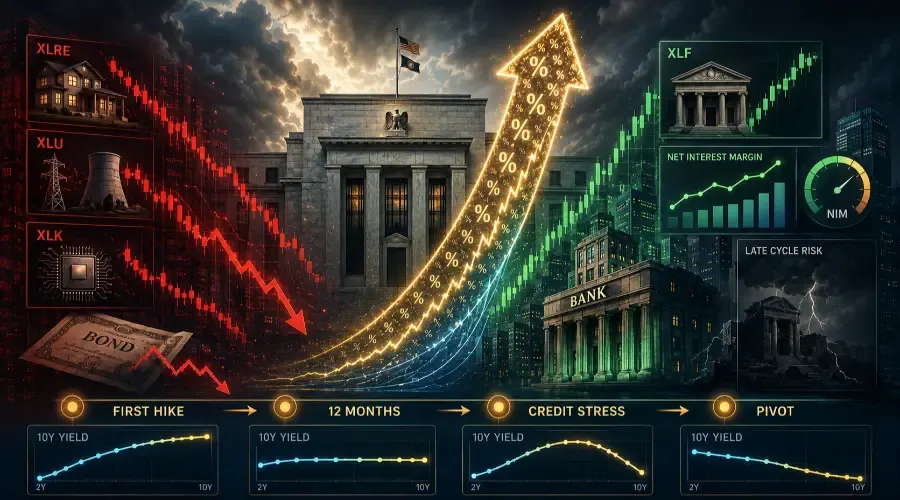
The Federal Reserve's explanation of monetary policy describes rate hikes in measured, institutional language. Schwab, LendingTree, US Bank, and Investopedia all provide clear summaries of how higher rates affect borrowing costs, bond prices, and broad sector sensitivity. What none of those sources provide is the framework that separates professional investors from retail traders on Fed day: the distinction between a hike that signals a healthy economy tightening a labour market running hot, and a hike that signals a central bank fighting an inflation problem it should have addressed a year earlier. Those two hike types produce opposite near-term equity outcomes – and until you know which one you are in, every sector rotation call is a guess.
Why This Matters More Than Most Traders Realize
When the Fed raises interest rates, you're looking at one of the biggest, most misunderstood macro events in the market. It's not that the mechanism is complicated – even a first-year finance student can explain that higher rates mean lower bond prices and more expensive borrowing. The misunderstanding comes from all the things the headline number doesn't tell you: where we are in the hiking cycle, how fast rates are rising, how the market was positioned going into the decision, and whether the Fed is tightening because the economy is strong or because inflation forced its hand.
The magnitude data frames the stakes. Since 1954, every US recession has been preceded by a Federal Reserve tightening cycle. That correlation is not causation – the Fed raises rates to cool an overheating economy or fight inflation, and the same conditions that prompted tightening often contain the seeds of the subsequent recession. But the practical implication is clear: every hiking cycle eventually stresses rate-sensitive assets, leveraged companies, and credit-dependent consumers. The question is not whether some parts of the economy get hurt – it is when, which sectors, how severely, and whether the landing is hard or soft.
What the strongest competing analyses miss is the regime-change dimension. A Federal Reserve rate hike is not a data event that mean-reverts. It is a policy shift that changes the operating environment for every company in the S&P 500 for the duration of the cycle. Unlike a CPI miss or an NFP disappointment – which the market processes and moves past within days – a rate hike regime persists and compounds. The first hike establishes the direction. Each subsequent hike extends the duration of the regime. The cumulative effect is not the sum of individual hikes – it is a fundamentally different financial environment in which everything from mortgage rates to corporate bond spreads to venture capital availability is recalibrated. [LINK: Macro Events Hub]
Data Event vs Regime Change: Why This Distinction Matters
Every other post in this series covers data events – commodity prices, economic releases, geopolitical incidents. These events produce transmission chains that run for months and then resolve. A crude oil spike hurts XLY for two to three quarters, then the trade is over. A copper crash signals recession risk for six to nine months, then either confirms or reverses.
A Federal Reserve rate hike regime is categorically different, and the distinction shapes everything about how you should position.
Data events are mean-reverting. The economy absorbs a crude oil spike over several quarters and margins recover. An NFP miss prompts a rotation to defensives that reverses when the next jobs report beats. The market processes the information and reprices, then moves forward.
Policy regimes are self-reinforcing until they break. Once the Fed begins hiking, every subsequent month that inflation remains above target provides justification for the next hike. The policy environment – higher rates, tighter credit, stronger dollar – remains in place not until the economy has processed the first hike, but until the Fed explicitly decides the tightening is complete. That decision can take twelve to thirty-six months.
The practical implication: when the Fed is hiking, you are not watching for the sector rotation trade to complete and reverse. You are watching for the regime to change. The defensive positioning that makes sense at the first hike – underweight XLRE, underweight XLU, underweight XLK – may need to be held for the entire duration of the cycle, which has historically lasted one to three years.
The second critical dimension is cycle position. The first rate hike in a cycle arrives in an economy that is typically healthy – the Fed does not raise rates in recessions. Employment is strong, consumer spending is robust, corporate earnings are growing. In this environment, the equity market often holds up surprisingly well around the first hike. The danger is cumulative: by the eighth or tenth hike in a cycle, the economy is absorbing the lagged effects of eighteen months of tightening simultaneously, and the recession risk that was theoretical at hike one has become quantifiable at hike eight. Milton Friedman's observation – that monetary policy works with long and variable lags – means that every hike you read about today is hitting a company's balance sheet twelve to eighteen months from now.
Which Transmission Channel Is Active?
The Fed raises rates through three distinct channels, and the active channel in any given hiking cycle determines which sectors bear the brunt and in what sequence. In practice, you'll often see all three at work, but the mix matters enormously.
Channel 1: The Rate Channel. This is the most direct and most discussed mechanism. As the federal funds rate rises, short-term borrowing costs rise immediately. Adjustable-rate mortgages reprice. Credit card rates follow within weeks. Corporate floating-rate debt reprices at each reset date. The Present Value of all future cash flows – whether a real estate investment, a business project, or a stock price – falls as the discount rate rises. This channel is immediate, mathematical, and unavoidable. It hits XLRE and XLU first (their valuations are most sensitive to discount rate changes), then XLK (long-duration growth stock DCF compression), then XLY (auto and mortgage financing costs).
Channel 2: The Credit Channel. The rate channel operates on existing credit. The credit channel operates on the availability of new credit. As the Fed tightens, banks simultaneously raise rates on new loans AND tighten lending standards – requiring higher credit scores, more collateral, lower loan-to-value ratios. The Federal Reserve's Senior Loan Officer Opinion Survey (SLOOS), published quarterly, measures this credit availability directly. When the SLOOS shows lenders tightening standards – which historically happens with a six to twelve month lag after the first hike – the credit channel is activating. This channel hits XLI (companies dependent on revolving credit for working capital), XLRE (commercial real estate developers who need construction financing), and small-cap companies that rely on bank lending rather than capital markets.
Channel 3: The Expectations Channel. This operates before any hike even occurs. When the Fed signals that a hiking cycle is coming – through minutes, speeches, or dot plot revisions – markets reprice immediately in anticipation. Long-term Treasury yields rise. Mortgage rates move. The dollar strengthens. Growth stock multiples compress. This channel explains why the largest market moves in any hiking cycle often occur in the months before the first actual hike, not after. By the time the Fed raises rates at the press conference, the expectations channel has already done much of the work.
A Quick Word on the US Dollar and International Spillovers
The expectations channel also works through the currency market. As the Fed tightens and US real yields rise, capital flows into dollar-denominated assets, pushing the US Dollar Index higher. A stronger dollar creates several crosswinds that this post only touches on:
- Commodities priced in dollars (oil, copper, industrial metals) face downward pressure, which amplifies the headwind for materials and energy exporters.
- US multinationals with significant overseas revenues see their foreign earnings lose value when translated back to dollars, creating an earnings drag that affects sectors well beyond those directly sensitive to rates.
- Emerging market equities often suffer disproportionately, as dollar strength tightens global financial conditions and raises the burden of dollar-denominated debt.
This piece focuses on US sector tilts, but if you hold international exposure, the dollar channel is an additional reason to review your portfolio when a hiking cycle begins.
Sector Re-rating: Immediate vs Structural
The timelines below reflect typical historical patterns, but every cycle is unique. The severity of the repricing depends on the speed of hikes, the starting level of rates, and the health of the economy. Use these as a direction-first framework, and refine your timing with the real-time data signals described later.
Real Estate (XLRE) – Strong Negative – Immediate.
XLRE is the most rate-sensitive equity sector because its valuation is explicitly modelled as a capitalisation rate applied to net operating income – and the capitalisation rate moves directly with interest rates. A 100 basis point rise in the Fed funds rate eventually translates into a comparable rise in real estate capitalisation rates, reducing REIT valuations by the mathematical equivalent of a 10–20% price decline depending on leverage and lease duration. XLRE reprices within weeks of a hiking cycle beginning as the 10-year Treasury yield – the benchmark for real estate discount rates – moves upward. In the 2022 hiking cycle, XLRE fell roughly 26% (a peak-to-trough drawdown near 30%), making it the worst-performing sector of that year. Residential REITs face both the valuation headwind and the transaction volume headwind as mortgage rates rise and home purchase activity slows.
Utilities (XLU) – Significant Negative – Immediate.
XLU functions as a bond proxy – its yield-oriented investors hold utility stocks as a substitute for fixed income. When interest rates rise and Treasury yields increase, utility stocks become relatively less attractive as income instruments, and capital rotates out into direct bond purchases. Additionally, regulated utilities face higher financing costs for their capital-intensive infrastructure projects, which must pass through regulatory approval before being reflected in customer rates. XLU historically underperforms the S&P 500 by 5–8% during sustained hiking cycles, with the most significant underperformance in the first few months as the bond-proxy repricing occurs.
Financials (XLF) – Early Positive, Late Negative – Asymmetric.
This is the most timing-critical sector call in the entire rate hike analysis. In the early phase of a hiking cycle – typically the first six to eighteen months – XLF benefits from net interest margin expansion. Banks earn more on their loans and investments while deposit costs lag the rate increase, creating a spread improvement. This NIM expansion effect produced significant XLF outperformance in the early phase of every post-2000 hiking cycle. However, as the cycle matures and rates stay elevated for longer, the second-order effects overwhelm the NIM benefit: commercial real estate loan quality deteriorates, consumer credit delinquencies rise, and the credit channel produces loan loss provisions that compress earnings. The SVB collapse in March 2023 – triggered directly by the interest rate and credit effects of the 2022-2023 hiking cycle – illustrated the late-cycle XLF risk at its most acute. Trade the NIM expansion in the early innings; reduce XLF exposure as the cycle ages, once leading credit indicators begin to turn.
Technology (XLK) – Significant Negative – 1–6 Months.
Technology stocks are long-duration assets: their value is based on earnings projected far into the future, discounted back to present value. When the discount rate rises – as it does during a hiking cycle – the present value of those future earnings falls even if the earnings themselves do not change. A company with a price-to-earnings ratio of 40x – pricing in thirty years of above-average earnings growth – experiences a larger multiple compression from a 100 basis point rate rise than a company with a P/E of 12x. This is why the 2022 hiking cycle produced a decline of over 28% in XLK (peak-to-trough over 33%) despite technology companies continuing to grow revenues and earnings. Unprofitable or high-multiple technology companies face the largest compression; profitable, cash-generating technology companies with lower multiples are more insulated.
Consumer Discretionary (XLY) – Moderate Negative – 1–6 Months.
Higher rates directly increase the cost of the two largest financed consumer purchases: automobiles and homes. The average auto loan rate rising from 4% to 7% adds hundreds of dollars per month to vehicle payments, reducing the pool of buyers at any given price point. Mortgage rates doubling – as in 2022 – effectively reduce purchasing power by 25–30% for a given monthly payment, removing the marginal buyer from the housing market entirely. XLY home improvement retailers (Home Depot, Lowe's) face slower housing transaction volumes; auto dealers face lower unit sales; luxury goods companies face wealthier consumers who are more insulated. Expect noticeable relative underperformance over two to three quarters in a sustained hiking cycle.
Consumer Staples (XLP) – Mild Negative Relative – 1–3 Months.
XLP is a classic defensive sector, but it is not immune to rate hikes. The borrowing costs for capital-intensive food and household products manufacturers rise with rates, modestly increasing interest expense. More significantly, XLP's defensive premium is challenged by rising Treasury yields – when a 6-month T-bill offers 5% yield risk-free, the relative appeal of a 3% dividend-yielding consumer staples stock diminishes. XLP tends to underperform during hiking cycles despite its defensive characteristics, losing the yield-advantage that makes it attractive in low-rate environments.
Industrials (XLI) – Moderate Negative – 1–6 Months.
Capital expenditure projects that were viable at 3% financing become marginal at 6% financing. Manufacturing facility upgrades, fleet replacements, and infrastructure investments all face a higher hurdle rate when the cost of capital rises. XLI companies with high debt loads and capital-intensive operations – particularly in sectors like construction, aerospace, and heavy manufacturing – face both higher interest expense and reduced demand from clients who are similarly tightening their own capital budgets. Expect 3–5% relative underperformance over two quarters in a sustained hiking cycle.
Materials (XLB) – Mild Negative – 1–6 Months.
Higher rates slow construction activity (reducing demand for building materials), compress manufacturing investment (reducing industrial metals demand), and strengthen the dollar (creating headwinds for commodity prices denominated in dollars). The XLB signal in a hiking cycle is modestly negative, concentrated in construction materials and industrial metals sub-sectors. Commodity producers with dollar-denominated export revenues face an additional currency headwind as the Fed's tightening attracts capital to dollar assets.
Communication Services (XLC) – Moderate Negative – 3–12 Months.
As consumer spending capacity is constrained by higher borrowing costs, corporate advertising budgets face pressure – reducing revenue for the advertising-dependent digital media and social platform companies that dominate XLC. The timing lag is longer than for directly rate-sensitive sectors, appearing in advertising revenue data one to two quarters after the consumer spending slowdown validates.
Healthcare (XLV) – Mild Negative Relative – 1–6 Months.
Healthcare faces modest multiple compression from rising discount rates and marginally higher borrowing costs for capital-intensive hospital and device manufacturer operations. But its defensive revenue characteristics make it one of the less impaired sectors in a hiking cycle. XLV's relative underperformance versus the market during hiking cycles is typically small – smaller than most sectors – making it a reasonable defensive destination.
Historical Regime Cases: Two Full Cycles
1994 | The Surprise Rapid Hike – Bond Market Shock
The Federal Reserve doubled the federal funds rate from 3% to 6% in twelve months beginning February 1994 – the most aggressive single-year tightening in modern history at that time. The speed and scale of the hikes surprised markets that had priced in a more gradual pace, producing a bond market crash where some 30-year Treasury bonds lost as much as 20% of their value. XLRE and interest-rate-sensitive stocks fell sharply. However, the equity market as a whole was relatively contained in its damage because the economic backdrop was genuinely healthy – GDP growth remained strong through the cycle, the labour market was robust, and the hikes were ultimately successful in cooling inflation without triggering a recession. The S&P 500 ended 1994 essentially flat. This underscores a crucial point: not every hiking cycle ends in recession. When the central bank engineers a soft landing, rate-sensitive sectors still underperform, but the broad market can absorb the tightening. The sectors that suffered (XLRE, XLU, XLK-equivalent growth names) suffered; the sectors that benefited (XLF NIM expansion, cyclical XLI and XLY on strong growth) offset. Duration of regime: twelve months. Exit signal: Fed held rates at 6% for twelve months then began cutting in 1995.
2022–2023 | The Fastest Cycle Since 1980 – When Velocity Overwhelms Defense
The Federal Reserve raised rates from 0.25% to 5.50% in sixteen months – 525 basis points of tightening including four consecutive 75 basis point hikes. The velocity of this cycle was unprecedented in modern market experience, and it produced sector damage that exceeded what the cumulative rate increase alone would predict because the speed overwhelmed hedging programs, repriced adjustable-rate instruments faster than balance sheets could adjust, and compressed multiples before earnings growth could absorb the discount rate change. Importantly, this tightening also coincided with a significant withdrawal of fiscal stimulus relative to the pandemic era, amplifying the drag on demand. XLRE fell roughly 26% (peak-to-trough drawdown near 30%), XLK fell over 28% (peak-to-trough over 33%), and XLU lost ground in a year when its defensive characteristics should have provided shelter. XLF initially benefited from NIM expansion in H1 2022 before the SVB crisis in March 2023 demonstrated the late-cycle credit risk. The 2022 cycle confirms that hiking velocity matters as much as the total magnitude: 525bps in sixteen months produces more economic disruption than 525bps over three years, because the lagged effects of early hikes have not yet materialised when subsequent hikes are already landing. Duration of regime: sixteen months of hikes, followed by hold at 5.25-5.50% for twelve months before first cut in September 2024. Exit signal: core PCE sustaining below 3% combined with labour market softening.
How Long Does This Last? The Duration Framework
Hiking cycles have lasted between eight months (1999-2000) and forty-two months (2004-2006) in the modern era. The duration is determined by three variables:
Inflation persistence. When inflation is the primary driver of hiking, the cycle ends when inflation – specifically the PCE deflator, the Fed's preferred measure – convincingly returns toward the 2% target. The market's forward estimate of this timeline is visible in the Fed funds futures market (CME Group's FedWatch tool, available free at cmegroup.com). When the market prices the first rate cut more than twelve months forward, the hiking regime is expected to be persistent. When the market prices the first cut within six months, the market believes the cycle is near its end.
Labour market evolution. The Fed's dual mandate requires both price stability and maximum employment. Even if inflation is falling, the Fed will typically not cut rates while the unemployment rate is below its estimated natural rate (currently approximately 4.5%). Rising unemployment – above 4% and climbing – is the most reliable trigger for the Fed to halt hiking and begin contemplating cuts.
Credit event risk. Banking stress, commercial real estate delinquencies, or a systemic credit market disruption can force the Fed to pause or reverse course regardless of inflation. The SVB crisis in March 2023 paused the hiking cycle and eventually contributed to the decision to hold rates rather than hike further. A credit event does not necessarily end a hiking cycle, but it changes the pace and signals that the credit channel has activated in ways that require the Fed to balance financial stability against inflation fighting.
The Before/During/After Playbook
Before: What to Watch for Early Warning
Monitor the CME FedWatch Tool daily (cmegroup.com/markets/interest-rates/cme-fedwatch-tool.html). FedWatch shows the market's real-time probability of each rate decision at every upcoming FOMC meeting, derived from Fed funds futures prices. When the probability of a rate hike at the next meeting crosses 80%, the expectations channel has already priced most of the immediate sector rotation – meaning the best entry for defensive positioning is before the 80% threshold, not after. Watch for FedWatch probabilities rising from below 50% to above 70% over a two to four week period – that acceleration is the optimal defensive positioning window.
Read the Fed's dot plot quarterly (published with the Summary of Economic Projections after each quarterly FOMC meeting). The dot plot shows each FOMC member's projection for the appropriate federal funds rate at year-end for the next three years. When the median dot moves higher between meetings – FOMC members revising their rate projections upward – the hiking cycle is expected to be longer and deeper than the market previously assumed. Dot plot revisions that surprise the market hawkishly (higher dots than expected) produce some of the largest single-day sector moves in the rate-sensitive sectors.
Watch the 10-year Treasury yield alongside the 2-year Treasury yield (both available at treasury.gov, updated daily). The 2-year yield reflects near-term Fed policy expectations; the 10-year yield reflects longer-term growth and inflation expectations. When both rise together – a bear steepening – economic growth expectations are strong and the hiking cycle is likely early-to-mid stage. When the 2-year rises faster than the 10-year – curve flattening or inversion – the market is signalling that the hiking cycle is reaching the point where it is beginning to impair future growth. Yield curve inversion has preceded every US recession since 1978.
During: Positioning When the Hike Regime Is Active
Underweight XLRE and XLU from the first credible hike signal – not from the first actual hike, but from the point at which CME FedWatch prices the first hike above 70% probability. The mathematical present value repricing of rate-sensitive assets begins the moment market participants update their discount rate assumptions, not when the Fed actually moves. Both XLRE and XLU should be reduced to below-benchmark weight and maintained there for the duration of the hiking cycle.
Overweight XLF relative to benchmark in the early phase of the hiking cycle (historically the first six to eighteen months) for the NIM expansion trade. The exact window depends on the pace of rate increases, the starting level of rates, and the speed at which credit conditions deteriorate. Rather than relying on a rigid calendar date, monitor quarterly SLOOS data for tightening lending standards and watch weekly initial jobless claims for a sustained rise. Once credit indicators begin to weaken, reduce XLF to benchmark weight and eventually to below-benchmark weight. The XLF trade in a hiking cycle is explicitly time-limited and sequence-dependent – you are trading the early-cycle benefit, not the full cycle.
Rotate within XLK from high-multiple unprofitable growth names toward profitable, cash-generating technology companies with lower price-to-earnings multiples. The rate hike regime compresses all XLK multiples, but the compression is proportional to the duration of the earnings stream being discounted. A technology company trading at 60x earnings loses a much larger proportion of its value from a 100bps rate rise than one trading at 18x earnings. Moving from speculative, unprofitable technology positions toward established, cash-generating technology positions within XLK reduces exposure to the most rate-sensitive segment while maintaining sector exposure.
After: The Exit Signal – What Ends the Hiking Regime
The primary exit signal is a Fed pivot announcement – either an explicit pause ("we believe rates are sufficiently restrictive") or a cut ("we are reducing the target rate"). The language shift typically appears first in FOMC minutes and Chair press conferences rather than in the dot plot, which is updated only quarterly. Watch for the phrase "sufficiently restrictive" in Fed communications – once the Fed uses this language, the hiking cycle is effectively over even if rates have not yet been cut.
Begin rebuilding XLRE and XLU positions when the 10-year Treasury yield makes a confirmed peak – defined as a new high followed by three consecutive weekly closes lower. The 10-year yield peaks before the first Fed cut in most historical cycles, giving you a three to six month window to rebuild rate-sensitive positions before the first cut confirms the pivot. This signal is available weekly from Treasury data and requires no interpretation of Fed language.
The XLK recovery trade is best entered not at the first cut but at the first dot plot that shows rate projections declining. Dot plot dovish revisions – FOMC members marking their rate projections lower – signal that the rate path has turned, and XLK multiples can begin expanding even before the first actual cut occurs. Position in XLK broadly, with a tilt toward the highest-multiple names that were most impaired during the hiking cycle.
The 3 Mistakes Most Retail Traders Make
Mistake 1: Buying the Dip in XLRE and XLU Because "They've Already Fallen"
The most common rate hike trading error is looking at XLRE down 15% and concluding it is cheap relative to its pre-hike price – then buying it before the hiking cycle is complete. This is the value trap of rate sensitive assets: they can look "historically cheap" on valuation metrics while continuing to fall as rates rise further. XLRE kept dropping in 2022 despite looking cheap after the first 10% decline. The institutional rule is to never buy rate-sensitive assets using prior-price comparisons as the valuation anchor during an active hiking cycle. The correct entry is after the 10-year yield makes a confirmed peak – not before.
Mistake 2: Holding XLF Too Long Into the Hiking Cycle
The second mistake is extending the XLF NIM expansion trade through the entire hiking cycle because "banks benefit from higher rates." Banks benefit from the early phase of a hiking cycle – the NIM expansion from rising rates before deposit costs fully catch up. But as the cycle matures (often 12–18 months in, signaled by tightening SLOOS data and rising loan delinquencies), the late-cycle effects overwhelm the NIM benefit: loan loss provisions rise, commercial real estate credit deteriorates, and the banking system stress that the hiking cycle has been building for months begins appearing in earnings. Traders who held XLF through the SVB crisis in March 2023 – month thirteen of the hiking cycle – experienced a sharp drawdown that erased months of early-cycle outperformance. Plan to reduce XLF exposure when credit conditions begin to crack, not when the calendar says a certain month.
Mistake 3: Treating Every Hike as Equivalent Regardless of Cycle Position
The third mistake is applying the same defensive rotation intensity to every rate hike regardless of where in the cycle it falls. A first hike from 0% to 0.25% in a healthy economy with strong employment produces a modest rate-channel repricing and may be followed by months of equity market strength. A ninth hike from 5.0% to 5.25% in an economy where credit standards are tightening, leading indicators are falling, and yield curves are deeply inverted is a fundamentally different risk event that warrants much larger defensive positioning. The cycle position – first hike versus late-cycle hike – is the most important variable in sizing the defensive rotation, and it requires looking at cumulative tightening, credit market conditions, and leading indicators rather than just the current rate decision in isolation.
A Note on Sector ETFs
The recommendations above use broad sector ETFs as a convenient reference. However, every sector contains significant sub-industry variation. Within XLF, for example, money-center banks respond to NIM expansion differently than regional banks or insurers. Within XLK, mega-cap cash-rich firms behave very differently from high-growth, unprofitable names. Treat the sector-level tilts as a starting point; if your portfolio allows, refine them with sub-sector or factor screens that match the specific channel you expect to dominate (e.g., avoiding highly leveraged REITs within XLRE, or favouring low-P/E, cash-flow-positive tech within XLK).
Frequently Asked Questions
What happens when the Fed raises interest rates?
When the Federal Reserve raises interest rates, borrowing costs increase across the economy. Mortgage rates, credit card rates, business loans, and bond yields rise, while sectors like real estate and technology often face pressure due to higher discount rates and tighter financial conditions.
Which sectors benefit from Fed rate hikes?
XLF often benefits early in a hiking cycle because banks earn higher net interest margins. However, late in the cycle, rising credit stress and loan defaults can hurt financial stocks.
Why do technology stocks fall when interest rates rise?
XLK contains many long-duration growth companies whose valuations depend on future earnings. Higher interest rates reduce the present value of those future cash flows, compressing valuations.
Why are real estate stocks sensitive to higher rates?
XLRE is highly rate-sensitive because higher Treasury yields increase capitalization rates and borrowing costs, reducing REIT valuations and slowing property transactions.
How long do Fed hiking cycles usually last?
Historically, Fed hiking cycles have lasted between 8 months and 42 months depending on inflation persistence, labour market conditions, and credit market stress.
What is the expectations channel in a Fed hiking cycle?
The expectations channel refers to markets repricing assets before the Fed actually raises rates. Treasury yields, mortgage rates, the US dollar, and stock valuations often move months before the first official hike.
Do higher interest rates always hurt the stock market?
Not immediately. Early-stage hiking cycles can occur during strong economic growth, allowing stocks to remain resilient. However, prolonged tightening eventually pressures earnings, valuations, and credit markets.
Why is the 10-year Treasury yield important during hiking cycles?
The 10-year Treasury yield acts as a benchmark for discount rates, mortgage pricing, and equity valuations. A confirmed peak in the 10-year yield often signals the later stage of a Fed tightening cycle.
What is the biggest mistake traders make during Fed hiking cycles?
Many traders buy rate-sensitive sectors like real estate and utilities too early because prices appear “cheap,” even though the hiking cycle is still active and rates continue rising.
In a Nutshell: Your Rate Hike Cheat Sheet
When the Federal Reserve embarks on a tightening cycle, rate-sensitive sectors—especially real estate, utilities, and high-multiple technology—feel the squeeze first, while financials can get a temporary tailwind from expanding margins. Sector rotation becomes a question of how long the cycle runs, how quickly rates climb, and whether the Fed is engineering a soft landing or fighting stubborn inflation. Monitoring bond yields and Fed communication for the first signs of a pivot gives you the exit signal to rebuild positions in the hardest-hit corners of the market. A disciplined, cycle-aware approach turns a rate hike regime from a threat into a roadmap.
Bottom Line: The One-Sentence Institutional Framework
When the Fed begins raising rates, immediately underweight XLRE and XLU, overweight XLF for the early phase of the cycle only, rotate within XLK toward profitable low-multiple technology, and use the 10-year Treasury yield making a confirmed weekly peak as the signal to begin reversing all three positions – because rate hike regimes are not events, they are environments that persist until the Fed explicitly changes direction.
This framework works across cycles because the mathematical mechanisms – present value of future cash flows, net interest margin economics, credit availability – are structural features of how the financial system responds to the price of money. They operated in 1994, in 2004, in 2015, and in 2022, and they will operate in the next hiking cycle regardless of its specific trigger.
The retail edge is the timing discipline within XLF – the only sector that transitions from winner to loser within a single hiking cycle – and the patience to maintain defensive positioning in XLRE and XLU for the full duration of the regime rather than buying perceived value before the yield peak is confirmed.
This post is part of the BreakoutBulletin "What Happens When" series. [LINK: Macro Events Hub] · [LINK: Series Pillar Page]
Educational content only. Not investment advice. Past sector performance patterns do not guarantee future results.