
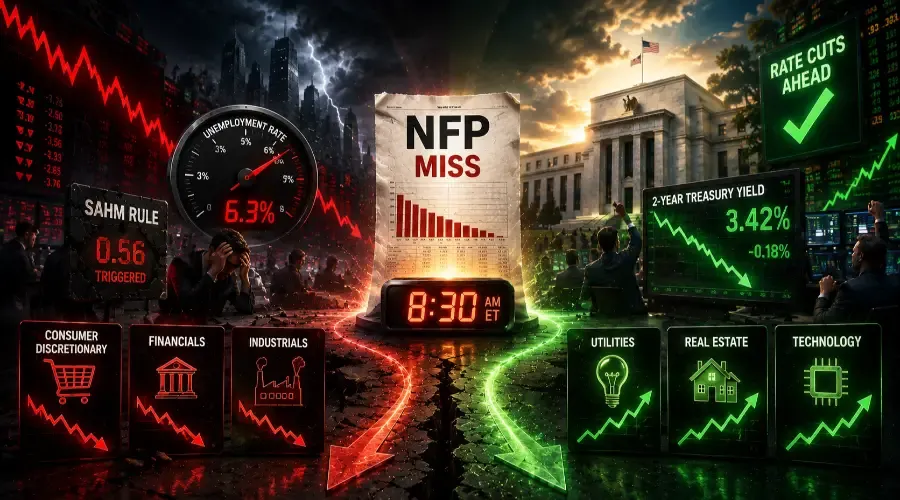
When a bad NFP report hits, the market doesn't simply sell off–it splits. Traders immediately start asking: is this a recession signal, or a rate-cut catalyst? Those two reads send sector rotations moving in opposite directions, and which one wins depends on a single number sitting right next to the payroll figure in the same 8:30am release.
Imagine this: Non-Farm Payrolls misses badly. Investing.com framed the analytical question precisely: "What this NFP miss really means – recession signal or rate-cut catalyst?" ING documented how a weak jobs report reignites the prospect of imminent rate cuts. Fortune covered July 2025's downward revisions and what they meant for Jerome Powell's next move. Tastylive noted the confounding reality that stock markets sometimes shrug off weak jobs data entirely. Every source is correct – because a bad NFP report can produce four different equity market outcomes depending on two variables that the payroll number alone does not reveal. Getting the NFP trade right is not about knowing the number. It is about reading the unemployment rate that accompanies it and determining whether the miss is a rate-cut gift or a recession warning – because those two reads produce sector rotations that point in opposite directions.
Why This Matters More Than Most Traders Realize
Non-Farm Payrolls drops on the first Friday of each month at 8:30am Eastern. It's the most widely anticipated monthly data release in the United States. The report measures the net change in employment excluding agricultural workers, private household employees, and non-profit organisation employees. In any given month, approximately 150,000–200,000 jobs are considered the "break-even" pace needed to absorb new entrants to the labour force and keep the unemployment rate stable.
The stakes are high for a simple reason: employment is the Federal Reserve's second mandate and the economy's primary income source. When hiring slows meaningfully, two things happen at once. The probability of Fed rate cuts rises–lowering borrowing costs and benefiting rate-sensitive sectors–while consumer spending capacity weakens, which cuts into revenue expectations for employment-sensitive sectors. These effects pull equity sectors in opposite directions, and the market's dominant read on which force is larger determines whether a bad NFP print sparks a risk-on rally in rate-sensitive assets or a risk-off selloff across cyclicals.
The quantitative baseline puts it all in perspective. Consensus NFP expectations are compiled from approximately seventy professional economists and published the week before the release. These consensus estimates are widely available–you'll find them on financial news sites and economic calendars from Reuters, Investing.com, Forex Factory, and broker research platforms. A miss of 30,000–50,000 jobs below consensus is considered mild noise; a miss of 100,000+ jobs below consensus is a significant signal; a miss of 200,000+ is a shock that typically produces the "recession signal" read rather than the "rate-cut catalyst" read. The unemployment rate that drops in the same report is the diagnostic tool that tells you which read is correct–and you can check it the moment the numbers cross the tape. [LINK: Macro Events Hub]
Why the Surprise Is the Trade, Not the Number
Just like CPI, the NFP trade turns on the deviation from consensus, not the absolute level. A month where the economy adds 100,000 jobs that exactly matches consensus won't stir much of anything. But 75,000 jobs against a consensus of 185,000–a 110,000 miss–ignites immediate, sector-differentiated moves.
The consensus expectation is public knowledge, published on Bloomberg, Reuters, and major financial news sites each week before the release. The actual number drops at exactly 8:30am on Friday morning. The gap between them is the trade signal–and its size determines both the magnitude of the immediate market reaction and which analytical framework (rate-cut catalyst or recession signal) applies.
There's one layer of complexity here that the CPI report doesn't have: the revision problem. NFP data is released as a preliminary estimate, then revised in the following month's release, then revised again in the subsequent release. The final reading–available two months after the initial release–can differ from the preliminary by 50,000 to 200,000 jobs. The August 2024 annual benchmark revision revealed that job creation throughout 2023 and early 2024 had been significantly overstated–by approximately 818,000 jobs over twelve months–meaning that the market had been reacting to artificially strong preliminary data for over a year. The revision risk is the reason that a single weak payrolls report should carry less positioning weight than three consecutive weak prints: the preliminary reading has a meaningful probability of being revised upward or downward. Historical patterns suggest that large preliminary misses are revised upward by 50,000 or more in roughly 40% of cases, so robustness checks are essential.
The Central Diagnostic: Recession Signal or Rate-Cut Catalyst?
Before applying any sector rotation framework to an NFP miss, answer two questions using data available in the 8:30am release.
Question 1: Did the unemployment rate rise?
If payrolls missed badly AND the unemployment rate rose–particularly if it rose more than 0.1 percentage point–the recession signal read is dominant. Rising unemployment means the labour market is genuinely deteriorating, not just experiencing a seasonal or statistical anomaly. In that environment, the equity market tends to react with a risk-off selloff that overwhelms any rate-cut benefit.
If payrolls missed but the unemployment rate held steady or fell, the payroll miss may reflect statistical noise (birth-death model adjustments, seasonal factors) rather than genuine labour market deterioration. The rate-cut catalyst read is dominant, and the equity market tends to rally on the rate-cut expectation–especially in XLRE, XLU, and XLK.
Question 2: Has the Sahm Rule been triggered?
The Sahm Rule–developed by former Federal Reserve economist Claudia Sahm–states that when the three-month moving average of the national unemployment rate rises 0.5 percentage points above its prior twelve-month low, the United States has historically always been in recession within months of that trigger. The Sahm Rule is calculated using publicly available BLS data and published in real time by the Federal Reserve Bank of St. Louis (FRED database, series SAHMREALTIME). When a bad NFP print pushes the Sahm Rule indicator above 0.50, the recession signal read is nearly definitive–and the equity market response shifts from sector rotation to broad risk-off deleveraging.
It's worth noting that the Sahm Rule triggered in August 2024 without a recession subsequently materializing, illustrating that even historically reliable recession indicators are probabilistic rather than deterministic. The rule remains a valuable real-time alarm, but its trigger should be interpreted as a heightened-warning condition rather than an infallible prediction. The market's reaction in 2024–VIX spiking, sharp equity selloff–demonstrated that traders still treat the trigger as a genuine recession signal, even if the economy later skirts the downturn.
The August 2024 episode–July 2024 jobs data–illustrated this precisely. NFP came in at 114,000 versus a 175,000 consensus, a 61,000 miss. The unemployment rate simultaneously rose to 4.3% from 4.1% the prior month. The Sahm Rule indicator crossed above 0.50 for the first time in the cycle. The reaction was immediate and severe: the VIX spiked intraday to above 65, the S&P 500 fell 3%+, and the equity market processed the miss as a recession signal rather than a rate-cut catalyst. The July miss was followed by Fortune's August 2025 coverage of subsequent downward revisions–confirming that the 2025 labour market was also showing signs of weakening beyond preliminary data.
Sector ETF Quick Reference
Throughout this analysis, sector performance is discussed using the following representative ETFs. If you're unfamiliar with the tickers, here's a quick guide:
Ticker
Sector
XLRE
Real Estate
XLU
Utilities
XLK
Technology
XLF
Financials
XLE
Energy
XLB
Materials
XLI
Industrials
XLY
Consumer Discretionary
XLP
Consumer Staples
XLC
Communication Services
XLV
Healthcare
Consensus vs Reality: The Shrug-Off Phenomenon
Tastylive's observation–that markets sometimes shrug off weak jobs data–is something every trader runs into eventually. Understanding when the market ignores a bad payroll print and when it reacts violently is the second most important diagnostic step, right after the recession-vs-rate-cut question.
Markets shrug off weak NFP when:
The miss is small (under 50,000 below consensus)
Rate cuts are already fully priced–CME FedWatch shows 90%+ probability of a cut at the next meeting
The unemployment rate did not rise
The Fed has recently signalled that rate cuts are coming regardless of one month of data
The bond market barely reacts (2-year yields fall less than 5 basis points)
In all of these conditions, the NFP miss contains no new information about the policy path that the market had not already priced. The asset allocation that would make sense in response to the news has already been made–and there is nothing left to reprice.
Markets react strongly to weak NFP when:
The miss is large (100,000+ below consensus)
The unemployment rate rises simultaneously
Rate cut odds were low or moderate before the release–meaning there is significant policy repricing to do
Recent Fed communication had been hawkish–suggesting the Fed needed convincing before it would cut
Revisions to prior months are also negative–confirming the miss is a trend, not a one-month anomaly
The bond market reaction in the first thirty minutes is the fastest confirmation of which scenario applies. If the 2-year Treasury yield falls 10 basis points or more within thirty minutes of the release, the market is pricing significant policy repricing–the full NFP playbook applies. If the 2-year barely moves, the shrug-off scenario is in effect.
The Market's Reaction Scorecard: Sector by Sector
The NFP miss produces the most split sector scorecard in the series–with rate-sensitive sectors moving opposite to employment-sensitive sectors, and the magnitude determined by which read dominates.
Real Estate (XLRE) – Positive (Rate-Cut Read) / Negative (Recession Read) – Immediate.
XLRE is simultaneously the biggest rate-cut beneficiary and a recession victim. When NFP misses and the rate-cut catalyst read dominates–unemployment stable, Sahm Rule not triggered–XLRE rallies immediately as mortgage rate expectations fall and REIT discount rates compress. Historically, rate-cut-catalyst NFP misses produce 1–3% XLRE outperformance on the release day. When the recession signal read dominates–unemployment rising, Sahm Rule triggered–XLRE faces competing forces: falling rates support valuation, but deteriorating economic conditions threaten occupancy and rent growth. The net effect in the recession scenario is approximately neutral to modestly negative–better than cyclical sectors, worse than pure defensives.
Utilities (XLU) – Positive – Immediate (Both Reads).
XLU is the most consistently positive sector regardless of which read dominates. Rate-cut catalyst scenario: bond proxy reprices immediately as Treasury yields fall. Recession scenario: defensive rotation into yield-generating defensive assets provides additional support. XLU is the only sector that benefits from both reads simultaneously–making it the clearest immediate buy across all NFP miss scenarios. Expect 1–2% relative outperformance within the first trading day of a significant NFP miss.
Technology (XLK) – Positive (Rate-Cut Read) / Negative (Recession Read) – 1–3 Months.
Long-duration growth stock DCF expansion accompanies falling rate expectations–the same mechanism that makes XLK a victim of hot CPI makes it a beneficiary of a weak NFP miss when the rate-cut catalyst read dominates. However, when the recession signal read dominates, enterprise and consumer technology spending expectations fall alongside the growth outlook–overwhelming the DCF expansion benefit. In August 2024, XLK initially fell on the recession signal read before recovering as the market revised its interpretation over subsequent weeks. Apply XLK only when the rate-cut catalyst read is confirmed–unemployment stable, Sahm Rule not triggered.
Financials (XLF) – Negative – 1–3 Months.
NFP misses are consistently negative for XLF across both reads. Rate-cut catalyst scenario: falling rates compress NIM expectations–the same mechanism that hurt XLF in the rate-cut regime post. Recession scenario: rising credit risk from employment deterioration threatens loan quality–the more severe headwind. XLF is the one sector that faces a fundamental negative under both interpretations of a bad NFP report: either the rate environment turns against bank margins, or the credit environment turns against bank asset quality. Expect 2–4% relative underperformance in significant NFP miss scenarios.
Consumer Discretionary (XLY) – Negative – 1–3 Months.
Employment is the primary driver of consumer spending capacity–the most direct transmission from the NFP report to the equity market. When payrolls miss badly, the expectation that consumer revenue growth will slow begins immediately. Auto sales, restaurant visits, retail spending, and travel bookings all correlate with employment levels with a one to two quarter lag. XLY faces the dual headwind of weaker expected revenue growth (employment deterioration) and higher financing costs–wait, no. The Fed rate-cut read actually HELPS XLY through lower auto and mortgage financing costs. The net XLY signal depends on the read: rate-cut catalyst dominant means XLY is approximately neutral to mildly positive; recession signal dominant means XLY underperforms by 3–5% over two quarters as the employment headwind overwhelms the financing cost benefit.
Consumer Staples (XLP) – Mild Positive Relative – Immediate.
Defensive rotation accompanies an NFP miss regardless of read. XLP's inelastic revenue characteristics–people continue buying food and household goods even in recessions–provide relative shelter from the employment sensitivity that hits XLY. The positive is relative rather than absolute. Expect 1–2% relative outperformance within two to four weeks of a significant NFP miss.
Industrials (XLI) – Moderate Negative – 1–3 Months.
Employment is a leading indicator for industrial demand–fewer employed workers means lower aggregate income, which means lower demand for manufactured goods, lower freight volumes, and lower capital equipment orders. A bad NFP miss signals that the industrial demand cycle is at risk of deceleration within one to two quarters. XLI underperforms by 3–5% over two quarters when the recession signal read dominates, and by 1–2% even in the rate-cut catalyst scenario as industrial demand expectations are tempered.
Materials (XLB) – Moderate Negative – 1–3 Months.
Employment weakness signals lower construction activity, lower manufacturing output, and lower commodity demand. XLB faces demand-side headwinds that compound any commodity price weakness triggered by global growth concern. Expect 2–4% relative underperformance in recession-signal NFP misses; 1–2% in rate-cut-catalyst misses.
Energy (XLE) – Moderate Negative – 1–3 Months.
Employment-driven demand destruction concerns reduce the forward demand expectations for energy consumption. A bad NFP print that signals genuine economic weakness reduces oil demand growth forecasts, which pressures XLE revenue expectations regardless of supply factors. Expect 2–3% relative underperformance in recession-signal scenarios; approximately neutral in rate-cut-catalyst scenarios.
Communication Services (XLC) – Moderate Negative – 1–3 Months.
Employment is the primary driver of advertising budget growth–corporate marketing spend follows revenue, which follows employment and consumer spending. A bad NFP miss signals future advertising budget pressure for the digital platform companies dominating XLC. Expect 2–3% relative underperformance over two quarters when the recession signal read dominates.
Healthcare (XLV) – Mild Positive Relative – 1–3 Months.
Defensive rotation and inelastic demand characteristics make XLV a relative safe haven in NFP miss scenarios. Healthcare employment is itself relatively countercyclical–healthcare sector jobs often increase during economic slowdowns as the population faces more health stress. Expect 1–2% relative outperformance as defensive positioning builds.
Magnitude Matters: Mild Miss vs Shock Miss
Mild miss (NFP 20–50K below consensus, unemployment stable):
This is the shrug-off scenario. CME FedWatch rate-cut probabilities shift by 5–10 percentage points. Treasury yields fall 3–6 basis points. The equity market reaction is muted–often less than 0.5% for the S&P 500. XLRE and XLU outperform modestly. Sector rotation is minimal and often reverses the following week when markets determine the miss was noise. Mean-reversion of the first-day trade is highly probable.
Significant miss (NFP 75–150K below consensus, unemployment stable or +0.1%):
Rate-cut catalyst read is most common. CME FedWatch rate-cut probabilities shift 15–25 percentage points. Treasury yields fall 8–15 basis points. XLRE and XLU rally 1–2%. XLF underperforms 1–2%. XLY is approximately neutral. The sector rotation is real and persists for two to three weeks. This is the "rate-cut gift" scenario that ING documented–weak jobs report reigniting rate-cut prospects.
Shock miss (NFP 150K+ below consensus AND unemployment rising 0.2%+):
The recession signal read dominates. CME FedWatch shows dramatic rate-cut probability surge but the equity market falls regardless–because recession risk overwhelms the rate-cut benefit. VIX spikes. XLF falls significantly. XLY falls on employment headwinds. Even XLRE may fall as the contradictory forces of lower rates and deteriorating economic conditions create uncertainty. XLU and XLP are the only relative outperformers. The August 2024 episode–VIX intraday at 65, S&P 500 -3%+–is the definitive shock miss case study.
Historical Cases Sorted by Surprise Magnitude
October 2008 | NFP -533,000 vs -200,000 Expected – The Recession Signal Extreme
October 2008 Non-Farm Payrolls fell 533,000–the worst monthly reading since the 1974 recession–against a consensus expectation of -200,000. The unemployment rate jumped from 6.5% to 6.7%. The Sahm Rule indicator had been above 0.50 for months. The equity market had already fallen substantially since September's Lehman collapse, but the NFP shock added to the dislocating evidence that the recession was severe. XLY fell sharply as employment destruction translated immediately into consumer spending collapse. XLF continued declining as credit quality concerns intensified. XLU and XLP provided relative but not absolute shelter–everything fell. The case illustrates the extreme end of the shock miss scenario: when the unemployment rate is rising rapidly, the Sahm Rule is triggered, and the recession signal read is unambiguous, there is no rate-cut catalyst offset–the market prices an earnings recession simultaneously with rate cuts. Lag window: all risk sectors immediate; defensive sectors held up relatively but still fell; rate cuts did not prevent equity market decline for another five months.
August 2019 | NFP 130,000 vs 160,000 Expected – The Rate-Cut Catalyst Case
August 2019 Non-Farm Payrolls came in at 130,000 versus a 160,000 consensus–a 30,000 miss that, while modest, occurred in the context of Federal Reserve rate-cut expectations building since July 2019 (the first "insurance cut"). The unemployment rate held at 3.7%–confirming the rate-cut catalyst read rather than the recession signal. XLRE rallied 1.5% on the day as rate-cut expectations solidified. XLU gained 1.2%. XLK gained modestly as DCF expansion expectations improved. XLF underperformed modestly on NIM compression concerns. The S&P 500 itself was approximately flat–the rate-cut benefit to rate-sensitive sectors offset by mild concern about growth trajectory. This is the textbook rate-cut catalyst case: modest miss, stable unemployment, Fed already cutting, market focuses on the rate benefit rather than recession risk. Lag window: XLRE and XLU immediate; XLF modest underperformance; S&P 500 approximately neutral.
August 2024 | NFP 114,000 vs 175,000 Expected – Sahm Rule Triggered
The July 2024 jobs report released in August 2024 produced the most significant NFP-driven market reaction in years. Payrolls came in at 114,000 against a 175,000 consensus–a 61,000 miss. The unemployment rate simultaneously jumped to 4.3% from 4.1%, triggering the Sahm Rule indicator above 0.50 for the first time in the cycle. The initial market reaction was the sharpest in years: the VIX spiked intraday to above 65–a level previously only seen during the GFC and the 2020 COVID crash. The S&P 500 fell over 3% on the release day before partially recovering as the week progressed and subsequent data suggested the miss was partly a weather-related anomaly. XLU and XLP were the only clear outperformers on the session. XLF fell sharply on credit risk concerns. XLY fell as employment concerns outweighed any rate-cut benefit. Fortune's subsequent coverage documented the broader pattern of downward revisions in July 2025–confirming that the 2024–2025 labour market had been weaker than preliminary data suggested throughout. Lag window: VIX and risk assets immediate; defensive sectors outperformed throughout August; subsequent September 2024 stronger NFP (142K, unemployment falling to 4.2%) partially reversed the recession signal read, illustrating the mean-reversion dynamic.
The Trading Playbook
Before: What to Watch for Early Warning
Track the ADP National Employment Report, released every Wednesday of NFP week (adpemploymentreport.com). ADP's private payroll estimate–while not a precise predictor of NFP–provides the same-week employment signal that can shift NFP consensus estimates by 10,000–20,000 jobs. When ADP comes in significantly below consensus in the days before NFP, the probability of a weak payrolls report increases and pre-positioning in XLU and XLP defensive overweights is justified before the Friday release.
Monitor the Sahm Rule indicator on FRED weekly (fred.stlouisfed.org, series SAHMREALTIME). The current Sahm Rule reading is available with one-month lag on FRED and updated in real time when the unemployment rate releases at 8:30am. Before each NFP release, know the current Sahm Rule reading relative to the 0.50 threshold. When the indicator is at 0.35–0.49–approaching but not triggering the threshold–a significant NFP miss that pushes unemployment 0.1–0.2% higher could cross the threshold, elevating the recession signal risk for that month's release.
Read the initial jobless claims data weekly (BLS, released every Thursday at 8:30am). Four-week moving average of jobless claims is the most reliable weekly labour market indicator and provides a running preview of NFP direction. When the four-week jobless claims average rises more than 15,000 above its prior six-month average for three consecutive weeks, the setup for an NFP miss is building. This indicator led the August 2024 shock miss by approximately four weeks.
During: Positioning in the 30-Minute Post-Release Window
Read three numbers in the first sixty seconds: NFP actual vs consensus deviation, unemployment rate change from prior month, and whether the prior month's NFP was revised up or down. These three numbers determine which playbook applies before any price chart is examined.
Rate-cut catalyst confirmed (NFP misses, unemployment stable, prior revisions neutral or positive):
Add XLU immediately–it benefits from both reads and has no ambiguity. Add XLRE within the first thirty minutes as the rate-cut repricing unfolds. Reduce XLF modestly for NIM compression. Begin reducing XLY if the miss exceeds 75,000–even in the rate-cut read, employment weakness eventually constrains consumer spending.
Recession signal confirmed (NFP misses badly, unemployment rises, Sahm Rule approaching or crossing 0.50):
Add XLU and XLP as the dual defensive rotation. Do NOT add XLRE in this scenario–the competing forces of lower rates and deteriorating economic conditions create too much uncertainty. Reduce XLF significantly–credit risk is the dominant signal. Reduce XLY, XLC, and XLE for demand destruction concerns. Hold cash or short-duration Treasuries rather than adding equity exposure into an uncertain recession signal.
The shrug-off scenario (miss under 50K, unemployment stable, bond market barely moves):
Do not trade the report. Wait for the subsequent week's data (jobless claims, retail sales, PPI) to determine whether the NFP miss was signal or noise before making any sector adjustments.
After: The Revision Risk Management
Monitor the following month's NFP release specifically for the prior-month revision. Historical patterns suggest that large preliminary misses are revised upward by 50,000 or more in roughly 40% of cases, so positions built on the miss signal should be fully or partially unwound when such an upward revision arrives. The revision is published in the same 8:30am Friday release that contains the new month's data, making it simultaneously actionable with the next round of positioning.
The Mean-Reversion Question: Is the Miss Real?
NFP has a higher mean-reversion rate than almost any other macro data release due to the revision dynamic and the seasonal adjustment methodology. The Bureau of Labor Statistics applies seasonal adjustment factors that can produce apparent misses that are entirely statistical rather than economic.
One-month miss:
Mean-reversion probability is high. Historical data shows that a majority of months following a large miss produce an in-line or above-consensus reading the next month, so wait for three consecutive weak prints before concluding the miss is a trend. One bad number with a benign revision in the following month should be treated as noise.
Three-month trend miss:
When NFP misses consensus for three consecutive months–even by modest amounts–and the unemployment rate has drifted higher, the signal is structural rather than statistical. The Sahm Rule is likely approaching or crossing the threshold. Defensive positioning should be sustained and sized for a six to twelve month horizon.
Post-benchmark revision miss:
When the annual benchmark revision (typically released with the January NFP report) reveals that prior-year payroll data was systematically overstated–as in the August 2024 revision that reduced 2023 payrolls by 818,000–the recession signal read receives retroactive validation. Positions built on the preliminary data's apparent strength may need to be fully reversed.
The 3 Mistakes Most Retail Traders Make
Mistake 1: Trading the Headline Number Without Reading the Unemployment Rate
The most costly NFP trading mistake is positioning based solely on the payrolls miss without checking whether the unemployment rate rose simultaneously. A 100,000 payrolls miss with a stable 4.0% unemployment rate is a rate-cut catalyst. A 100,000 payrolls miss with unemployment rising from 4.0% to 4.2% is a recession signal. These two scenarios require opposite positioning in XLY, XLF, and XLE–and the unemployment rate is in the same 8:30am release, takes ten seconds to check, and determines the entire subsequent analysis. Traders who apply the sector rotation from the rate-cut catalyst scenario to a recession signal NFP miss end up buying the wrong sectors into a deteriorating employment environment.
Mistake 2: Ignoring the Revision Risk and Holding Positions for Multiple Months
The second mistake is building large sector positions on a single weak payrolls report and holding them for three to four months without accounting for the revision risk. The August 2024 shock miss triggered recession fears and VIX at 65–then the September 2024 NFP came in at 254,000, far above expectations, and the August data was revised upward by 86,000. Traders who had built maximum defensive positions on the August shock miss and held through September gave back significant gains as the positions reversed sharply on the September beat and revision. The correct approach is to build defensive positions after a significant miss but size them for a one to two month horizon, with a defined exit rule tied to the following month's revision and new data rather than a calendar-based hold period.
Mistake 3: Applying the Same Playbook When Rate Cuts Are Already Fully Priced
The third mistake is executing the full rate-cut sector rotation from an NFP miss in an environment where CME FedWatch already shows 90%+ probability of a rate cut at the next meeting. When rate cuts are fully priced, an NFP miss contains no new policy information–the market was already expecting a cut regardless. In this shrug-off scenario, buying XLRE and XLU on the miss means paying a premium for the rate-cut expectation that was already reflected in prices, with no additional upside from the new data. Check CME FedWatch before the release: if the probability of a cut at the next meeting is already above 80%, the rate-cut catalyst from the NFP miss is already in the price and the trade is much smaller than the standard rate-cut sector rotation would suggest.
Bottom Line: The One-Sentence Institutional Framework
When NFP misses badly, read three numbers in sixty seconds – payrolls deviation from consensus, unemployment rate change, and Sahm Rule proximity – then: stable unemployment means add XLU immediately and XLRE within thirty minutes; rising unemployment approaching Sahm threshold means add XLU and XLP as defensives only and reduce XLF, XLY, and XLC for demand destruction; and when CME FedWatch already shows 90%+ cut probability, the miss is already priced and the shrug-off scenario requires no action.
This framework works across cycles because the employment report's market impact runs through the same two channels in every cycle–the rate expectations channel and the consumer spending expectations channel–and the direction and magnitude of each channel's effect depends on whether the unemployment rate validates the recession signal or confirms the labour market resilience that makes the miss a one-month rate-cut catalyst.
The retail edge is the sixty-second read of three numbers before any chart is examined, the Sahm Rule as the probabilistic recession signal threshold, and the revision risk discipline that prevents holding large positions through the one-month period in which the preliminary data is most likely to be corrected.
Run this scenario through the [Breakout Bulletin Ripple Engine](LINK: Ripple Engine Tool) to see the full sector transmission map for a bad NFP print under both reads–rate-cut catalyst and recession signal–and compare how XLY, XLF, and XLK flip direction between the two scenarios while XLU remains positive across both.
FAQ: Weak Jobs Report and Market Reaction
What does it mean when NFP misses badly?
A bad NFP miss means the Non-Farm Payrolls report showed significantly fewer jobs created than economists expected. This often triggers immediate repricing of interest rate expectations and sector rotation.
Why does the jobs report move markets so much?
The jobs report impacts expectations around economic growth, consumer spending, and Federal Reserve interest rate decisions–three of the biggest drivers of equity and bond markets.
What is the difference between a recession signal and a rate-cut catalyst?
A recession signal suggests the economy is weakening sharply, with rising unemployment and deteriorating spending. A rate-cut catalyst suggests the Fed may lower interest rates to support growth, but the labour market itself remains resilient.
Why is the unemployment rate important alongside NFP?
The unemployment rate helps determine whether a weak payroll number reflects temporary noise or genuine labor market deterioration–and it's available in the same 8:30am release.
What is the Sahm Rule?
The Sahm Rule is a recession indicator triggered when the three-month average unemployment rate rises 0.5 percentage points above its prior 12-month low. Historically, it has flagged recessions with high reliability, though it can generate false positives.
Which sectors perform best after a weak jobs report?
Utilities (XLU) and defensive sectors often outperform because lower interest rates and recession fears increase demand for stable, yield-generating assets.
Which sectors perform worst after a bad NFP report?
Financials (XLF), Consumer Discretionary (XLY), and cyclical sectors often struggle because weak employment reduces spending and growth expectations.
How does weak NFP affect Treasury yields?
Weak payroll data usually pushes Treasury yields lower because traders expect the Federal Reserve to cut interest rates in response.
Why do markets sometimes ignore weak jobs data?
Markets may shrug off weak NFP reports if rate cuts are already fully priced in or if the unemployment rate remains stable, signaling no genuine deterioration.
Can one weak jobs report trigger a recession?
Usually not. Traders look for multiple consecutive weak payroll reports and a clear upward trend in unemployment before concluding recession risk is structurally elevated.
Educational content only. Not investment advice. Past sector performance patterns do not guarantee future results.