
Published: March 23, 2026
Subhead: Major indices hit year-to-date lows as Iran-Qatar escalation forces a systematic repricing of Fed rate-cut expectations
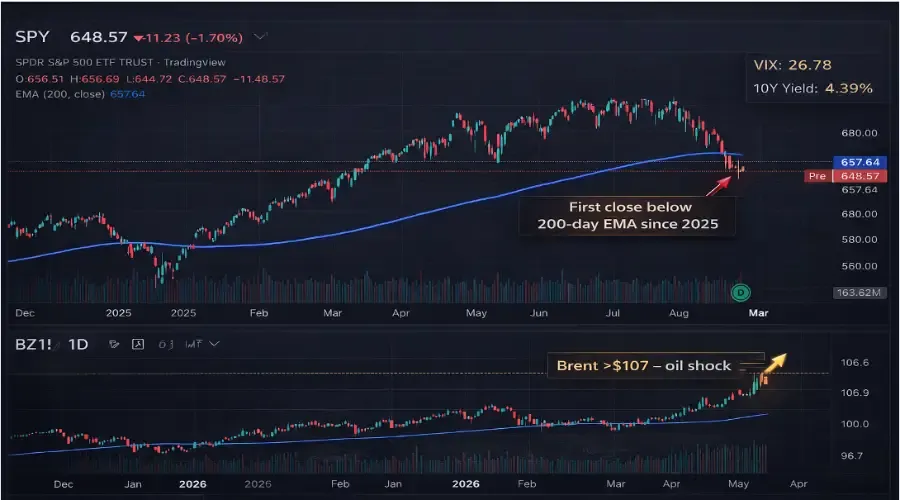
This week confirmed that oil is no longer an input-it is the primary driver of cross-asset pricing. The market did not move on isolated news but on a clear transmission chain where energy prices dictated inflation expectations, policy constraints, and valuation resets. The S&P 500 closed near 6,506, marking its fourth consecutive losing week, while Brent crude moved above $107 and touched $110, reinforcing inflation pressure across assets
The Week in Review - A Cross-Asset Repricing
Markets did not adjust gradually-they repriced in sequence. Oil moved higher on geopolitical escalation, which fed directly into inflation expectations. This pushed the 10-year Treasury yield to 4.39%, tightening financial conditions and compressing equity valuations
The result was broad-based weakness across indices. The Nasdaq underperformed due to its sensitivity to higher discount rates, while small caps reflected rising credit stress. At the same time, VIX rose to 26.78, indicating elevated hedging demand rather than full panic
What stood out was the divergence across traditional hedges. Gold declined despite geopolitical tension, while Bitcoin rose 3.6%, signaling a shift in how markets are positioning within a stagflation-driven environment
What Changed This Week - The Oil Shock Expansion
The defining shift was the expansion of the energy shock beyond crude into broader pricing expectations. The Iran-Qatar escalation and LNG disruption extended the inflation impulse across multiple energy channels
In practical terms, this matters because energy is no longer a contained variable. Oil influences transportation, logistics, and production costs, while LNG disruptions affect industrial and utility pricing globally. When both move together, inflation expectations become more persistent
This persistence directly impacts Federal Reserve flexibility. As inflation risks rise, the probability of near-term rate cuts declines. Markets are now adjusting to a scenario where policy remains restrictive for longer than previously expected
Technical Landscape - Key Market Signals
The S&P 500 holding near 6,506 places it at a critical reference level. Sustained weakness around this zone reflects the market adjusting to higher discount rates rather than reacting to isolated events
The 10-year yield at 4.39% is equally important. This level represents the bond market pricing a reduced probability of easing. Stability or further increases reinforce the higher-for-longer narrative, while a pullback would suggest growth concerns are beginning to offset inflation
Volatility metrics confirm the environment. A VIX near 27 indicates active hedging and institutional repositioning rather than panic-driven selling. This distinction suggests that the market is undergoing a structured repricing rather than a disorderly decline
Narratives in Motion - Sector and Asset Divergence
Energy remains the clearest beneficiary of the current environment. Higher crude prices translate directly into improved earnings expectations, reinforcing energy sector outperformance as capital rotates toward sectors with direct pricing leverage
In contrast, long-duration assets continue to face pressure. Technology equities are sensitive to rising yields, while consumer sectors face margin compression as energy costs rise and discretionary spending adjusts
Bitcoin’s performance introduces a notable divergence. Its positive movement against declining equities suggests that markets are testing alternative hedging mechanisms in a stagflation context. This divergence is not yet structural, but it is an observable shift in positioning behavior
Flows and Positioning - What Institutional Activity Signals
Institutional flows reflect a consistent pattern of repositioning. Capital is moving toward energy-linked exposures while reducing allocations to long-duration assets
Outflows from bond-focused instruments align with rising yields, while equity flows indicate rotation rather than broad capitulation. The presence of elevated volatility alongside continued positioning adjustments suggests that markets are still in a rebalancing phase
From a structural standpoint, this behavior is consistent with early-stage stagflation dynamics where investors shift toward assets with direct exposure to inflation drivers
Sentiment Check - Elevated Risk Awareness
Sentiment indicators confirm a high level of caution across markets. Elevated volatility and defensive positioning indicate that investors are actively hedging downside risk rather than exiting markets entirely
Importantly, the absence of panic signals suggests that the market has not yet reached capitulation. Instead, it is adjusting expectations gradually as new information reinforces the inflation-driven narrative
What Markets Are Watching Next
The next phase of this cycle depends on three observable variables. The first is EIA crude oil inventory data, which will provide direct insight into supply-demand balance. A draw would reinforce the structural shock narrative, while a build would support the temporary spike thesis
The second is Federal Reserve communication, particularly from key policymakers. Any shift in tone regarding inflation persistence will influence rate expectations and yield direction
The third is the evolution of energy prices themselves. Sustained levels above $110 Brent reinforce inflation pressure, while any meaningful decline would ease policy constraints and support broader market stabilization
The Bigger Picture - A Stagflation Configuration Emerging
The current environment reflects a shift toward a stagflation data configuration, where inflation remains elevated while growth risks begin to surface. This combination creates a complex macro backdrop where traditional diversification strategies become less effective
What makes this episode distinct is the clarity of the causal chain. Oil prices are not just influencing inflation-they are actively shaping policy constraints and asset valuations simultaneously
Bottom Line
The past week was not a typical market correction-it was a macro-driven repricing event led by energy markets. The removal of the rate-cut premium is now visible across equities, bonds, and alternative assets
The framework remains unchanged: Oil → Inflation → Fed policy → Yields → Equity valuations. Each data point in the coming week will add clarity to one part of this chain
As long as oil remains elevated, markets remain in a Fed-constrained environment where inflation dominates and traditional relationships across asset classes continue to shift
Disclaimer
This article is for informational and educational purposes only and does not constitute financial, investment, or trading advice. You are solely responsible for your own investment decisions and should consult a licensed financial professional before acting on any information in this post.