
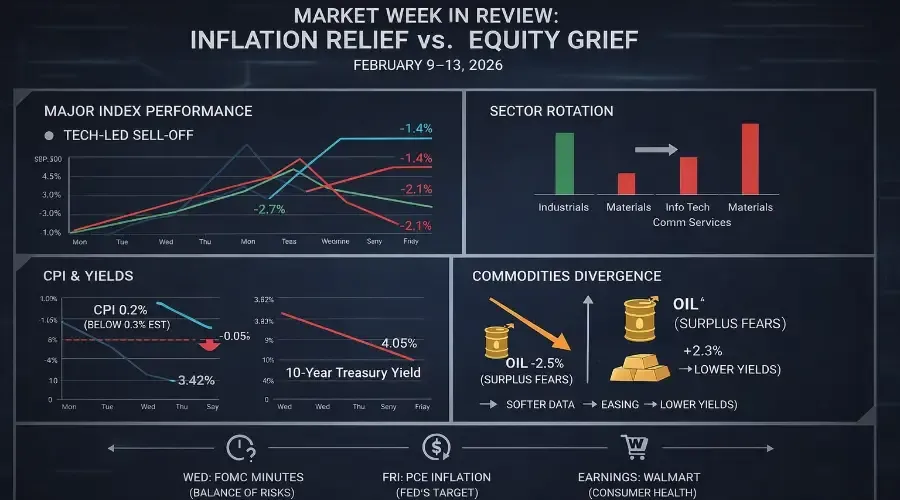
U.S. equity markets faced a reality check this week. Major indices closed in negative territory as the “higher-for-longer” rate backdrop continued to pressure Growth and Technology sectors.
While Friday’s softer inflation print offered a brief reprieve, it was not enough to reverse the broader weekly trend.
The Tape: Weekly Performance
Nasdaq Composite: -2.1%
Led the decline, reflecting high sensitivity to the restrictive rate environment.
S&P 500: -1.4%
Dragged lower by Technology. The index remains technically constructive above its 200-day moving average.
Dow Jones (DJIA): -1.2%
Showed relative resilience due to heavier exposure to value and cyclical components.
Russell 2000: Lagging
Small-caps remain sensitive to financing conditions and domestic growth expectations.
Section 1: Market Mechanics & Rotation
The primary theme this week was rotation, not capitulation.
Rather than a broad-based sell-off, capital rotated toward “Old Economy” sectors that are less immediately sensitive to rate volatility.
Sector Performance
Industrials and Materials showed relative strength.
Information Technology and Communication Services extended their underperformance, reflecting ongoing valuation sensitivity to rate expectations.
Treasury Yields & Currency
The 10-year Treasury yield drifted toward ~4.05%.
The 2-year yield settled near ~3.42%.
The U.S. Dollar Index (DXY) was modestly higher on the week (around +0.6%), reflecting steady demand for dollar assets rather than acute risk aversion.
This cross-asset configuration suggests adjustment rather than disorder.
Section 2: The Catalyst — Friday’s CPI Release
The most pivotal development came Friday morning.
January CPI rose 0.2% month-over-month, slightly below the 0.3% consensus.
Market Interpretation
Disinflation Narrative
The softer reading supports the gradual cooling narrative, suggesting inflation continues to trend lower, albeit unevenly.
Rate-Cut Repricing
Markets modestly increased the probability of a June rate cut and nudged 2026 easing expectations slightly higher.
The Fed Anchor
Core PCE, the Fed’s preferred inflation gauge (previously 2.8% YoY), remains the more decisive hurdle. A single CPI print is unlikely to materially shift policy expectations without confirmation.
Section 3: Commodities & Cross-Asset Signals
Commodity markets provided additional macro signals.
Oil (WTI)
Closed near $62.50, marking a second consecutive weekly decline. The move was largely driven by IEA projections of a potential 2026 supply surplus.
Gold
Advanced roughly 2–3% on the week, tracking softer yields following CPI. The move reflected positioning around potential policy easing.
The divergence between oil and gold suggests a transitional macro phase rather than synchronized global expansion.
Section 4: The Week Ahead (February 17–23, 2026)
Markets now look to confirmation—or complication—of the inflation cooling narrative.
Wednesday — FOMC Minutes
Investors will analyze the January 27–28 minutes for insight into the Fed’s internal balance of risks between inflation persistence and growth moderation.
Friday — PCE Inflation
As the Fed’s preferred metric, a Core PCE reading moving meaningfully below 2.8% would likely reinforce expectations for policy easing later in 2026.
Earnings Watch: Walmart (WMT)
Walmart’s report may offer insight into consumer pricing power, margin stability, and spending resilience—key indicators for both retail investors and institutions.
The Bottom Line
This week represented an incremental adjustment in inflation and policy expectations rather than a confirmed regime change.
The Fed continues to emphasize patience. Until Core PCE demonstrates a clearer downward trajectory, volatility may remain the baseline environment.
Strategy Note
Monitor whether sector rotation extends beyond a single week. A more durable shift in sentiment may require a clearer turn in the Fed’s internal tone or sustained confirmation from inflation data.