
FAST-TURNOVER · WEEKLY PREVIEW · BREAKOUTBULLETIN
Published: March 22, 2026
Subhead: Four consecutive losing weeks and a year-to-date low on the S&P 500 put the focus on Vice Chair Jefferson’s remarks and critical energy supply data to determine if the current shock is a temporary spike or a structural inflation wave.
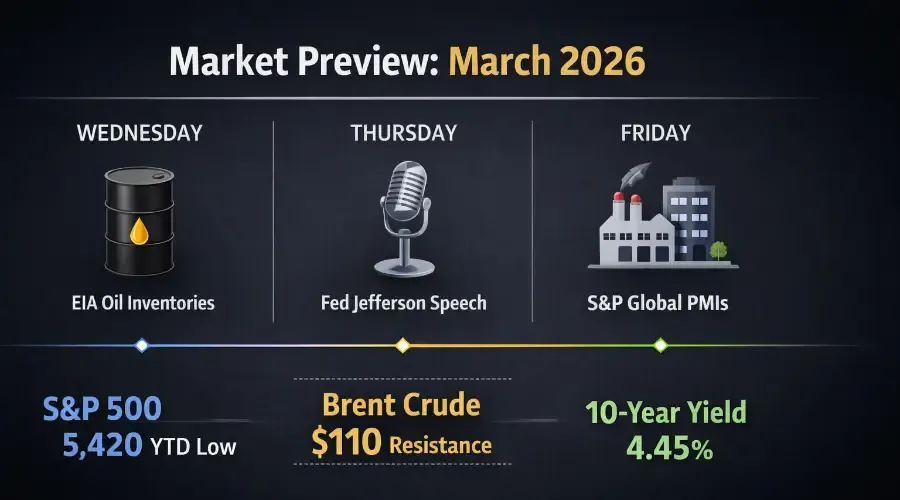
Four consecutive losing weeks and a year-to-date low on the S&P 500 have sharpened the market’s focus on a single macro question: is the Iran-Qatar energy disruption a temporary spike, or the beginning of a structural inflation wave. This weekly market preview March 2026 centers on three catalysts—Wednesday’s EIA crude oil inventory, Thursday’s Fed Jefferson speech, and Friday’s PMI data—that together define the supply, policy, and growth outlook. What changed here was the shift toward a regime where oil is driving inflation expectations and constraining Federal Reserve flexibility at the same time.
Quick Hits — Five Questions Shaping the Week Ahead
What are the three most important events this week?
Wednesday’s EIA crude oil inventory report (supply signal), Thursday’s Fed Vice Chair Jefferson speech (policy signal), and Friday’s S&P Global PMIs (growth signal). Together they determine whether the oil shock is temporary or structural.
Why is the Fed Jefferson speech critical for markets?
As Vice Chair, Jefferson’s remarks carry significant weight. Markets will parse his language on whether the Fed views energy-driven inflation as transitory or persistent—a direct input to rate-cut expectations.
What will the EIA crude inventory report tell us?
A large inventory draw confirms physical tightness and supports the structural shock narrative. A build suggests demand destruction may already be offsetting supply constraints, favoring the temporary spike thesis.
How will Friday’s PMIs impact the stagflation debate?
Weak PMI readings would signal that growth is slowing while inflation remains elevated—a stagflation data configuration. Strong readings would suggest resilience, keeping the focus on inflation rather than growth deterioration.
What technical levels are markets watching?
The S&P 500 near 5,420 (year-to-date low) remains the key support zone. Brent crude at $110–$115 resistance defines the energy narrative, while the 10-year yield at 4.45% reflects ongoing pressure from inflation expectations.
The Macro Question of the Week
Heading into this week, the market is not searching for new narratives but for confirmation of an existing one. The question is whether oil above $110 represents a short-lived geopolitical premium or a sustained supply-driven inflation cycle. This distinction matters because it determines whether the Federal Reserve can maintain a path toward easing or must remain restrictive for longer.
This question cannot be answered by equities alone. It requires cross-asset confirmation from energy data, policy communication, and growth indicators. In practical terms, Wednesday’s inventory data addresses supply, Thursday’s Fed commentary defines policy interpretation, and Friday’s PMIs provide the first signal of economic impact. Together, they form the decision framework for the week.
Economic Calendar Breakdown
Monday begins as a low-data session, providing a reset after the prior week’s volatility. With no major releases, the focus remains on positioning and early signals from oil prices and global trade flows.
Tuesday’s consumer confidence March 2026 reading becomes the first meaningful check on demand conditions. This is the first survey released after oil moved above $100, making it an early indicator of whether rising fuel costs are affecting household sentiment. A stronger reading suggests resilience in consumer demand, while a weaker reading supports the thesis that energy costs are beginning to weigh on spending behavior.
Wednesday’s EIA crude oil inventory report is the week’s most critical data point. It provides a direct read on supply-demand balance in crude markets. A large inventory draw confirms physical tightness and supports the structural shock narrative, while a build suggests demand destruction may already be offsetting supply constraints. This single data release will heavily influence oil direction and, by extension, inflation expectations.
Thursday brings durable goods data alongside weekly jobless claims, offering insight into business investment and labor market conditions. At the same time, the Fed Jefferson speech becomes the most important policy signal of the week. As a Vice Chair, Jefferson’s remarks carry significant weight in shaping market interpretation of the Fed’s stance on energy-driven inflation.
Friday’s S&P Global Manufacturing & Services PMIs provide the earliest indication of whether the oil shock is translating into reduced economic activity. A strong reading supports resilience, while a weaker reading introduces the possibility of a stagflation data configuration where growth slows even as inflation remains elevated.
Why This Week Matters — The Oil-Fed-Growth Link
The importance of this week lies in how clearly it maps the transmission chain between oil, inflation, and policy. Oil prices influence inflation expectations, which in turn shape Federal Reserve decisions. Those decisions then determine discount rates applied across asset classes.
From a structural standpoint, the market is currently adjusting to the removal of the Fed rate-cut premium repricing. Earlier expectations of multiple cuts in 2026 have been reduced significantly. This shift is already visible in rising yields and declining equity valuations.
What makes this episode structurally important is that oil is not just driving inflation—it is simultaneously tightening financial conditions, accelerating the repricing cycle across asset classes. This dual effect explains why equities, bonds, and gold are all reacting within the same macro framework.
Technical Landscape — Key Reference Zones
The S&P 500 enters the week near 5,420, its year-to-date low. This level serves as a key reference point for market stability. Holding above it suggests consolidation, while a break below signals continuation of the current trend.
The 10-year Treasury yield at 4.45% reflects ongoing inflation pressure. Stability or further increases reinforce the higher-for-longer rate environment, while a decline would indicate that growth concerns are beginning to offset inflation expectations.
Brent crude near $110–$115 resistance remains the central macro variable. Sustained levels above this range confirm the structural shock narrative, while a move lower would support the temporary spike thesis.
Sector Focus — Diverging Outcomes
Sector performance this week is likely to reflect the same macro drivers shaping the broader market. Energy sector outperformance (XLE) continues to be directly tied to oil prices and remains the clearest beneficiary of the current environment. However, any reversal in oil would quickly unwind that positioning.
Consumer-facing sectors face the opposite pressure. Rising fuel costs and declining confidence can reduce discretionary spending, placing pressure on retail and service-oriented businesses.
Financials remain sensitive to both yield movements and growth expectations. A stable or rising yield environment supports margins, but any signs of economic slowdown introduce credit risk concerns.
Global Signals — Expanding the Framework
The Iran-Qatar energy disruption remains the primary geopolitical variable. Any escalation or de-escalation will directly impact oil prices and reset market expectations.
European PMI data will provide insight into how energy shocks are affecting other major economies. Weak readings would indicate that growth concerns are spreading globally, while stable readings suggest resilience outside the US.
Emerging market indicators, particularly currency and bond movements in energy-importing economies, add another layer. Stress in these markets signals tightening global financial conditions, which can feed back into developed markets.
What This Week Tells Us About the Macro Regime
The current environment reflects a market stagflation regime, where inflation remains elevated while growth risks begin to emerge. This combination creates a complex policy environment and reduces clarity for market direction.
What is notable is that the market is not reacting to isolated events but to a connected set of drivers. Oil prices, Fed policy, and economic data are interacting in a way that reinforces the current narrative.
The role of this week is not to introduce a new theme but to determine whether the existing one strengthens or begins to shift.
Bottom Line
This weekly market preview March 2026 centers on a single decision point: whether the current energy shock is temporary or structural. The answer will come through the interaction of three key signals—oil data, Fed communication, and economic indicators.
The framework remains unchanged: Oil → Inflation → Fed policy → Yields → Equity valuations. Each release this week adds clarity to one part of that chain.
As long as oil remains elevated and inflation expectations persist, markets remain in a Fed-constrained environmentwhere traditional assumptions about policy support and diversification are challenged.
Disclaimer
This article is for informational and educational purposes only and does not constitute financial, investment, or trading advice. You are solely responsible for your own investment decisions and should consult a licensed financial professional before acting on any information in this post.