
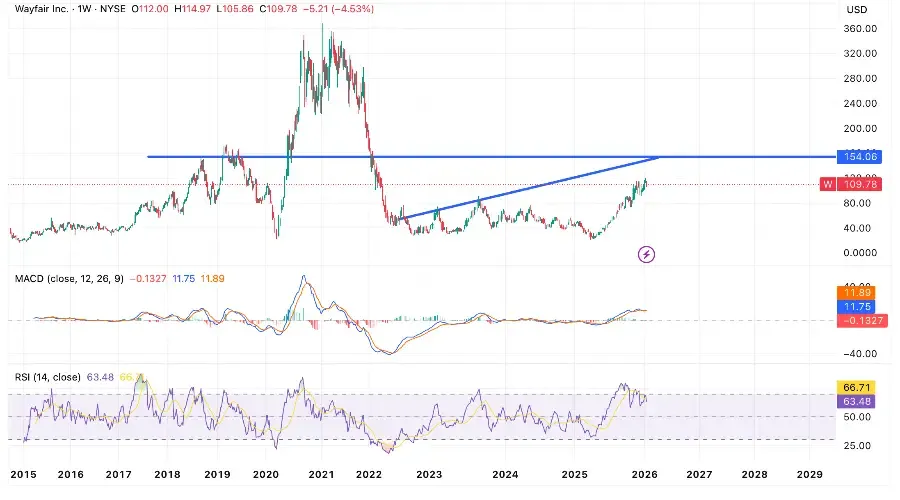
Wayfair (W) Surges +23% on 5.8x Volume - Strength or Forced Buying?
Wayfair (W) surged +23.22% to $106.52 on 17.5 million shares, trading at 5.8x its normal daily volume after an earnings-driven catalyst.
At first glance, the move looks similar to strong breakout rallies. But professional traders analyze not just the size of the move — but the behavior behind it.
A key warning sign emerged:
40% of the day’s volume occurred in the opening hour, followed by a fade from intraday highs.
This pattern strongly suggests short squeeze mechanics, not steady institutional accumulation.
This analysis breaks down how to distinguish real earnings-driven strength from short-covering rallies, using volume timing, technical structure, and price extension behavior.
Breakout Summary: What Happened
Key Metrics
- Price Gain: +23.22%
- Closing Price: $106.52
- Volume: 17.5M shares (5.8x average)
- Volume Efficiency Ratio: ~4.0:1
- Intraday High: ~$110
- Fade from Highs: ~3%
While the efficiency ratio looks strong, price faded into the close, a common trait when buying pressure is forced rather than voluntary.
Technical Setup: Overextended Breakout Zone
Wayfair recently traded in a volatile consolidation range between $75 and $86, where multiple prior breakout attempts failed.
Breakout Behavior
- Gapped from $86 → $98 at open
- Spiked to $110 intraday
- Closed at $106.52, below highs
Measured Move Context
- Pattern target: ~$97
- Actual price exceeded target by ~$9–10
When a stock exceeds its measured target on Day 1 and fades, it often reflects temporary price distortion rather than sustainable demand.
Extreme Price Extension: Mean-Reversion Risk
Wayfair is now trading approximately:
- +33% above its 20-day moving average
- Far above its 50-day moving average
This is extreme extension, even for a volatile stock like W.
Historically, unprofitable, high-beta stocks that extend 25–35% above short-term averages often retrace within days as price normalizes.
Conclusion:
This rally is technically overextended, increasing the risk of cooling or pullback.
Volume Distribution: The Short Squeeze Signature
Intraday Volume Breakdown
- Opening Hour: ~40% of daily volume
- Mid-Day: ~46%
- Final Hour: ~14%
What This Means
Front-loaded volume + fading close = forced buying.
Short Squeeze Characteristics (Seen Here)
- Heavy early-session urgency
- Shorts covering positions after an earnings gap
- Retail traders chasing price higher
- Light closing volume — indicating no long-term institutional commitment
Institutional Accumulation Typically Shows
- Balanced or rising volume throughout the day
- Strong closes near highs
- Continued demand into the close
Wayfair’s volume profile matches a squeeze, not patient accumulation.
Context Matters: High Short Interest + Earnings Catalyst
Wayfair has:
- Elevated short interest (~15–20%)
- High volatility history
- Unprofitable financial profile
When earnings surprise positive in high-short stocks, the move often reflects:
- Short sellers rushing to cover
- Options hedging activity
- Temporary price dislocation
This does not guarantee sustained bullish follow-through unless institutions later step in to build positions.
Intraday Price Action: Exhaustion Signal
During the session:
- Price spiked rapidly early
- Traded in a wide, choppy range ($105–$110)
- Faded into the close
If institutions were building long-term positions:
- Price would hold highs
- Closing volume would increase
- Price action would tighten, not widen
Instead, the price behavior signals emotional and forced buying — not strategic accumulation.
Conviction Score: Medium, Squeeze-Biased
|
Factor |
Strength |
Interpretation |
|
Breakout above resistance |
Positive |
Bullish signal |
|
Volume magnitude |
Strong |
Institutions active |
|
Volume distribution |
Weak |
Front-loaded squeeze |
|
Price extension |
Risk |
Overextended |
|
Closing strength |
Weak |
Fade from highs |
|
Trend structure |
Mixed |
Needs confirmation |
Overall Conviction Score: 55 / 100
Meaning:
This is not high-conviction trend strength — it sits in a “squeeze-driven move” zone, where chasing carries elevated risk.
Key Levels & Signals to Monitor
Important Price Zones
- Above $105–110: Needs sustained strength to prove real demand
- Below $100: Signals cooling momentum
- Below $90: Indicates squeeze unwinding risk
Volume Behavior to Watch
- Declining volume (5–8M/day): Healthy digestion
- High-volume down days (>20M): Possible unwind
- Sustained high volume with price stability: Would indicate institutions stepping in
Sector Confirmation
Compare Wayfair’s performance to:
- RH (Restoration Hardware)
- Home retail peers
- Consumer discretionary ETF (XLY)
If W rises alone, squeeze risk stays high.
If the sector confirms, sustainability improves.
Key Lessons for Traders & Investors
1. Not All Big Earnings Moves Are Sustainable
Large gap-ups in high-short stocks often reflect forced buying, not real conviction.
2. Volume Timing Reveals True Intent
Heavy early volume + weak closing volume = short-covering behavior.
3. Extreme Price Extension Raises Pullback Risk
When price stretches far above moving averages, mean reversion becomes likely.
4. Intraday Fade Signals Lack of Institutional Support
Real accumulation holds highs - squeezes fade from them.
5. Medium Conviction = Wait, Not Chase
A 55/100 conviction score suggests monitoring, not aggressive positioning.
Bottom Line
Wayfair’s +23% earnings rally shows strong headline momentum, but the volume timing, fade from highs, and extreme price extension point toward a short squeeze — not confirmed institutional accumulation.
Until price stabilizes and holds elevated levels with stronger closing demand, this move should be treated as high-risk and short-term in nature.
Smart approach:
Avoid chasing parabolic strength — instead, wait to see if price builds support and volume normalizes.
Educational Disclaimer: This analysis is for learning market behavior, not financial advice. Short squeezes often reverse quickly. Past performance does not guarantee future results.