
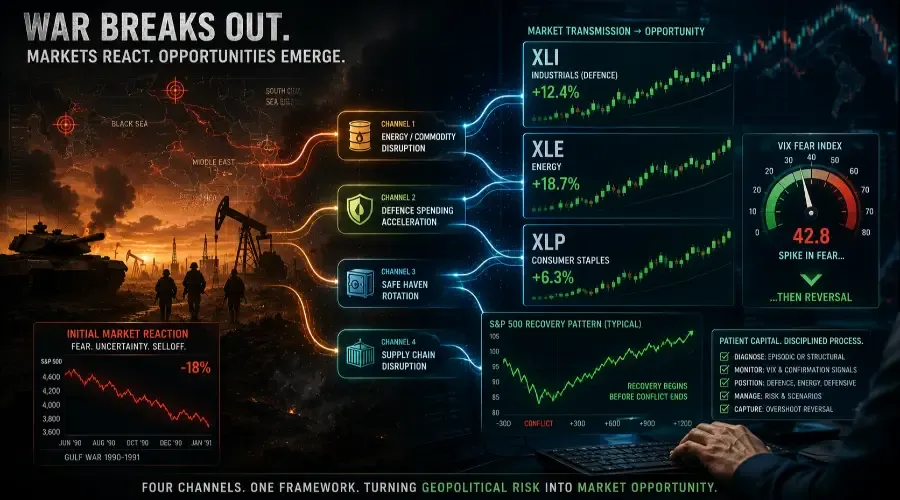
Amnesty International, the United Nations, West Point’s Modern War Institute, and academic research document what war does to societies – displacement, supply disruption, institutional collapse, and humanitarian catastrophe. What none of these sources provide is the equity market framework that converts a military conflict into actionable sector positioning – because the market’s reaction to war follows a documented pattern that has repeated across many major conflicts of the modern era: an initial selloff that has historically overshot, a recovery that frequently begins the moment military outcome becomes visible, and a sustained sector divergence that separates structural conflicts from episodic ones. The traders who understand this pattern position before the consensus does. The traders who don’t often exit the market at exactly the wrong time.
Important: This framework is built on historical patterns, not guaranteed outcomes. Every conflict carries unique risks – including tail events – that can override past tendencies. It’s a starting point for analysis, not a rulebook.
Why This Matters More Than Most Traders Realize
Military conflict is one of those rare macro events where the market’s first reaction tends to be wrong – and often dramatically so. Across many significant military conflicts since 1945, the initial equity selloff in the stock market during war has overshot the eventual economic damage. The recovery from that overshoot has often begun before the conflict ends, before the geopolitical situation is resolved, and before any analyst consensus has shifted from bearish to bullish.
The historical pattern is consistent in its direction: the S&P 500 during the Gulf War selloff in August 1990 fell roughly 18% – before recovering around 25% in the three months following the January 1991 air campaign launch. The 9/11 selloff produced a roughly 15% decline in one week – with full recovery within three months. Russia’s invasion of Ukraine in February 2022 produced a sharp selloff – before XLE energy stocks surged 58% in 2022 and energy markets restructured in ways that were sustainably positive for US energy producers.
The reason the overshoot is reliable: markets initially price the worst-case scenario (the conflict expands, oil supply is permanently disrupted, financial systems are compromised) before information gradually reveals which of those scenarios is materialising. The overpricing of worst-case risk is often the entry opportunity. When you trade war and geopolitical conflict, understanding this panic mechanics is what separates disciplined buyers from reactive sellers. [LINK: Geopolitical Hub]
Regime Change: The Episodic vs Structural Diagnostic
Military conflict is a regime change event – but uniquely, the duration and depth of the regime change must be determined rapidly because the positioning implications are completely different for episodic versus structural conflicts.
Episodic Conflict
Acute military event that resolves within weeks to months without permanently altering global trade flows, commodity supply chains, or geopolitical alliances. The market overshoots down and then recovers to or above pre-conflict levels as the acute risk premium unwinds. Gulf War 1991, 9/11 (in terms of equity market recovery), the 2014 Russia-Crimea annexation, the 2019 Saudi drone strikes – all episodic in their equity market impact.
Structural Conflict
Military event that permanently or durably alters global supply chains, energy flows, territorial control, or alliance structures. The market selloff is followed not by full recovery but by a sustained sector divergence that persists for years. Russia-Ukraine 2022 is the definitive modern structural case – European energy independence from Russian gas became a multi-year restructuring project, US LNG exports expanded permanently, and defence budgets across NATO increased structurally. This was not a two-week trade; it was a two-to-five-year sector restructuring that is still in progress.
The Diagnostic Test – Run This in the First 48 Hours:
Ask four questions: Does the conflict threaten a major commodity supply route or producing region? Does it involve a nuclear-armed state directly (not by proxy)? Does it permanently change the alliance structure of major trading partners? Does it alter semiconductor or technology supply chains (South China Sea, Taiwan)? Two or more “yes” answers indicate structural; zero or one indicates episodic.
Handling Ambiguity – Use a Confidence Score:
In the fog of early conflict, answers may not be clear. A simple scoring method can guide positioning size: assign 0 (clearly no), 1 (possibly), or 2 (clearly yes) to each question. A total of 0–2 suggests episodic; 5+ points strongly to structural; 3–4 is a gray zone – size smaller, stay flexible, and be ready to adjust as information improves. The more structural the conflict, the longer the sector positioning typically needs to be held and the more significant the commodity channel impacts.
Which Transmission Channels Are Active?
Channel 1 – The Energy/Commodity Disruption Channel:
Conflicts in or near oil-producing regions, strategic shipping routes (Strait of Hormuz, Bab-el-Mandeb, South China Sea), or major commodity-producing areas create immediate energy and materials supply risk premiums. XLE surges when this channel activates; the magnitude depends on whether the supply disruption is potential (episodic) or actual (structural). War and energy prices are tightly linked here – oil supply disruption stocks tend to react violently in the first hours.
Channel 2 – The Defence Spending Channel:
Every military conflict accelerates defence procurement. The countries involved increase military spending; allied nations raise defence budgets in solidarity and deterrence. US defence contractors (Lockheed Martin, Raytheon, Northrop Grumman, General Dynamics within XLI defence stocks) see forward order book expansion regardless of whether the conflict is episodic or structural – because governments respond to visible military threats by increasing defence investment.
Channel 3 – The Safe Haven Channel:
Risk-off capital rotation into gold, US Treasuries, and defensive equities. XLP, XLV, and XLU receive defensive rotation inflows. Gold and precious metals within XLB surge. This channel is most active in the initial overshoot phase and partially unwinds as the conflict’s episodic nature becomes clearer. Sector rotation into safe havens during geopolitical conflict investing tends to be a temporary refuge, not a permanent destination.
Channel 4 – The Supply Chain Disruption Channel:
Modern conflicts affect technology and manufacturing supply chains when they occur near semiconductor production (Taiwan), shipping routes (South China Sea), or critical materials production (Ukraine’s ~50% global neon supply, Russia’s palladium). XLK is specifically vulnerable when this channel activates.
Sector Scorecard: The Conflict Playbook
Defence Within XLI – Strong Positive – Immediate and Sustained.
One of the most historically reliable conflict trades across many military events in modern market history. Lockheed Martin, Raytheon Technologies, Northrop Grumman, and General Dynamics surge within the first trading session of any significant military conflict announcement – and unlike most initial conflict reactions that partially reverse, the defence trade typically holds because the forward order book expansion is real, multi-year, and bipartisan. Defence budgets, once raised in response to conflict, have historically not returned to pre-conflict levels for years. This is often the most structural positive in any military conflict scenario. Size for a one-to-three-year holding period, not a tactical two-week trade – but recognize that budget trajectories can shift if geopolitical priorities change abruptly. In practice, XLI defence stocks benefit from the defence procurement cycle that outlasts the headlines.
Energy (XLE) – Significant Positive (if Energy Supply at Risk) / Neutral (if Not) – Immediate.
The geography of the conflict determines the XLE signal more than any other factor. Middle East conflict, Strait of Hormuz tensions, or Russia-involving conflicts all threaten energy supply chains and produce immediate XLE energy stocks surges. Conflicts in regions without energy infrastructure relevance (sub-Saharan Africa, most of East Asia outside of Taiwan) produce limited XLE response. The 2022 Russia-Ukraine conflict produced the clearest modern case – XLE gained 58% in the full year, as European energy independence restructuring created sustained US LNG export demand that persisted well beyond the initial conflict shock.
Materials (XLB) – Positive – Immediate.
Safe haven gold demand within XLB surges in every conflict. Additionally, conflicts near critical materials production – Ukraine (neon, titanium), Russia (palladium, nickel, aluminium), or Middle East (petrochemical feedstocks) – create commodity supply premiums. The XLB positive from conflict is more reliable than from many commodity demand events because both safe haven (gold) and supply disruption (industrial metals) channels activate simultaneously.
Consumer Staples (XLP) – Mild Positive Relative – Immediate.
Defensive rotation into XLP accompanies the initial conflict-driven risk-off event. The positive is relative – consumers continue buying food and household goods regardless of geopolitical events – and it partially reverses as the episodic nature of the conflict becomes apparent and risk appetite recovers. XLP defensive rotation is the classic safety trade when the war impact on stock market uncertainty spikes.
Utilities (XLU) – Mild Positive Relative – Immediate.
Same defensive rotation logic as XLP. Additionally, domestic utilities gain relative appeal as risk capital rotates away from internationally-exposed growth sectors. The XLU positive partially reverses in structural conflict scenarios where higher defence spending is financed by debt, raising long-term interest rate expectations. So XLU during war can get a bid, but it’s not immune to the bond market’s second-order reaction.
Healthcare (XLV) – Mild Positive Relative – Immediate.
Inelastic healthcare demand and defensive characteristics provide relative shelter during conflict-driven risk-off events. Pharmaceutical supply chain disruptions (Ukraine produces ~50% of global semiconductor-grade neon; Russia is a significant pharma raw material supplier) create modest XLV input cost headwinds that offset some of the defensive premium in severe structural conflicts.
Technology (XLK) – Negative Initially, Then Mixed – Immediate.
XLK faces two simultaneous pressures during conflict: risk-off multiple compression (initial) and supply chain disruption risk (structural, geography-dependent). Conflicts involving Taiwan, the South China Sea, or major semiconductor material producers create existential supply chain concerns for XLK. Conflicts in unrelated geographies produce primarily risk-off multiple compression that recovers as the episodic nature becomes apparent. The 48-hour episodic/structural diagnostic is most critical for XLK positioning – episodic conflict means buying XLK on the dip; structural conflict near semiconductor supply chains means holding the underweight significantly longer.
Consumer Discretionary (XLY) – Moderate Negative – Immediate.
Consumer confidence falls on conflict headlines; discretionary spending deferrals are immediate. Travel and leisure sub-sectors face the most acute consumer response to military conflict. The XLY negative is typically episodic – confidence recovers faster than fundamental economic damage warrants once the conflict appears contained.
Financials (XLF) – Moderate Negative Initially – Immediate.
Credit risk concerns and risk-off capital flight pressure XLF in the initial conflict period. Banks with exposures to the affected regions face asset quality concerns. Insurance companies face liability uncertainty from conflict-related claims. The XLF negative typically recovers within two to four weeks in episodic conflicts as the credit risk concerns prove overstated.
Historical Cases
Gulf War 1990–1991 – The Episodic Template
Iraq’s invasion of Kuwait on August 2, 1990 sent oil from 21 to 42 per barrel and produced an 18% S&P 500 selloff over the following two months. The market’s initial pricing reflected worst-case oil supply disruption scenarios. When the US-led coalition’s air campaign began on January 17, 1991 and produced rapid, clear military progress, markets bottomed that day and rallied 25% over the following three months – one of the strongest short-term equity recoveries in market history. XLE surged on the oil risk premium then fell as the conflict’s resolution removed the supply disruption concern. XLI defence names surged and held gains beyond the conflict resolution because the Gulf War triggered sustained Middle East defence investment. The Gulf War stock market reaction remains a textbook episodic template. The case confirms: the moment military outcome visibility increases, the overshoot reversal often begins regardless of whether the conflict has formally ended.
Russia-Ukraine 2022 – The Structural Template
Russia’s February 24, 2022 invasion of Ukraine produced the clearest modern structural conflict case. XLE gained 58% in the full year – the best-performing S&P 500 sector by a wide margin – as European energy independence from Russian gas became a multi-year capital expenditure cycle benefiting US LNG exporters, pipeline companies, and energy infrastructure builders. European industrial companies faced production curtailments (XLI European equivalents suffered). Defence budgets across NATO increased structurally – the first sustained European defence spending increase in decades. The Russia Ukraine market impact continues to reshape sector allocation years later. Distinguishing this from Gulf War-style episodic conflict in the first 48 hours – by asking whether European energy flows were being permanently altered – was the difference between a tactical overshoot trade and a structural multi-year positioning.
The Trading Playbook
Before
Monitor geopolitical risk indices and escalation signals. The Armed Conflict Location & Event Data (ACLED) database tracks conflict incidents globally in real time. When ACLED data shows rapid escalation in a strategically significant geography – energy-producing regions, semiconductor supply chain nodes, major shipping corridors – pre-position defensively in XLU and XLP while identifying the specific commodity or supply chain at risk. Geopolitical conflict investing requires watching these early warning systems.
Know the VIX levels that historically mark maximum conflict-driven fear. VIX above 35 during a conflict-driven selloff has historically marked the beginning of a favourable entry window for the overshoot reversal trade. VIX above 45 has marked near-maximum fear – a level that, based on the author’s analysis of S&P 500 returns following VIX closes above 45 during major geopolitical shocks from 1990 to 2023, produced positive 30-day forward returns approximately 80% of the time. (Past performance is not a guarantee.) The VIX above 35 signal is what many professional traders watch as the fear gauge in a conflict-driven market selloff.
During
Run the 48-hour episodic vs structural diagnostic. Use the four questions. If answers are ambiguous, deploy the confidence score to size accordingly. When in doubt, err on the side of a smaller, more flexible position until the structural picture clarifies.
Buy XLI defence names immediately, sized for a multi-year horizon – this has been one of the most reliable conflict trades regardless of episodic vs structural determination. Defence procurement increases with nearly every significant military conflict and often does not reverse quickly when the conflict ends. However, no single trade should dominate your portfolio; keep position sizing prudent. The defence sector ETFs are where the multi-year story plays out most clearly.
Add XLE if the geography threatens energy supply – sized for the structural hold if the conflict involves Russian energy, Strait of Hormuz, or other major supply routes; sized for a tactical reversal trade if the geography is energy-irrelevant.
For the overshoot reversal: When VIX is above 35 and the conflict has been active for more than 48 hours without evidence of rapid escalation to nuclear or direct great-power confrontation, begin scaling into broad equity exposure. To improve timing and reduce whipsaws, consider a simple technical confirmation layer: wait for a bullish reversal bar on the S&P 500 daily chart, or a close back above its 20-day moving average, before committing full size. The optimal entry often lies between day two and five of the conflict, when the acute shock phase transitions to the information-processing phase. Use prudent leverage; geopolitical uncertainty demands a margin of safety.
After – The Exit Signal
For episodic conflicts:
The exit signal is when military outcome visibility is clear – ceasefire announced, coalition victory declared, or conflict contained to a defined geography. At this point, the safe haven premium in XLP, XLV, and XLU typically begins unwinding and capital rotates back to the sectors that sold off during the conflict.
For structural conflicts:
There is no clean exit signal – the trade becomes about the specific supply chain restructuring timeline. Monitor the pace of alternative supply development (European LNG terminal construction for Russia-Ukraine, domestic semiconductor fab investment for Taiwan scenarios) as the indicator that the supply chain restructuring trade is maturing.
The 3 Mistakes Most Retail Traders Make
Mistake 1: Exiting Equities at the Height of Conflict Fear.
One of the most consistent and costly conflict trading errors is the instinctive move to cash or maximum defensive positioning at the peak of conflict-driven media coverage – which often coincides with maximum market fear and the beginning of the overshoot reversal. The data across many major conflicts since 1945 confirms: the equity market has frequently bottomed during or immediately after the acute conflict shock in episodic cases and has continued producing positive returns for patient holders in structural cases. Exiting equities at peak fear risks selling near the bottom.
Mistake 2: Applying the Same Playbook to All Conflicts Regardless of Geography.
A military conflict in West Africa and a military conflict in the Taiwan Strait require completely different sector positioning – yet many retail investors apply the same “sell everything, buy gold and defence” framework to both. The geography of the conflict determines which commodity or supply chain is threatened, which determines whether XLE or XLK faces the greater impact. Running the supply chain geography analysis before applying any sector rotation takes less than five minutes and prevents the most common conflict-positioning error.
Mistake 3: Ignoring the Defence Trade as a Multi-Year Position.
Another frequent mistake is treating the XLI defence surge as a tactical trade to be exited when the conflict ends. Defence budgets, once raised in response to a visible military threat, have historically not returned to pre-conflict levels for years – sometimes decades. The NATO defence spending stocks increase following Russia-Ukraine is a structural budget commitment that continues generating defence contractor order book growth regardless of conflict resolution. Exiting XLI defence names when the immediate conflict coverage fades often misses the multi-year earnings growth that defence procurement expansion produces.
When the Pattern Breaks: Limitations and Tail Risks
This framework is built on a historical sample primarily consisting of conflicts where the US and its allies either contained or won the engagement without catastrophic domestic damage. Several low-probability but high-impact scenarios could cause the pattern to fail:
Rapid nuclear escalation:
A direct nuclear exchange or even a limited tactical nuclear use would shatter historical assumptions. Markets would not necessarily overshoot and recover; the risk premium could become permanent.
Permanent supply disruption without quick resolution:
A blockade of a critical chokepoint (e.g., Strait of Hormuz) that lasts months without a military solution could trigger a sustained oil shock that drags the global economy into recession, preventing an overshoot reversal.
Simultaneous global financial crisis:
If a conflict coincides with a banking crisis or sovereign debt meltdown, the historical VIX and overshoot patterns may not hold – liquidity panics can override geopolitical logic.
Conflict directly impacting the US homeland:
A major cyber attack on critical infrastructure or a direct military strike on US territory would change the safe-haven status of US assets and alter the sector dynamics described here.
Aggressor achieving rapid strategic victory:
In a scenario where the aggressor permanently alters the global trade order without a clear military counter-response, the market may never fully recover the pre-conflict valuation premium.
No playbook survives first contact with a genuinely novel crisis. The diagnostic, sector map, and VIX thresholds are tools, not crystal balls. In tail-risk environments, capital preservation and scenario planning take precedence over pattern-based positioning.
A Note for Non-US Traders
This playbook is written from a US-centric perspective, using US sector ETFs (XLE, XLI, XLK, etc.). If you trade outside the US, map these sectors to your local market equivalents. Also consider currency dynamics: conflict-driven flight-to-safety often strengthens the US dollar, which can distort returns for unhedged international investors. For example, a European trader holding US energy stocks might see gains partially offset by euro weakness, while a European defence stock (within the STOXX Europe 600 Industrial Goods & Services) might outperform local benchmarks in a structural conflict that boosts EU defence spending. Always adapt the geographic and currency lens to your own portfolio.
Bottom Line: The One-Sentence Institutional Framework
When military conflict breaks out, buy XLI defence names immediately for the multi-year procurement cycle, add XLE if the conflict geography threatens energy supply, rotate into XLP and XLU defensives for the initial risk-off phase, run the 48-hour episodic vs structural diagnostic to determine position sizing and duration, and use VIX above 35 – preferably with a technical confirmation – as the entry signal for the overshoot reversal trade in broad equities.
This framework works across many cycles because the defence procurement response to military conflict is near-universal – every government increases military spending when conflict becomes visible – and because the equity market’s initial overshoot of worst-case risk is a historically persistent tendency. The episode-vs-structure distinction determines duration and commodity channel, but the defence trade and the overshoot reversal are frequently reliable across both categories.
The retail edge is the overshoot discipline – recognizing that historically maximum fear has often been the entry point, not the exit point – and the VIX quantification that provides an objective trigger for the reversal trade.
Run this scenario through the [Breakout Bulletin Ripple Engine](LINK: Ripple Engine Tool) to see the full sector transmission map for military conflict – comparing episodic and structural scenarios across all twelve sectors.
Frequently Asked Questions
What happens to the stock market during war?
Markets usually experience an initial fear-driven selloff that often overshoots the actual economic damage. Defensive sectors, energy, and defence stocks typically outperform during the early stages of conflict.
Why do defence stocks rise during military conflict?
Defence spending increases during geopolitical tension and military conflict. Companies inside XLI that manufacture military equipment often see stronger order books and long-term procurement growth.
Why does XLE rise during war?
XLE benefits when military conflict threatens oil supply routes, energy infrastructure, or major commodity-producing regions. Oil prices often rise on supply disruption fears.
What is the difference between episodic and structural conflict?
Episodic conflicts are short-term events that do not permanently alter supply chains or energy flows. Structural conflicts reshape global trade, defence spending, and commodity markets for years.
Why is VIX important during military conflict?
The VIX measures market fear. Historically, VIX above 35 during conflict-driven selloffs has often marked attractive entry points for long-term equity positioning as panic reaches extreme levels.
Which sectors perform best during war?
The strongest sectors during military conflict are often:
XLI (Defence exposure)
XLE (Energy supply disruption)
XLP (Defensive rotation)
What sectors usually struggle during war?
XLK and XLY often face pressure due to risk-off sentiment, supply chain disruption, and falling consumer confidence.
This post is part of the BreakoutBulletin “What Happens When” series. [LINK: Geopolitical Hub] · [LINK: Series Pillar Page]
Educational content only. Not investment advice. Past sector performance patterns and historical conflict-market relationships do not guarantee future results. All trading involves risk, and geopolitical events carry tail risks that can override historical tendencies.