
Walmart Hits $1 Trillion Valuation on AI Efficiency; Old Economy Transformation Validated
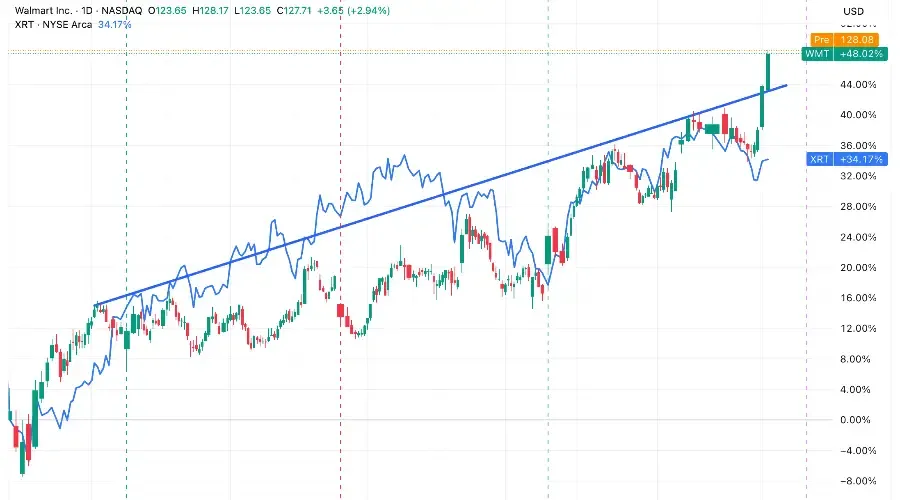
Walmart crossed the $1 trillion market capitalization mark on Tuesday morning, becoming only the second retailer in history to reach that milestone after Amazon at $2.6 trillion. The stock closed up 2.9% at $127.71, extending its annual gain to 28%. This revaluation has little to do with traditional retail metrics and everything to do with how markets are repricing “old economy + AI.”
For traders watching retail through XRT or tracking broader sector rotation, the message is clear: Walmart is no longer valued as a brick-and-mortar retailer. It is increasingly priced as a technology-enabled logistics and operations platform that happens to sell groceries.
The valuation gap tells the story. Walmart trades at 32x forward earnings, while Target sits at 18x. This divergence isn’t about store traffic or same-store sales. It reflects confidence that AI-driven operational efficiency is producing measurable and repeatable margin expansion. One company has demonstrated execution. The other has not.
What Actually Happened
On February 3 at 9:15 AM ET, Walmart surpassed the $1 trillion valuation threshold, driven by a 28% annual stock gain. The rally has been fueled by accelerating e-commerce growth, sustained investment in AI and automation across supply chain and inventory systems, and leadership continuity under CEO John Furner (Wall Street Journal).
The milestone occurred during a session when technology stocks were under pressure from AI disruption concerns. The Nasdaq fell 1.43%, while enterprise software names such as Salesforce and ServiceNow dropped roughly 7%. In contrast, Walmart gained 2.9%, a divergence that signals institutional capital rotating away from uncertain AI narratives and toward companies delivering proven execution.
Walmart’s omnichannel transformation underpins this revaluation. E-commerce growth has exceeded 20% for eight consecutive quarters. At the same time, AI-driven inventory and demand forecasting systems have lifted gross margins by 80–120 basis points annually since 2023. Markets reward that combination of digital growth and operational leverage with technology-like multiples rather than traditional retail valuations.
Why This Matters
The headline gain is straightforward: Walmart shareholders captured 28% over the past year, compared with an 11% return for the broader retail ETF (XRT). The more important implication is what this says about capital flows.
On Tuesday, XRT rose 0.8% even as the S&P 500 fell 0.84%. That kind of divergence typically signals defensive rotation, where investors favor businesses with stable demand and improving margins over growth narratives reliant on future promises. Walmart’s peers benefited modestly: Target gained 1.4%, Costco rose 0.9%, while Amazon declined 1.6%.
Walmart’s valuation highlights how far market perception has shifted. Its 32x forward P/E is comparable to mid-cap software companies. On a price-to-sales basis, Walmart trades at 1.47x, above Costco’s 1.2x but below Amazon’s 2.6x. That positioning implies markets are assigning a 40–50% probability that Walmart evolves into a more Amazon-like hybrid platform over the next three to five years.
The mechanism behind this repricing is straightforward. Walmart’s use of machine learning for demand forecasting has reduced inventory carrying costs by 12% and lowered out-of-stock instances by 18%. At $680 billion in annual revenue, a 100-basis-point margin improvement translates into roughly $6.8 billion in incremental operating income. Capitalized at 25-30x, that efficiency alone adds $170–200 billion to equity value.
Options activity supports the thesis. Call buying in April $130–135 strikes rose to 62% of total volume, with open interest building toward the $135 level. The flow suggests positioning for continuation rather than distribution.
What to Watch Next
Over the next 30-45 days, three developments will test whether Walmart’s valuation holds.
1. Target earnings (February 25, tentative)
If Target reports e-commerce growth above 15% alongside margin expansion tied to AI efficiency, it validates that operational AI is becoming sector-wide rather than Walmart-specific. That outcome would support Walmart’s premium. A miss, particularly sub-10% digital growth or margin compression, would reinforce Walmart as an execution outlier and could raise questions about whether its multiple is sustainable.
2. Q1 2026 retail sales data (March 15)
Walmart’s valuation assumes consumer resilience. At 32x forward earnings, the stock is priced for near-perfection. Retail sales growth below 2% month-over-month or negative revisions would raise the risk of multiple compression back toward the retail average near 22x.
3. Amazon earnings (February 5 after-hours)
Amazon represents the long-term endpoint markets are implicitly modeling for Walmart. If Amazon shows retail margin expansion alongside 25%+ AWS growth, it validates the integrated tech-retail model at scale. Weak retail margins would challenge the assumption that AI alone can permanently lift retail economics.
The Cross-Story Connection
Walmart’s milestone contrasts sharply with Gartner’s recent 20% decline. Together, they show where AI delivers measurable ROI today and where it remains uncertain.
Gartner’s enterprise clients are deferring AI spend because returns are difficult to quantify. Walmart’s AI use cases - inventory optimization, logistics routing, demand forecasting—produce immediate and measurable results. A 12% reduction in inventory costs equates to more than $8 billion in annual savings. There is no ambiguity in the outcome.
The gap narrows only when enterprise AI moves from experimentation to execution. AWS and Google Cloud earnings this week will help determine whether that shift is underway.
The Question Traders Should Ask
Is Walmart’s $1 trillion valuation fairly pricing operational AI excellence, or is it assuming an Amazon-like transformation that may not fully materialize?
The answer lies in margins. Continued expansion of 20-30 basis points per quarter would justify the multiple. A stall would leave Walmart as a strong business but a vulnerable stock.
Key technical levels remain $135 resistance and $120 support. Sustained closes above $135 with volume above 18 million shares confirm accumulation. A breakdown below $120 on heavy volume would suggest the milestone marked a sentiment peak.
This analysis is for educational purposes only and is not investment advice. All trading involves risk. Verify all data independently and consult licensed professionals before making investment decisions.