
The Certainty Restoration Event: Why It Works
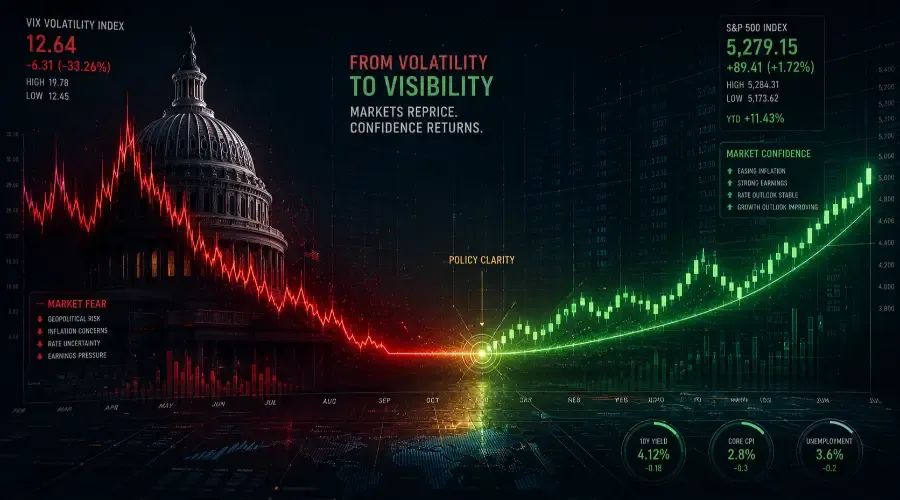
Leading up to a close election, institutional investors bid up option premiums to hedge against policy uncertainty, inflating the VIX and expanding the equity risk premium. The moment an undisputed winner is declared, that premium collapses. Options market-makers aggressively unwind short-gamma hedges, releasing trapped capital back into equities. The market rallies not because it prefers a specific candidate – but because the mathematical overhang of uncertainty has been resolved.
Important qualifier on the hook: Over the medium term, markets do care about policy direction – the party-specific sector rotations and Year 1 cycle dynamics that follow demonstrate this clearly. But in the immediate 24–48 hours post-result, certainty resolution dominates over policy preference.
The VIX compression trade is most powerful when:
- Pre-election VIX was elevated 3–6 points above its 90-day average (institutional uncertainty pricing)
- Prediction markets showed a genuine coin-flip probability (45–55% split)
- The result is confirmed cleanly – no extended counting period
Election Regime Matrix
| Market Phase | Core Indicator | Primary Sector Allocation | Tactical Rule |
|---|---|---|---|
| Pre-Election (Weeks −8 to −1) | VIX rises 3–6 points above 90-day average; tight polling | Expand cash; lower overall equity risk | Monitor VIX elevation as institutional uncertainty premium |
| Immediate Post-Confirmation (Hours 24–48) | Clear result declared; VIX collapses | Broad SPY exposure; XLRE/XLU as lower-beta alternatives | Deploy into broad equities to capture equity risk premium contraction |
| Policy Momentum Phase (Months 1–3) | 24-hour overshoot has corrected; institutional volume established | Republican: XLE, XLF, Defence XLI · Democrat: Clean energy XLB/XLI, XLK | Initiate party-specific weights; cap holding horizon at 3–6 months maximum |
| Governing Reality / Year 1 (Months 6–12) | Legislative setbacks emerge; macro reasserts | Neutralise allocations; shift toward fundamental drivers | Exit at first major legislative roadblock; prepare for historical Year 1 headwinds |
Which Channels Are Active
Channel 1 – Uncertainty Resolution (Both Parties, Immediate)
Regardless of winner, the election removes near-term policy uncertainty – corporate investment decisions deferred pending clarity can proceed, M&A transactions can advance, hiring plans can be finalised. This channel benefits the entire equity market, not specific sectors.
Channel 2 – Fiscal Policy Expectations (Party-Specific, Months 1–6)
The winning party's platform creates sector expectations – tax rates, regulatory environment, spending priorities. These expectations produce tactical sector rotation in the first weeks after the result. Critically, this channel is based on campaign promises, not implemented legislation. The rotation is often partially reversed within three to six months as governing reality diverges from the campaign narrative.
Channel 3 – Presidential Election Cycle (Four-Year Structural)
Yale Hirsch's documented cycle shows Year 3 (pre-election) is historically the strongest, and Year 1 (post-election) tends toward below-average returns as new administrations implement policy changes. This is a statistical tendency with notable exceptions – 2017 was strong – not a mechanical sell signal. Treat Year 1 as a headwind to monitor alongside fundamental signals, not a standalone reason to reduce equity exposure.
Sector Scorecard
Broad Equity (SPY) – The Primary VIX Compression Trade – Immediate
Post-election relief rallies historically favour cyclicals and the broad market, not defensives. In 2016, XLF and XLE led. In 2020, XLK and XLY outperformed. The primary VIX compression trade is broad equity exposure via SPY – capturing the risk-on surge without betting on which specific sectors lead. The magnitude is larger in unexpected-winner scenarios where VIX had elevated more dramatically.
Real Estate (XLRE) and Utilities (XLU) – Lower-Beta VIX Compression Alternatives – Immediate
For investors seeking lower-beta expressions of the VIX unwind rather than the primary cyclical surge, XLRE and XLU offer rate-proxy exposure to the equity risk premium contraction. As VIX falls and policy uncertainty resolves, the cost of equity and debt issuance for highly leveraged REIT corporate structures declines structurally – accelerating multiple expansion even before any Federal Reserve benchmark rate changes occur. These are relative value alternatives to SPY, not the primary expression of the certainty restoration trade.
Financials (XLF) – Positive – 1–3 Months (Both Parties)
M&A transaction activity, deferred pre-election pending regulatory clarity, accelerates post-result regardless of winner. Investment banking fee pipelines resume. Historically, XLF has outperformed in the immediate post-election period across both Republican and Democratic wins – for deregulation reasons in Republican scenarios and economic stimulus-driven credit growth in Democratic ones.
Republican Win – XLE, XLF, Defence XLI Outperform (Months 1–6)
Fossil fuel-friendly regulatory environment, financial deregulation, and corporate tax reduction expectations lift domestic-revenue sectors. Defence sub-sector benefits from increased spending expectations.
Democratic Win – Clean Energy within XLB/XLI, XLK Outperform (Months 1–6)
Renewable energy investment tax credits and infrastructure spending benefit clean energy manufacturers. XLK benefits from any fiscal stimulus package.
The Reversal Warning:
T. Rowe Price's research confirms party-specific election rotation reverses more often than it sustains. Within six to twelve months, outperformers driven by political expectations revert toward fundamental drivers. Cap all party-specific trades at three to six months maximum.
Historical Cases
2016 – The Definitive Surprise (Trump)
Every major poll showed Clinton winning with 70–85% probability. When Trump won, S&P 500 futures fell approximately 5% overnight, hitting the overnight futures price limit (note: this is distinct from the equity market circuit breakers triggered during regular trading hours). By the following morning, futures had recovered. Over the next three months, the S&P 500 rallied approximately 10%. XLF surged 20%+ on financial deregulation expectations. XLE rallied on fossil fuel expansion signals. The VIX, elevated above 22 before election night, collapsed to below 12 within two weeks – the largest post-election VIX compression in modern history.
2020 – The Expected Winner and the Delayed Result
Biden was the consensus favourite, yet the result was not confirmed for four days as mail-in ballots were counted. This extended uncertainty period sustained VIX elevation. When Biden's win was called on November 7, markets rallied 1.5% on the session as four days of accumulated uncertainty resolved simultaneously. Clean energy stocks surged. XLE initially fell before recovering. The modest post-election rally reflected that an expected winner winning produces far smaller certainty restoration than an unexpected winner.
Playbook
Before:
Track VIX against its 90-day average six to eight weeks ahead. A 3–6 point sustained elevation signals institutional uncertainty pricing. Monitor PredictIt or Polymarket – a genuine 45–55 coin-flip produces maximum post-result VIX compression.
Immediate Post-Result (Hours 1–48):
Primary trade: add broad SPY exposure for the certainty restoration rally – this captures the cyclical-led risk-on surge that historically outperforms defensives in the immediate period. Lower-beta alternative: add XLRE and XLU for the equity risk premium contraction if avoiding cyclical volatility.
Do not initiate party-specific trades in the first 24–48 hours. Historically, party-specific beneficiary sectors frequently overshoot in the first day as retail emotional bias and algorithmic headline-chasing drive prices past fundamental valuations. Waiting allows the overshoot to correct and institutional volume to establish a reliable entry baseline – though this rule applies as a useful heuristic rather than a mechanical law, as some elections show faster stabilisation than others.
Months 1–3:
Initiate party-specific positions after the 48-hour correction. Size for a three to six month maximum horizon.
Exit:
The first major legislative setback – a bill fails committee, a cabinet nominee faces unexpected opposition, or the policy agenda is scaled back from campaign promises – is the signal to exit all party-specific trades. Political narrative has decayed; fundamental drivers are reasserting.
Bottom Line Checklist
Hook: "In the immediate aftermath, certainty beats identity" – over the medium term, who wins matters
Primary VIX compression trade: SPY (broad cyclical rally), not XLRE/XLU specifically
XLRE/XLU: lower-beta alternatives, not the primary certainty restoration expression
Wait 48 hours before party-specific trades – overshoot heuristic, not a mechanical law
Republican win basket: XLE, XLF, defence XLI · Democratic win basket: Clean energy, XLK
All party-specific trades: 3–6 month maximum horizon, exit at first legislative roadblock
Year 1 weakness: a statistical tendency with exceptions – not a standalone sell signal
Circuit breaker note: 2016 overnight was a futures price limit, not an equity market circuit breaker
Q&A
Q: Why does the stock market rally after a confirmed election result regardless of which party wins?
A: This is a certainty restoration event. Leading up to a close election, institutions bid up option premiums to hedge policy uncertainty, inflating the VIX and expanding the equity risk premium. The moment an undisputed winner is declared, that premium collapses – options market-makers unwind short-gamma hedges, releasing trapped capital into broad equities. The market rallies because the mathematical overhang of uncertainty has resolved, compressing the risk premium for long-duration assets. It is a mechanical process, not a political preference signal.
Q: What is the 48-hour overshoot warning and why should traders wait before entering party-specific trades?
A: The immediate 24–48 hours following an election declaration are dominated by retail emotional bias and headline-chasing algorithms. Perceived political beneficiary sectors frequently overshoot past fundamental valuations, forcing day-one buyers to enter at a localised technical peak. Waiting 48 hours allows the emotional noise to clear and institutional volume to establish a reliable baseline entry for the true three-to-six-month policy implementation trend. Treat this as a useful heuristic – some elections stabilise faster – rather than a rigid mechanical rule.
Q: Why do political sector rotation narratives typically decay within three to six months?
A: Campaign rhetoric collides with governing reality. Legislative friction, split congressional control, and bureaucratic delays mean sweeping campaign promises are either severely diluted or stalled within the first 100 days. The definitive exit rule: treat party-specific allocations as short-term tactical windows capped at three to six months, with the first major legislative roadblock as the hard exit signal. At that point, fundamental macro drivers – Fed policy, earnings cycles, economic data – reassert dominance over political narratives.
Educational content only. Not investment advice. Historical election cycle patterns are statistical tendencies, not guarantees – each election occurs in a unique economic and geopolitical context.