
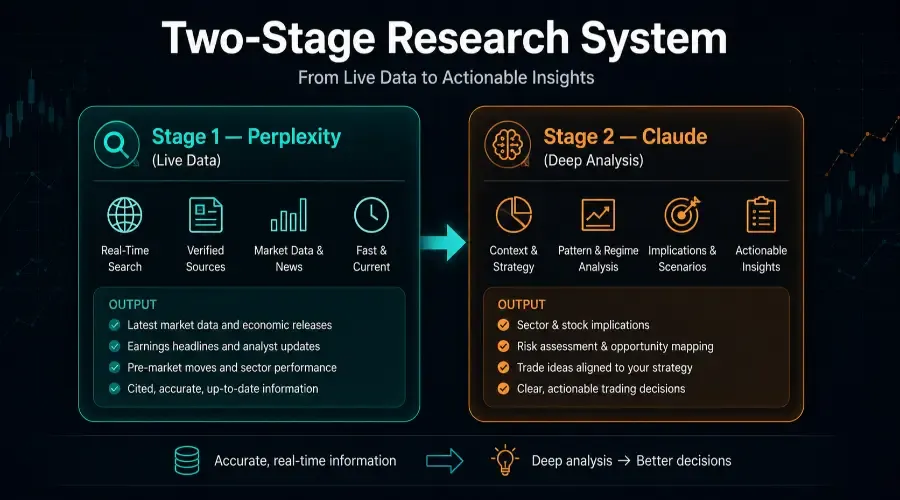
A trader who relies entirely on Claude for daily research is working with a tool that doesn't know what happened this morning. A trader who relies entirely on Perplexity gets current information without the analytical depth to know what it means for their positions. Neither tool, used alone, is sufficient for serious AI trading research. Used together – in a specific sequence, with a defined handoff – they produce something neither can produce independently: current, accurate information processed through analytical depth that turns raw data into actionable insight.
Traders who build this two-stage research system into their workflow are better equipped to make timely, well-analysed decisions than those using either tool in isolation. The mechanism is straightforward: Stage 1 gets the current reality into the session fast and accurately. Stage 2 produces the analytical depth that turns that reality into a trading decision framework.
Why Neither Tool Alone Is Sufficient
Claude's limitation in a trading context is the knowledge cutoff. It doesn't know what CPI printed this morning, what the Fed said yesterday, or which earnings report just dropped. Ask it about current market conditions without providing the data yourself and you're getting training-data approximations that may be months stale.
Perplexity's limitation is different. It's excellent at finding current information – pulling actual data from authoritative sources, synthesising recent news, presenting it with citations. What it doesn't do well is the sustained analytical work that turns information into trading insight. Ask Perplexity what today's CPI print means for sector rotation and you get a reasonable general answer. You won't get structured analysis calibrated to your specific strategy, current holdings, and the macro environment of the past six weeks.
The gap between these two tools is exactly where trading decisions live. The two-stage system closes it by using each for what it does best.
Stage 1 – Perplexity for Live Data and Real-Time Market Intelligence
Stage 1 is the retrieval phase. Perplexity's job is pulling current, sourced information that Claude can't provide: the actual CPI print versus consensus, pre-market sector ETF moves, earnings headlines, analyst rating changes, breaking news synthesis with citations.
The key discipline is selectivity. Extract the specific data points Stage 2 needs – the actual figure, the consensus, the surprise direction and magnitude, the initial market reaction. A Stage 1 output should be 150 to 200 words. A 600-word synthesis of everything published about the event introduces noise that makes the handoff harder to frame precisely.
One operational note: on fast-moving mornings, different sources may report slightly different consensus estimates or initial reactions. If Perplexity's results conflict, note the discrepancy explicitly in the handoff and flag it for Stage 2 to treat as uncertain rather than established fact. Additionally, in the first 60 seconds after an 8:30am macro release, Perplexity's indexing may lag the actual data. If the figure hasn't appeared within a minute, go directly to the primary source – the BLS page for CPI, the Fed's website for policy language – rather than waiting.
Stage 2 – Claude for AI-Driven Macro Analysis and Synthesis
Stage 2 is the analytical processing phase. Once it has verified, current data from Stage 1, Claude's strengths become fully available: sector-level implication mapping, regime contextualisation, pattern recognition across multiple inputs, and strategy-specific analysis calibrated to your holdings and parameters.
This is the core logic of the LLM trading system: retrieval tools are built for accuracy and citation; large language models are built for synthesis and structural reasoning. Keeping them separate prevents hallucination on facts and ensures the analytical engine is working from a verified, high-fidelity dataset.
How to Structure the Handoff
The handoff is where most traders introduce friction – either pasting the entire Perplexity output (context dumping that forces the model to find the signal inside the noise) or a single sentence that doesn't give Claude enough to work with.
The effective handoff has three components: the data (specific figures, consensus, surprise direction), the market context (initial reactions – what's moving and by how much), and the framing question (what specifically you need Stage 2 to analyse, grounded in your strategy parameters and current positions).
A properly structured handoff, using a below-consensus CPI morning as the example:
"Stage 1 data – CPI release this morning (verified against BLS release):
– CPI YoY: 3.1%. Consensus: 3.3%. Below consensus by 0.2 percentage points.
– Core CPI YoY: 3.8%. Consensus: 3.9%. Also below consensus.
– Month-over-month: +0.2% headline, +0.3% core.
– 10-year Treasury yield: down 8 bps to 4.18% as of 8:45am ET.
– S&P futures: +0.6%. Pre-market sector moves: XLU +1.2%, XLRE +1.0%, XLK +0.8%, XLF +0.4%, XLE flat.
Stage 2 request: Based on this data – use it for current facts; you may draw on historical sector tendencies from your training – assess: (1) which sectors historically benefit most from downside CPI surprises in environments where the 10-year yield has been above 4%; (2) whether the pre-market sector reactions are consistent with what this reading would historically produce; (3) what this reading suggests for the Fed's near-term posture."
Note the constraint phrasing: "use this data for current facts; you may draw on historical sector tendencies from your training." This resolves the logical contradiction of asking for historical pattern analysis while simultaneously instructing the model to use only what's been provided.
A CPI Morning – Both Stages Walked Through
The scenario: CPI releases at 8:30am. The trader needs to understand sector implications before the US market opens at 9:30am.
Stage 1 (8:35–8:43am): Three Perplexity searches. First: "BLS CPI report [month year] headline and core YoY actual vs consensus" – returns the 3.1% vs 3.3% headline print and 3.8% vs 3.9% core, with a direct BLS citation. Verified against the BLS release. Second: "market reaction CPI [date] treasury yields futures" – returns the 10-year yield move and futures snapshot. Third: "sector ETF pre-market moves CPI [date]" – returns the XLU, XLK, XLF, XLRE, XLE pre-market figures. Total: 8 minutes, all figures verified against primary sources.
Stage 2 (8:45–9:05am): The structured handoff above is submitted to Claude with the trader's existing XLK and XLF positions noted as context. The output: the below-consensus print was characterised as moderately positive for rate-sensitive sectors – meaningful enough to support the 10-year yield declining 8 basis points, but with core CPI at 3.8% (nearly twice the 2% target), insufficient to change the Fed's rate path materially. XLU's 1.2% pre-market move was consistent with its direct rate sensitivity. XLK's 0.8% move was consistent with the lower discount rate tailwind for growth stocks. XLF's positive pre-market move was flagged as slightly surprising – yield declines are modestly negative for net interest margins – suggesting the move was sentiment-driven rather than fundamentals-driven, warranting monitoring through the open. Total: 20 minutes.
By 9:05am, 25 minutes before the open, the trader had strategy-calibrated analysis of the morning's most important macro release – built on verified data and processed through analytical depth that real-time market intelligence tools alone cannot provide.
Building the System Into Your Workflow
The two-stage system works most efficiently when Stage 2 prompts are templates from your prompt library rather than written fresh each session. Build Stage 1 search queries into the template as a data sourcing checklist – this turns the two-stage system into a fully structured algorithmic research strategy rather than an ad-hoc combination of two tools. For macro event days specifically, a dedicated event-day template expecting the actual release number, consensus, initial rates reaction, and sector ETF snapshot produces consistently better Stage 2 output than a general briefing template.
Q&A: Mastering the Two-Stage Research System
Q: Why separate data retrieval from interpretation rather than using one tool for both?
Because retrieval and synthesis require fundamentally different processing modes. Retrieval tools are built for accuracy, citation, and search-based indexing – the foundation of reliable market data synthesis. LLMs like Claude are built for nuanced reasoning and structural logic. Keeping them separate prevents hallucination on facts and ensures your analytical engine has a verified dataset to work from. Combining both in a single Claude session means either the facts are stale or the analysis is shallow.
Q: What is the biggest mistake traders make when passing data from Perplexity to Claude?
Context dumping – pasting entire articles or raw search results. This dilutes context, introduces noise, and forces the model to find the signal inside irrelevant material. A high-leverage handoff in any two-stage research system requires extracting only the data points (the what) and the market context (how it moved) before asking for the analysis (why it matters). If a data point wouldn't change your trading decision framework, it doesn't belong in the handoff.
Q: How does this system prevent information overload on a fast-moving market day?
It forces a structural bottleneck. Requiring a handoff summary before any Stage 2 analysis occurs gives you a 60-second filter between raw information and analytical processing. If the data isn't relevant to your strategy parameters, it doesn't enter the Stage 2 prompt. This keeps AI trading research focused strictly on what drives your positions – rather than everything that's happening in the market simultaneously.