
BreakoutBulletin | Markets Intelligence | March 7, 2026
Educational commentary only. Not investment advice.
Here's a strange thing about how markets work. At 8:29 AM ET, traders had pretty much made up their minds about the Fed—one rate cut in all of 2026, maybe, and certainly nothing happening anytime soon. The CME FedWatch tool put June cut odds at about 25%. March was effectively off the table at 97% odds of a hold.
By 9:00 AM, that whole narrative had flipped. June cut odds jumped to 45%. Suddenly the market was pricing two cuts by year-end.
So what actually changed in those thirty minutes? Not just the payroll number—a headline-grabbing drop of 92,000 jobs—but what that number implied about the Federal Reserve's next move. The February employment report forced investors to rethink how the central bank navigates a labor market that's softening while wages stay sticky and oil hangs elevated on geopolitical tensions.
That shift matters because the Fed's reaction function now looks materially more complicated than it did just hours earlier. And with the FOMC meeting now just ten days away, this morning's data has quickly become the dominant variable in that policy discussion.
Primary Catalyst: The Rate Path Repricing
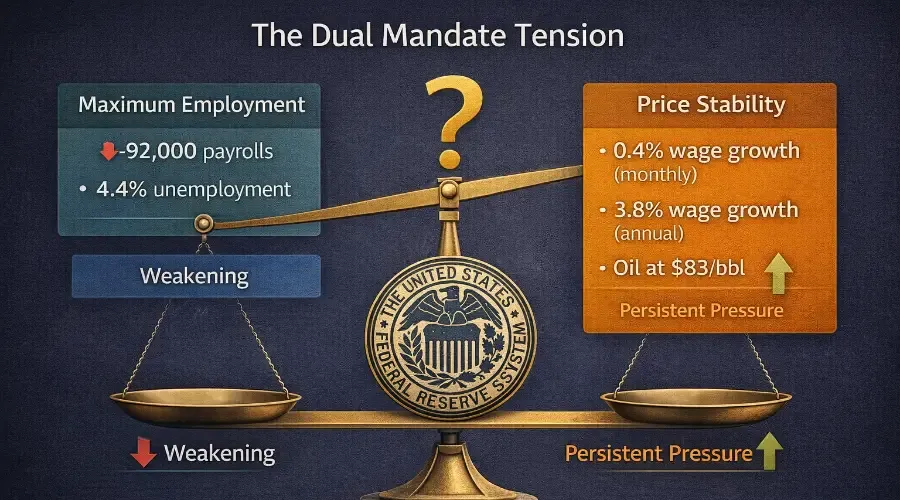
The Federal Reserve operates under a dual mandate—maximum employment on one side, price stability on the other. What made this morning unusual was that the February jobs report managed to put both sides under pressure at the exact same time.
The employment side points toward rate cuts. That much is straightforward. A 92,000 payroll decline. An unemployment rate ticking up to 4.4%. A household survey showing 185,000 fewer people working. Put those together and you've got the weakest labor market configuration we've seen in this cycle. Within the Fed's own framework, labor deterioration of this magnitude normally argues for some degree of accommodation.
In practical terms, markets translated that framework into higher probability of rate cuts later this year.
But here's the complication. The price stability side argues for caution. Average hourly earnings rose 0.4% month-over-month—a pace that's still running above what most economists would consider consistent with the Fed's 2% inflation target. Meanwhile WTI crude remains elevated, driven by those Iran headlines that won't seem to fade. Energy prices introduce an external inflation impulse that monetary policy can't directly control but has to somehow incorporate into its outlook.
That tension—labor weakening on one side, inflation risks lingering on the other—is exactly what Morgan Stanley economist Ellen Zentner was getting at when she described the Fed's "difficult position" earlier this week. The analytical framework itself is familiar. What's unusual is how clearly both sides of the mandate came under pressure in the same report, at the same time.
Reinforcing Signals: How Markets Priced the Shift
Once the payroll data crossed the tape, the repricing happened fast.
FedWatch data tells the story clearly enough. Before 8:30, June cut odds hovered around 25%. By early afternoon they'd pushed toward 45%. Year-end expectations shifted from one cut to two. The expected timing of the first move also moved forward—market chatter started focusing on July rather than September.
The bond market confirmed the move almost immediately. The 10-year Treasury yield fell about 5 basis points, settling near 4.15% shortly after the release. The 2-year yield declined more sharply, which makes sense—that's the maturity most sensitive to changes in Fed policy expectations. The yield curve steepened modestly, which is exactly what you'd expect when markets start pricing earlier monetary easing.
Equity futures were more cautious. They initially sold off on the payroll miss, then partially recovered as lower rate expectations provided some support for valuations. The recovery wasn't dramatic—investors still have to reconcile weaker labor data with questions about economic momentum—but the direction was clear enough.
Cross-Asset Confirmation
The repricing of the Fed's expected policy path didn't happen in isolation. You could see it rippling through other asset classes in ways that reinforced the same story.
Treasury markets confirmed it first. The decline in yields, particularly at the short end, signaled that bond investors were adjusting their expectations for the path of rates.
The dollar softened modestly. The DXY index was already below 99 heading into the report, down about 0.29% on the session. Lower expected interest rates typically reduce the yield advantage that supports the dollar, so the gradual weakening made sense.
Rate-sensitive sectors also reflected the shift. Utilities, real estate investment trusts, long-duration growth stocks—these tend to benefit from lower discount rates. Some of the stabilization in equity futures likely reflected early buying in these areas as markets recalibrated for a potentially easier policy environment.
There's one complicating factor though: oil. Normally, rate cuts weaken the dollar and support commodity prices. But if cuts are being priced because economic growth is weakening, that same growth slowdown could reduce energy demand. So you've got these opposing forces—geopolitical supply risk pushing oil up, potential demand weakness pulling it down. That tension explains why the oil market feels a bit stuck right now.
The March FOMC Constraint
Despite the shift in rate expectations, the March FOMC meeting itself remains unlikely to produce an immediate policy change. This is worth emphasizing because it's easy to get carried away with the repricing narrative.
A 45% probability of a June cut implicitly assumes that the Fed will gather more information before adjusting policy. Historically, the central bank rarely pivots based on a single employment report, especially when previous market expectations had assigned near-zero probability to a near-term move.
So the March meeting will probably function more as a communication event than a policy action. Markets will be watching a few specific signals:
The language around the "balance of risks." Any revisions to unemployment projections. Whether the dot plot shifts toward more than one cut in 2026.
Those signals could either reinforce the new rate-cut narrative or push back against it. Right now, the market is leaning toward the former interpretation, but that could change quickly depending on how Fed officials frame the data.
Structural Implications
What changed today isn't the level of interest rates but the expected path of those rates. That distinction matters because asset prices ultimately reflect discounted future cash flows. If markets believe rates will fall sooner, the present value of those cash flows increases.
In practical terms, that environment tends to support long-duration assets—growth equities, investment-grade credit, long-dated Treasuries. The math is fairly straightforward.
But the durability of this shift remains uncertain. Rate-cut expectations could change quickly if upcoming data contradicts the payroll signal. A few things to watch: a strong rebound in March payrolls, higher-than-expected CPI readings, or more hawkish Fed communication at the March meeting could all reverse this morning's repricing.
For now, that 45% June cut probability represents a market interpretation, not a policy commitment.
Portfolio Context
The policy repricing lands differently depending on what you're holding.
Growth-oriented portfolios benefit from lower discount rates because future earnings become more valuable in present terms. At the same time, the payroll weakness raises legitimate concerns about consumer spending and revenue growth. Those competing forces help explain why equities recovered only partially from their post-release decline.
Fixed-income portfolios experienced a more direct effect. The drop in Treasury yields generated immediate mark-to-market gains for investors holding duration exposure. If two cuts ultimately materialize in 2026, longer-dated bonds could benefit further as yields continue to compress.
Balanced portfolios face a more complicated allocation environment. The same data that supports adding duration also reinforces the need for inflation hedges, particularly given where wage growth and oil prices are sitting. In practice, many balanced strategies respond by adjusting exposures gradually rather than making abrupt allocation shifts. That feels like the right approach here.
Bigger Picture
The Federal Reserve's dual mandate tension shows up in every economic cycle, but it's rarely illustrated as clearly as it was in today's employment report.
The February data didn't offer policymakers a clear answer. Instead, it raised a more difficult question.
Labor market conditions appear to be weakening. At the same time, wage growth and energy prices remain elevated. The Fed now has to communicate a policy path that acknowledges both dynamics without committing prematurely to a specific course of action.
Markets responded by adjusting expectations rather than assuming a definitive outcome. That 45% June cut probability is really just a weighted average of several possible scenarios.
Between now and the March 17 FOMC meeting, every public comment from Fed officials—Waller, Daly, Goolsbee, the whole group—will be closely watched for clues about how policymakers interpret the data.
Today's payroll report introduced the question. The answer will emerge gradually as new data and policy communication reshape expectations over the coming weeks. But one thing's already clear: the Fed debate just got a lot more interesting.
BreakoutBulletin | Markets Intelligence | March 7, 2026
Educational commentary only. Not investment advice. All market data reflects observed session activity and should be independently verified. No content constitutes a recommendation to buy or sell any security.