
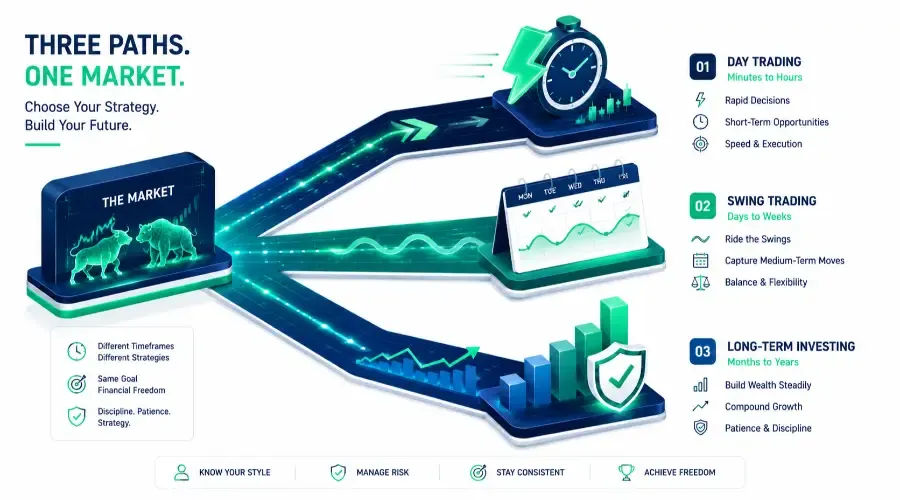
Three distinct approaches to stock market participation differ primarily in how long positions are held – from minutes to years. Each carries different capital requirements, time demands, regulatory constraints, and realistic success rates. Choosing the right approach means matching the method to your actual situation – not the one you're aspiring toward.
The Three Timeframes
Day trading: Positions opened and closed within the same trading session. No overnight exposure. Targets intraday price movements of 0.5 to 2%.
Swing trading: Positions held for two days to several weeks. Captures medium-term price movements driven by technical patterns, earnings catalysts, or sector trends.
Position trading (long-term investing): Positions held for months to years. Returns driven by fundamental business performance over time.
These aren't personality types – they're tools. Many experienced investors use a combination, with a core long-term portfolio and a smaller active component for shorter-term opportunities.
Day Trading: The Full-Time Discipline
Day traders open and close every position within the same trading session. No position is held overnight. The goal is to capture intraday price movements – typically 0.5 to 2% – across multiple trades per session.
What it actually requires:
Full attention from 9:30 AM to 4:00 PM ET. Real-time data feeds, direct access market platforms, and same-day news monitoring. The ability to make rapid decisions under uncertainty without emotional contamination from open positions. Continuous technical pattern recognition across multiple charts simultaneously.
Missing a position for 30 minutes can mean missing the full move – or holding through a reversal that turns a gain into a loss. A 10-minute distraction during a position is not acceptable in day trading the way it is in a swing trade or long-term position.
The infrastructure cost: Day trading carries ongoing operating expenses before any trade is made. Real-time data feeds typically run $10–100+ per month, Level II quotes add additional cost, direct-access platforms may charge monthly fees, and professional news services can range from modest subscriptions to Bloomberg Terminal at approximately $2,000 per month. These costs represent a real drag on profitability that must be factored into the calculation.
The regulatory constraint: Day trading in a margin account requires $25,000 or more in account equity to trade freely. Under the Pattern Day Trader (PDT) rule, accounts below $25,000 are limited to three day trades in any rolling five-business-day period. A fourth triggers a 90-day restriction to closing-only trades. This effectively makes true day trading inaccessible for most new investors with small accounts.
The realistic success rate: Research consistently documents that the large majority of retail day traders lose money over sustained periods, with a meaningful percentage losing substantially. The SEC includes specific disclosures about day trading risk in its investor education materials. Profitable day trading is possible – the bar for consistency is substantially higher than most newcomers expect.
Day trading fits when: Account equity exceeds $25,000, full-time availability during market hours exists, technical analysis skills are developed through documented practice (not theory), and profitability has been demonstrated over at least six months of paper or small-size live trading before scaling.
Day trading doesn't fit when: Account is under $25,000, any other commitments exist during market hours, technical analysis experience is minimal, or the goal is building long-term wealth rather than generating active income.
Swing Trading: The Active Middle Ground
Swing traders hold positions for two days to several weeks, targeting medium-term price movements driven by chart patterns, earnings catalysts, sector trends, or technical setups. The holding period sidesteps PDT restrictions entirely – a position held overnight is not a day trade regardless of how quickly it's subsequently sold.
What it actually requires:
30 to 90 minutes of research and monitoring per day rather than continuous screen time. Basic technical analysis competency: support and resistance levels, chart patterns (flags, breakouts, reversals), volume confirmation, and moving averages. The ability to hold a position through normal intraday volatility without reacting to noise. Willingness to accept overnight gap risk.
Overnight gap risk: News released after hours – earnings, regulatory decisions, management changes – can cause a stock to open significantly higher or lower than the previous close. A swing position held through an earnings report can gap 15% in either direction at the following morning's open. Many experienced swing traders avoid holding through earnings announcements entirely, or use options strategies to hedge the gap risk. Stop-loss orders (set to sell automatically if a position falls to a specific level) and position sizing (limiting any single position to a percentage of portfolio where the maximum gap loss is acceptable) are the primary tools for managing this risk.
The PDT relationship: Swing trading is specifically accessible to investors with under $25,000 because the holding period eliminates day trade counting. A position bought Monday and sold Friday is one trade, not a day trade. A position bought Monday and sold the following Wednesday is one trade. Swing trading allows active participation without the $25,000 threshold.
Capital requirements: Swing trading is accessible with $1,000 or more, though position sizing becomes constrained at very small account sizes. Most effective swing traders work with $5,000 to $25,000 before reaching the PDT threshold. At a $5,000 account, a 5% position is $250 – which on a $50 stock equals just 5 shares. This limitation can restrict stock selection and make it harder to achieve meaningful returns from a single setup.
Swing trading fits when: 30 to 60 minutes of daily market monitoring is available, basic technical analysis has been studied and practiced, account size is between $1,000 and $25,000 (or above), and overnight risk can be accepted and managed through position sizing.
Swing trading doesn't fit when: Daily monitoring is impossible, technical analysis is unfamiliar, or the goal is passive long-term accumulation rather than active position management.
Position Trading (Long-Term Investing): The Default That Outperforms
Position trading – holding for months to years based on business fundamentals – is what most people mean when they say "investing." It requires the least time, carries the fewest regulatory constraints, and has the strongest historical success rate of the three approaches.
What it actually requires:
Monthly or quarterly portfolio review (not daily). Fundamental business analysis: revenue growth, profit margins, competitive positioning, management quality, and valuation. The emotional discipline to hold through short-term price volatility without selling based on market noise. A written investment thesis for each position that can be revisited when prices move.
The historical return case: Broad market index funds – which require almost no individual stock analysis – have outperformed approximately 85 to 90% of actively managed large-cap funds over 15-year periods, per the S&P SPIVA scorecard. A $100 monthly contribution into a total market index fund starting at age 18 and continuing to 65 at 10% average annual returns accumulates approximately $1.2 million. Starting at 28 with the same contribution: approximately $470,000. The 10-year head start is worth $730,000 through compounding alone. The core principle: time in the market beats timing the market.
Tax efficiency: Positions held more than one year qualify for long-term capital gains rates (0%, 15%, or 20% depending on income) rather than ordinary income rates applied to short-term gains from day and swing trading. For a taxpayer in the 22% income bracket, that difference represents approximately 7 percentage points annually on gains – a meaningful drag on active trading returns.
The settlement advantage: Long-term investors almost never encounter settlement violations, PDT restrictions, or margin calls. The holding period eliminates the complexity of managing unsettled funds, counting day trades in rolling windows, or monitoring margin levels.
Capital time horizon: Strategy choice should match not just time availability but also the time horizon for the capital. If you need the money within 3 to 5 years, long-term investing in equities may not be appropriate regardless of its historical success rate. Shorter time horizons typically warrant more conservative positioning or a greater allocation to cash and fixed income.
Position trading fits: Every investor at every account size and experience level. The simplest implementation – a low-cost index fund with automatic monthly contributions and quarterly review – has historically outperformed more sophisticated approaches for most investors.
The Pattern Day Trader Rule: The Constraint That Shapes Strategy
The PDT rule is a FINRA regulation that applies to margin accounts with under $25,000 in equity. Understanding it is mandatory for any active investor.
The definition: Four or more day trades (buying and selling the same security on the same calendar day, including opening and closing a position as well as opening, closing, and re-opening on the same day) within any rolling five-business-day period triggers the PDT flag. The window rolls forward each day – it's not a weekly reset on Monday.
The trigger consequence: Once flagged as a Pattern Day Trader, you must deposit funds to bring the account above $25,000 by the following trading day, or the account enters a 90-day closing-only restriction. Under this restriction, you can close existing positions but cannot open new ones.
Working within PDT under $25,000:
Three trades in five days is a real constraint that forces selectivity. Use day trades only for the highest-conviction setups – not reflexive reactions to price movements. Hold positions overnight when the setup warrants it (converting a potential day trade into a swing trade). Switch to a cash account to eliminate PDT entirely – though settlement constraints (T+2, Good Faith Violations) replace it. Build toward the $25,000 threshold through consistent contributions.
Cash accounts as the alternative: Cash accounts are not subject to PDT restrictions. They trade on settled cash only – no margin credit extended. The constraint instead is settlement: proceeds from sales are unsettled for two business days, creating Good Faith Violation risk for rapid buy-and-sell cycles using the same capital. In a cash account, you can only trade with settled funds – meaning frequent trading requires maintaining a larger cash buffer or accepting the settlement waiting period. The trade-off: no PDT restrictions, but more careful cash management required.
Short Selling: The Risk-Asymmetric Strategy
Short selling profits from stock price declines. A short position produces a maximum gain of 100% (if the stock goes to zero) and unlimited maximum loss (if the price keeps rising). A stock shorted at $50 that rises to $500 produces a 900% loss on the position.
This asymmetric risk profile – bounded upside, unbounded downside – is the opposite of long equity positions (bounded downside at 100%, unbounded upside). Combined with ongoing borrowing costs (0.5 to 100% annually depending on availability), the regulatory requirements for margin accounts, and the historical upward drift of equity markets, short selling is structurally disadvantageous for most investors.
Short squeezes amplify this risk. When a heavily shorted stock rises sharply – as GameStop did in January 2021, from approximately $20 to $483 – short sellers face forced buying to limit losses, which drives prices higher and forces more buying in a feedback loop. Melvin Capital, a hedge fund heavily short GameStop, lost 53% of fund value in January 2021 alone.
Short selling is worth understanding to interpret market dynamics, read short interest data on stocks you own, and recognize squeeze potential in heavily shorted positions. Active short selling as a trading strategy is inappropriate for most investors given the structural risk profile.
Choosing and Combining Approaches
For investors with under $5,000 and limited market experience:
Position trading in diversified index funds. PDT restrictions effectively eliminate day trading. Time constraints typically eliminate effective swing trading. The historical success rate is strongest with long-term, diversified ownership.
For investors with $1,000 to $25,000 and 30 to 60 minutes daily:
A core position-trading portfolio (70 to 80% of assets) in index funds or fundamentally sound long-term positions, supplemented by a swing-trading allocation (20 to 30%) for active market participation. Paper trading for three to six months before committing real capital to active strategies is informative rather than performative. Note that paper trading removes emotional pressure, so success on paper doesn't guarantee success with real money–it should be used primarily to test mechanics and process, not as a profitability test.
For investors with $25,000 or more and full-time market-hour availability:
Day trading becomes accessible as a component, though position trading should anchor the portfolio. Documented profitability over six months of paper or small-size trading should precede scaling any active strategy.
The blended framework in practice:
70 to 80% of assets: long-term positions in index funds and fundamentally strong companies. Quarterly review.
20 to 30% of assets: active swing trades based on technical setups or near-term catalysts. Weekly monitoring.
Optional, if $25,000+ and full-time available: a small day-trading allocation for intraday opportunities.
This is the core-satellite approach used by many professional investors–a stable core of long-term holdings provides compounding stability, while smaller satellite positions allow for active participation and potential alpha generation.
The proportions matter less than the underlying discipline: the core portfolio provides compounding stability that active trading shouldn't jeopardize. Position sizing the active component such that a complete loss wouldn't materially damage the overall portfolio keeps the approach sustainable.
What's Your Approach?
If you have full-time market availability and $25,000+, day trading may fit, but it's a full-time profession requiring documented practice. Most investors should not start here.
If you have some market availability and $1,000+, swing trading offers the best balance of activity and accessibility. This is the most realistic starting point for active traders.
If you have limited availability or any account size, position trading is the evidence-based approach. This is the default that outperforms over time.
The Behavioral Reality: Which Personality Fits Which Strategy?
Beyond time and capital, each approach demands different psychological traits:
Day trading requires high stress tolerance, comfort with rapid decision-making under uncertainty, emotional detachment from individual trade outcomes, and the ability to maintain focus for hours on end. A day trader who feels every loss personally will not last.
Swing trading demands patience with open positions (holding through days of normal volatility), acceptance of overnight uncertainty, the discipline to follow a technical plan rather than reacting to each price bar, and the emotional stability to withstand occasional gap moves against the position.
Position trading requires conviction in investment theses, tolerance for portfolio volatility (a 20% drawdown on a long-term position is normal, not a crisis), the ability to ignore market noise and financial media, and the patience to see strategies play out over years.
Your personality traits should inform your strategy choice just as much as your time availability and capital do.
This content is for educational purposes only and does not constitute investment, legal, or tax advice. Investing in securities involves risk, including possible loss of principal. Always conduct your own research and consult a licensed financial professional before making investment decisions.
Free educational guide by BreakoutBulletin.com
Go deeper:
Choosing the right timeframe is as important as choosing the right stock. Day trading, swing trading, and long-term investing each suit a different combination of capital, time, and temperament - and the regulatory rules treat them differently. For the order execution mechanics that underpin all three approaches, the full guide connects everything.
→ Stock Market Trading: Orders, Rules & Strategies → The complete guide: order types, settlement, PDT, and trading styles - www.breakoutbulletin.com/article/stock-trading-mechanics-beginners-guide
→ The PDT Rule Explained → The $25,000 threshold, the 90-day restriction, and how to work within the rule - www.breakoutbulletin.com/article/pdt-rule-explained-the-25k-day-trading-limit-
→ Day Trading vs. Swing Trading vs. Position Trading → Matching the approach to your actual situation - www.breakoutbulletin.com/article/day-vs-swing-vs-position-trading-teens
→ Stock Market Myths vs. Reality → Five beliefs that cost investors money — and what the data actually shows - www.breakoutbulletin.com/article/stock-market-myths-vs-reality-teens