
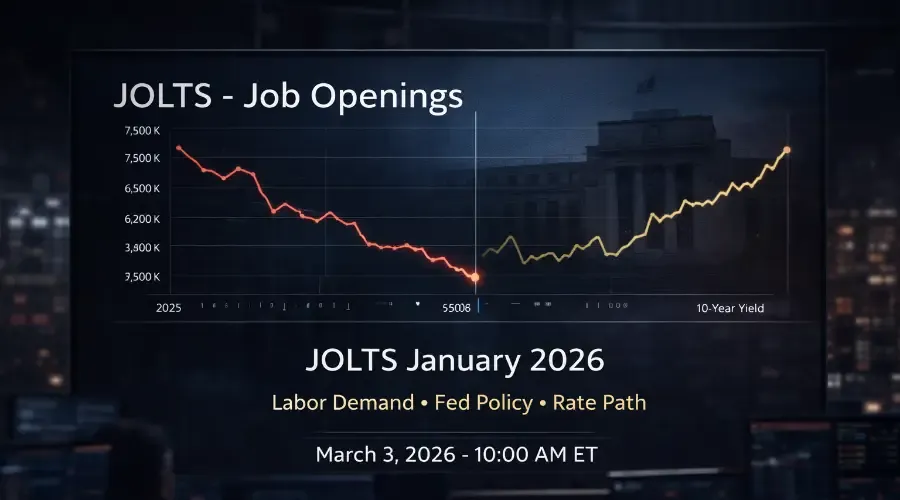
January 2026 Release - March 3, 2026 at 10:00 AM ET
Why This Data Matters Today
The Job Openings and Labor Turnover Survey - JOLTS - measures the total number of unfilled positions across U.S. employers at a point in time. In plain English: it tells us how much demand for labor exists independent of how many people are actually hired. A high openings number means employers want more workers than the labor market is currently supplying; a declining number means that demand is cooling.
The Federal Reserve watches JOLTS specifically because it informs one side of the inflation equation. When job openings are elevated relative to available workers, wage pressure tends to follow - and wage pressure is a persistent, services-driven inflation input that monetary policy cannot resolve quickly. In the current environment, with the Fed in a deliberate pause mode and an oil shock adding fresh inflation noise, JOLTS functions as a real-time calibration tool for how much labor-market slack - or tightness - actually exists beneath the headline unemployment rate.
What makes this particular reading important: January data captures the post-holiday employer demand reset, a seasonally significant moment when hiring intentions are recalibrated for the new fiscal year.
What Consensus Expects
The Bloomberg/Reuters survey consensus sits at approximately 6,542K job openings for January 2026, with an estimate range of 6,500K to 6,700K. The prior reading was 6,928K (November 2025, revised), with December 2025 printing at 6,542K - a meaningful step down from the 7,000K+ range seen through mid-2025.
The estimate range of roughly 200K is moderately wide by JOLTS standards, reflecting genuine uncertainty about whether December’s deceleration represents a durable trend or a seasonal distortion.
How Wall Street forms JOLTS consensus: Analysts use leading indicators - Indeed job postings data, LinkedIn hiring intent surveys, and regional Fed employment indices - to anchor their JOLTS estimates before the official release. These proxies are imperfect, which is precisely why JOLTS consistently produces larger-than-consensus surprises relative to its perceived analytical weight. The whisper number - an informal market expectation sitting slightly above consensus at approximately 6,600K - reflects analyst inference that January typically produces a seasonal rebound in posted positions as Q1 hiring cycles begin.
Historical Reaction Patterns
The last six JOLTS readings have produced a consistent and analytically important pattern: every print has come in above consensus, with the beat magnitude ranging from 1,249K to 2,291K above estimate. That is not a measurement error - it reflects a structural lag in how Wall Street models are anchoring JOLTS estimates below the actual labor market reality.
Pattern analysis: Six consecutive above-consensus prints is not noise - it is a systematic signal that JOLTS methodology is capturing labor demand that survey proxies consistently miss. The yield reaction has been asymmetric and relatively contained: large beats produced yield increases of 3-5 bps on average, but the equity reaction ranged from -1.1% to +0.8% on nearly identical surprise magnitudes. That equity inconsistency is the key teaching point: the S&P 500’s reaction to JOLTS is filtered through the broader macro environment at the time of release, not the JOLTS number alone.
Teaching frame: Historical reaction patterns establish the probable transmission range of a surprise, not its direction. When JOLTS has beaten by 2,000K+, the yield reaction has been contained to 5 bps - suggesting the bond market already partially prices labor tightness through other signals before the official release date.
The Three-Scenario Framework
All language below is conditional. These are transmission frameworks, not forecasts.
Scenario A - Hotter Than Expected (Above 6,700K)
Data prints above the top of the estimate range.
Fed narrative impact: Labor market demand is not cooling at the pace the Fed’s pause assumed. Rate cut odds for March and June compress further - a 25bps cut in June already has thin consensus support; a hot print erodes it further.
Treasury yield reaction: 10-year yields may test the upper range of recent trading around 4.10-4.15%. The 2-year yield, more directly tied to near-term rate expectations, would likely reprice more sharply, potentially steepening the yield curve inversion further.
Dollar impact: DXY may firm 0.5-1.0%, reflecting the rate differential trade - higher U.S. terminal rate expectations attract capital flows from lower-yielding currencies. EUR/USD and USD/JPY are the primary pairs to watch.
Equity sector rotation: Financials may absorb rotation inflows as rate-sensitive sectors benefit from a higher-for-longer environment. Tech, REITs, and consumer discretionary names with extended duration profiles face multiple compression pressure.
Full transmission chain: JOLTS beats - yields rise - dollar firms - gold faces headwind from rising real yields - Bitcoin and risk assets face mild pressure from tightening financial conditions narrative.
Scenario B - Cooler Than Expected (Below 6,400K)
Data prints below the bottom of the estimate range.
Fed narrative impact: Labor demand is softening more than the consensus soft-landing model assumed. This opens the analytical window for the Fed to begin considering rate cuts with more confidence - though a single month of data rarely shifts Fed communication materially.
Treasury yield reaction: 10-year yields may ease toward 3.90-3.95%, and the 2-year yield would price nearer rate-cut timing more aggressively. Duration assets - long-dated Treasuries, investment-grade credit - benefit from the yield compression.
Dollar impact: DXY softens modestly (-0.5%), as lower rate expectations reduce the dollar’s yield carry advantage relative to EUR and JPY.
Equity sector rotation: Tech, consumer discretionary, and REITs - the rate-sensitive, longer-duration equity categories - may recover from morning weakness. Financials face modest pressure as net interest margin projections decline at the margin.
Full transmission chain: JOLTS miss - yields fall - dollar weakens - gold benefits from declining real yields - crypto may recover as risk appetite improves with the softer rate narrative.
Scenario C - In-Line With Consensus (6,500K-6,600K)
When data lands within the expected range, the JOLTS number itself typically does not become the primary market driver. The S&P 500 reaction is likely contained to ±0.2%, with no sustained directional trend emerging from the data alone.
The session’s primary narrative reverts to its pre-existing drivers - in today’s specific context, that means geopolitics (U.S.-Iran) and individual earnings reactions from TGT, AZO, and BBY.
Watch for the secondary signals within the sub-components: the quits rate (voluntary resignations - a measure of worker confidence) and hires rate (actual hiring activity) often carry more forward-looking information than the openings headline. An in-line headline with a declining quits rate is softer than the headline implies. An in-line headline with a rising hires rate is structurally stronger than it appears.
The Fed Lens
The Federal Reserve’s current posture is explicitly data-dependent. CME FedWatch is pricing approximately 96% probability of a hold at the March 2026 meeting, with only 4% pricing a 25bps cut. The bar for a single JOLTS release to shift that probability meaningfully is high - a surprise of approximately 300K+ in either direction from consensus would be required to move March cut odds by more than 10 percentage points.
What the Fed specifically needs to see: a gradual, sustained decline in openings toward the 6,000K range - a level consistent with the pre-pandemic labor market’s equilibrium. A single month above or below that trajectory matters less than the directional trend across three to four consecutive readings. The Fed is watching JOLTS as a confirmation tool for a hypothesis it already holds, not as new information that fundamentally revises its framework.
Asset Class Sensitivity Map
Most sensitive - 2-Year Treasury Yield: Directly prices the timing of the next rate move. JOLTS has the most immediate transmission into short-duration bond pricing because it informs near-term Fed reaction function more precisely than any other labor release outside NFP.
Highly sensitive - 10-Year Treasury Yield: Responds to the terminal rate implication of the labor market read. A 3-5 bps reaction per large surprise has been the historical range over the last six readings.
Moderately sensitive - U.S. Dollar (DXY): Reacts to rate differential implications. The largest impact appears against JPY and EUR, where the yield gap is most sensitive to U.S. rate path changes.
Moderate - U.S. Equities (sector-specific): Index-level reaction is typically contained. Sector rotation - financials versus tech versus REITs - is where the real signal appears, not the headline SPY move.
Lower sensitivity - Gold: Responds to real yield changes (nominal yield minus inflation expectations). A JOLTS-driven yield move without a simultaneous inflation expectation shift produces a relatively muted gold reaction.
Least sensitive in this context - Bitcoin and crypto: Crypto’s JOLTS sensitivity is indirect - it operates as a risk-appetite proxy, and JOLTS only moves crypto meaningfully when the surprise is large enough to shift the broader risk-on/risk-off narrative at the index level.
How to Watch the Release
Release time: 10:00 AM ET, Tuesday March 3, 2026 via the Bureau of Labor Statistics.
The headline number to note first: Total job openings (seasonally adjusted), reported in thousands.
Sub-components that often carry more signal than the headline:
Quits rate: The percentage of total employment that resigned voluntarily. This is the Fed’s preferred measure of worker confidence and wage negotiating power. A declining quits rate signals workers are less willing to leave jobs - a leading indicator of wage pressure cooling.
Hires rate: Actual hiring activity, which tells you whether demand for labor is translating into employment growth or simply sitting as unfilled capacity.
Layoffs and discharges: A rising layoffs rate alongside declining openings creates a structurally different macro narrative than declining openings alone.
Teaching frame: Traders who react only to the headline openings number are reading one data point out of a four-part report. Professional analysts read quits and hires simultaneously - the combination tells a more complete story than any single component, and the market’s initial reaction to the headline often gets revised once the sub-components are absorbed in the following minutes.
DISCLAIMER:
This article is for informational and educational purposes only and does not constitute financial, investment, or trading advice. You are solely responsible for your own investment decisions and should consult a licensed financial professional before acting on any information in this post.