
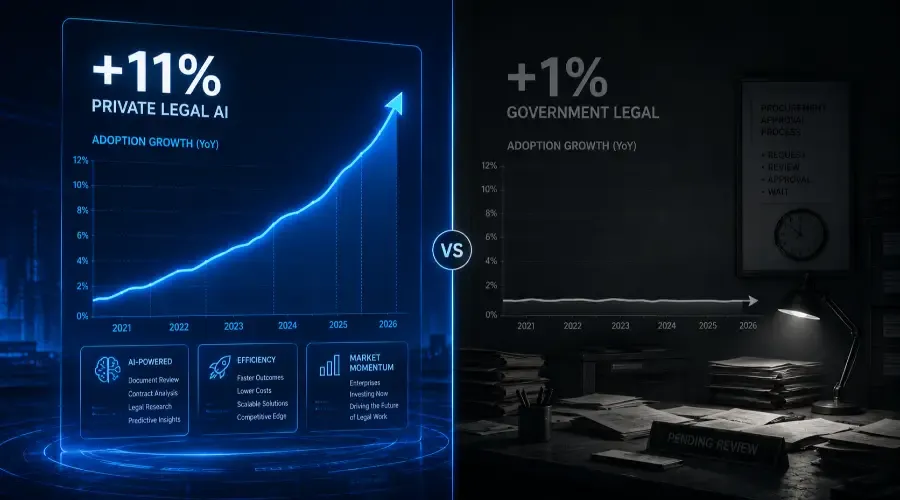
Thomson Reuters posted a clean Q1 earnings beat and rose 4% in premarket. The dividend increase to $2.62 per share - the 33rd consecutive annual hike - got most of the coverage. What did not get coverage was a disclosure buried twelve minutes into the Q1 2026 earnings call: the government legal sub-segment grew 1% organically while private-sector legal ran at 11% (as disclosed by the CFO), a gap of roughly 10 percentage points that the blended 9% headline completely conceals. It is a structural drag on the segment that carries the most weight in Thomson Reuters' AI revenue thesis, and it traces directly to prior-period contract cancellations that management flagged but did not quantify in the press release headline.
All figures in this post are based on publicly available data. Derived thresholds are labelled as such. Actual outcomes can differ materially.
What the Headline Number Obscures
The Q1 2026 press release reported Legal Professionals organic revenue growth of 9%. That figure is accurate. Thirteen of 17 analysts covering TRI carry a Buy or Outperform rating partly on that Legal growth trajectory.
The 9% is a blend. CFO Mike Eastwood disclosed on the Q1 2026 earnings call that Legal Professionals excluding government accelerated to 11%, up from 9% in Q4 2025. Government legal grew 1% year over year. When a sub-segment at 1% averages into a segment running at 11%, the blended headline obscures both the private-sector strength and the government channel weakness.
Most retail earnings coverage stopped at 9%. The transcript is where the split lives.
The Government Legal Business: What It Is and Why It Matters
Thomson Reuters' Legal Professionals segment includes large law firms, mid-size and small law firms, and government legal departments - federal, state, and local agencies that use Westlaw for legal research and related compliance tools.
Government legal is not the largest sub-segment by revenue. Thomson Reuters does not break out the exact government share in its 6-K filings, but based on prior earnings commentary and sell-side estimates, government legal is estimated to represent roughly 15–20% of total Legal Professionals revenue. Historically, TRI's government legal sub-segment has grown in the low-to-mid single-digit range over the past several years, making the current 1% print a meaningful deceleration from its typical trend line. The estimate is based on triangulating prior segment commentary and is used here for illustrative arithmetic; the exact figure may vary, but the directional drag is what matters — and it is covered by the derived threshold disclaimer at the top of this post.
The arithmetic confirms the drag: with the government sub-segment estimated at 15–20% of Legal Professionals, the disclosed 11% private-sector growth and 1% government growth mathematically produce the 9% blended headline. This also implies the government weight is likely at the higher end of that range (closer to 20%) than the midpoint. Government recovering from 1% to even 4–5% would add roughly 60–80 basis points to the blended Legal growth rate, assuming a 20% weight. Government remaining at 1% or deteriorating further would require private-sector legal to sustain its current 11% pace or accelerate further to hold the 9% blended rate through H2. That is possible given Westlaw Advantage pipeline commentary, but it is a narrower margin for error than the headline suggests.
Two characteristics make this sub-segment disproportionately important despite its moderate size. First, it is a high-retention, multi-year contract business. Government agencies do not switch legal research platforms frequently. When they cancel or downgrade, the decision plays out over several renewal cycles rather than a single quarter. Second, it sits largely outside the AI upgrade cycle driving the private-sector acceleration. Law firms are upgrading to Westlaw Advantage and CoCounsel because billable-hour economics create direct ROI from faster research. Government legal departments operate under different procurement constraints and technology adoption timelines.
The result is a sub-segment where the AI-driven revenue acceleration lifting the rest of Legal Professionals does not apply at the same pace, and where prior-period weakness compounds across renewal cycles rather than correcting quickly.
What Management Said - and What They Did Not Say
CFO Mike Eastwood stated on the Q1 2026 earnings call that the government slowdown traced to prior cancellations and downgrades in H2 2025, framing them as known headwinds the company was lapping.
Two things were not stated with precision. First, the specific dollar value of those cancellations was not disclosed. Second, management did not commit to a specific recovery quarter. That absence is the signal. Eastwood used language consistent with H2 2026 normalisation but did not anchor a quarter with the clarity typically applied to product launch timelines or margin targets. When a company can see the recovery, they usually say so with specificity. The lack of a quarter-level commitment suggests internal visibility on this sub-segment is limited.
What management confirmed: 2026 full-year guidance was reaffirmed. The framing is temporary drag from a known prior-period event. For the verbatim wording, reference the Q1 2026 6-K filed with the SEC or the full earnings call transcript on Thomson Reuters' investor relations page.
The distinction this angle tracks is between temporary drag with a visible endpoint and temporary drag with an unspecified one.
The AI Thesis Depends on Legal, and Legal Has a Weak Flank
Thomson Reuters' investment case in 2026 rests on GenAI-enabled ACV penetration rising from 30%, Big Three organic growth sustaining near 9.5%, and adjusted EBITDA margin expanding 100 basis points to approximately 40%. All three connect to Legal Professionals, the largest of the Big Three and the segment where Westlaw Advantage and CoCounsel are furthest into their commercial cycles.
Government legal at 1% does not break any of those pillars on its own. But if the segment does not recover in H2 2026, the blended Legal growth rate compresses in Q3 and Q4 exactly when the private-sector AI cycle faces tougher year-over-year comparables. A 1% government drag while sustaining 9% overall is manageable today. It is a tighter margin for error in H2.
The Ripple Beyond TRI
The government legal slowdown is a TRI-specific data point, but it may carry a broader signal for government-facing software vendors.
RELX (RELX), whose LexisNexis division competes directly with Westlaw in government legal research, has not yet disclosed a comparable government sub-segment metric for 2026. If Thomson Reuters' government weakness reflects budget-driven procurement freezes rather than a TRI-specific contract loss, RELX's government legal business likely faces the same pressure. Wolters Kluwer (WKL), which serves government tax and compliance functions, is a secondary read on the same theme.
Beyond legal research, the signal extends to government-facing enterprise software more broadly. Palantir (PLTR) and Booz Allen Hamilton (BAH) both carry significant federal contract exposure. Neither is a direct revenue peer to TRI's legal segment, but both serve as canaries in the federal budget coal mine. If the H2 2025 cancellations that hit Thomson Reuters reflect a broader pattern of federal agencies reducing or deferring software contracts, those names carry a comparable monitoring risk. The specific data point to track: whether RELX's next earnings disclosure includes any commentary on government legal research growth rates diverging from its commercial law segment.
The Numbers That Frame the Risk
Legal Professionals organic growth, Q1 2026: 9% overall; 11% excluding government; 1% government. Source: Q1 2026 earnings call, CFO Eastwood.
Big Three full-year 2026 guidance: approximately 9.5% organic growth. Legal Professionals guided at 9%. Source: Q1 2026 earnings transcript.
Adjusted EBITDA margin guidance: approximately 40% for full-year 2026, up 100 basis points versus 2025's 39.2%. Source: Q4 2025 earnings release and Q1 2026 reaffirmation.
GenAI-enabled ACV: 30% of total ACV as of March 31, 2026, up from 15% five quarters ago. Source: Q1 2026 earnings call, CFO Eastwood.
The arithmetic that matters: the disclosed 11% private-sector legal growth and 1% government growth blend to the 9% Legal Professionals headline, with the government sub-segment's estimated 15–20% weight implying the drag is concentrated at the higher end of that range. Government recovering to 4–5% would add approximately 60–80 basis points to the blended rate, assuming a 20% weight (illustrative). Government remaining at 1% requires private-sector legal to sustain its current 11% pace through H2 to hold the 9% blended guidance. All figures in this paragraph are derived approximations based on the disclosed blended and ex-government growth rates.
Scenario Analysis
The following is a hypothetical illustration for educational purposes only and does not constitute a trade recommendation.
Scenario A — Government normalises in H2 2026. H2 2025 cancellations roll off the comparable base. Government legal returns to mid-single-digit growth by Q3. The Legal Professionals blended rate holds at 9% or above. Full-year Big Three guidance of 9.5% is achievable. Equity shares are the instrument commonly associated with a thesis requiring two to three quarterly confirmation events — this is not a trade recommendation.
Scenario B — Recovery extends into 2027. H2 2025 cancellations prove deeper than disclosed, or additional downgrades occur in H2 2026. The blended Legal rate compresses toward 7–8% in Q3 and Q4. LLM cost headwinds in Q2 do not fully abate. Full-year EBITDA margin lands at 39% rather than 40%. In combination, these factors may trigger a downward revision to 2027 guidance on the Q4 2026 call — the event most likely to re-price the stock.
Scenario C — Government deteriorates further. New federal cancellations drive government growth negative. The blended Legal number falls below 8%. This scenario is not implied by current management commentary and carries low probability. A single large federal contract cancellation - the type that does not surface in transcript summaries until it hits the quarterly filing - would be the leading indicator.
The Metric to Track
Government legal organic growth in Q2 2026. This is the first quarter where H2 2025 cancellation comparables begin to roll. Growth above 3% signals recovery on track. At or below 1%, the timeline is slipping. Watch whether Eastwood's language shifts from "temporary drag" to anything that defers the endpoint further.
Legal Professionals blended growth ex-government in Q2 2026. If private-sector legal holds at 11% or above while government remains weak, the AI upgrade cycle is absorbing the drag. If private-sector legal dips toward 9% simultaneously, the blended rate compresses and full-year Legal guidance is at risk.
The Q2 2026 earnings call, typically in early August, is the first resolution event. The Q1 6-K at sec.gov/cgi-bin/browse-edgar (search TRI) contains the segment-level management discussion for readers who want the primary filing.
Risk Management: The Line in the Sand
This thesis may be invalidated if Thomson Reuters reports Q2 2026 government legal organic growth above 4% in the earnings transcript, combined with a Legal Professionals blended rate at or above 9.5%. At that point the H2 2025 cancellation drag is clearing faster than the absence of a specific recovery commitment implied, the temporary drag narrative is confirmed, and the government risk angle no longer applies.
The thesis strengthens if Q2 2026 government legal remains at or below 1% and management's language on the earnings call shifts from "we expect normalisation" to language that defers the recovery further. That language shift is the signal that what was characterised as a temporary drag is extending into a multi-quarter structural headwind.
This analysis is for educational purposes only and does not constitute investment advice. All figures are based on publicly available data as of June 2026. Derived thresholds and hypothetical scenarios are for educational illustration only and do not constitute trade recommendations. Instrument type references are educational context, not personalised financial advice. Please consult a qualified financial advisor before making investment decisions. BreakoutBulletin does not hold positions in any securities mentioned.