
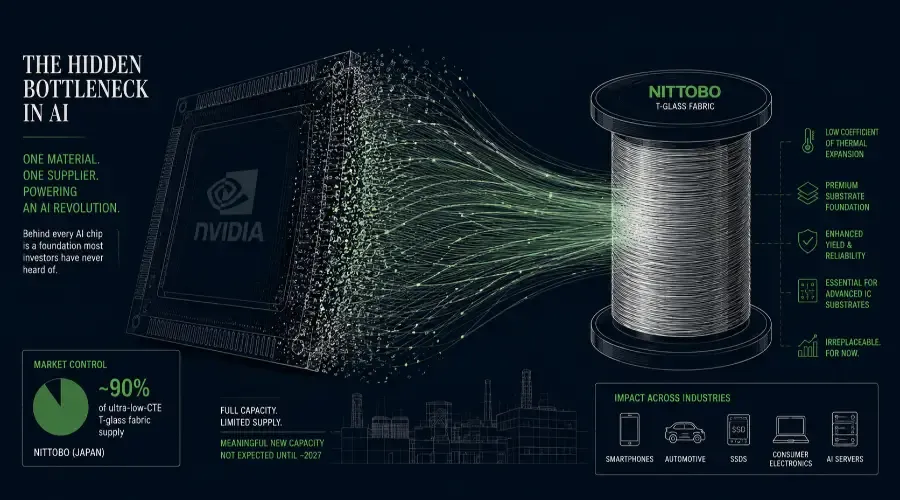
Nvidia ($NVDA) dominates GPU design, but a quiet Japanese supplier controls 90% of the specialized T-glass required for next-gen AI substrates (TSE: 3110).
By Manish T. · BreakoutBulletin
The AI-hardware shortage gets told in glamorous parts: GPUs, memory, advanced packaging. Underneath all of them sits a material almost no one outside the circuit-board industry has ever heard of, and it may be the tightest choke point of all.
It is a specialized woven fiberglass cloth called T-glass, and roughly 90% of the world’s supply of its most demanding grade comes from a single Japanese company. As AI servers grow denser and more complex, they need more of it, and there is not enough to go around. This is the quiet, deep bottleneck in the stack, the kind that never makes a headline until the boards it goes into start slipping.
What T-Glass Actually Is
Every circuit board and chip substrate is built on copper-clad laminate, and the structural skeleton woven inside that laminate is fiberglass cloth. T-glass is a premium grade of it, defined by a low coefficient of thermal expansion – an engineer’s way of saying it barely changes size when heated.
That property is exactly what a large, hot AI chip substrate needs: it keeps the substrate from warping during the high-temperature manufacturing of advanced packaging and in operation, which directly improves chip yields and thermal stability. It costs several times more than the standard fiberglass used in ordinary electronics, and as chips get bigger and run hotter, it stops being optional. T-glass is the unglamorous foundation the entire chip is built on, and the industry has quietly become dependent on it.
One Company Makes Almost All of It
Here is the problem in a sentence. Japan’s Nittobo makes roughly 90% of the world’s supply of this specific ultra-low-CTE glass fabric used in advanced IC substrates, and about 60 to 70% of the broader high-performance glass cloth market, according to supply-chain research and trade reports.
Its production lines are already running around the clock at full load, and meaningful new capacity is not expected to arrive until roughly 2027. When one supplier controls 90% of a material that AI servers cannot be built without, and demand is surging while supply is effectively fixed for two years, the result is predictable: allocation, stretched lead times, and steep price increases. Nittobo raised prices on the order of 20% in 2025 and another 20 to 30% in 2026, and premium T-glass now carries a scarcity premium of roughly 40% over late-2025 levels, based on industry pricing data.
Chipmakers have taken the situation seriously enough that Nvidia and AMD have reportedly sent staff to Nittobo’s headquarters to secure better allocation. When your buyers are flying to your factory to plead for supply, you are the bottleneck.
Why Demand Is Compounding
The accelerant is the newest generation of AI hardware. Nvidia’s Rubin-class systems use larger substrates, higher layer counts, and cableless rack designs that add midplanes and orthogonal backplanes, and inference-focused racks pack more compute trays into every unit.
Each of those changes multiplies the amount of high-end glass cloth a system consumes; according to PCB industry analysis, some designs roughly double the T-glass content in core layers while adding more layers overall – a figure derived from teardown assessments of substrate dimensions and layer stacks. So demand is compounding on two axes at once: more AI servers being built, and more T-glass required inside each one. A material that was already concentrated on the supply side is now facing a demand curve that bends sharply upward with every hardware refresh.
The Part That Reaches Everyone Else
This is where a niche AI-server story becomes a broad one. AI companies do not buy T-glass directly; they buy the premium substrates that sit under GPUs, and those substrates absorb the T-glass.
With hyperscalers’ deep pockets securing allocation for high-end AI substrates, the same scarce material is drained away from the lower-priority substrates and standard boards used in smartphones, cars, solid-state drives, and consumer electronics. Analysts tracking the PCB materials market have projected that makers of those lower-tier substrates could face double-digit percentage shortfalls, and small and mid-sized circuit-board factories, the ones without long-term supply contracts, have already been forced to pause production runs for lack of glass cloth.
So a fiberglass shortage that begins in AI servers quietly resurfaces as higher costs and longer waits in products that have nothing to do with AI. It is the same spillover pattern as the memory squeeze, one layer further upstream. For a typical smartphone main board, the actual T-glass content might be measured in grams, but the cost increase on the substrate can multiply downstream, adding cents to dollars per unit – a margin hit that becomes meaningful across tens of millions of devices. This is why the shortage is a cross-industry cost story rather than a data-center curiosity.
Substitution and Workarounds (Why the Ceiling Isn’t Completely Rigid – Yet)
No supply chain is perfectly inelastic. Board designers have some flexibility: they can use lower-cost, higher-CTE glass fabrics in non-critical layers of a substrate, reduce layer counts where possible, or explore alternative reinforcement materials.
However, these trade-offs come with costs – potential yield impacts, reduced thermal headroom, or a ceiling on signal integrity that the most advanced AI packages cannot tolerate. So while substitution does happen at the margin, it serves mainly to shift the shortage downstream rather than eliminate it. The premium AI segment remains firmly tied to T-glass, and the workarounds only reinforce why it is the bottleneck that matters most.
Why It Won’t Resolve Quickly
Concentration this severe does not unwind on a short schedule. Qualifying a new T-glass supplier is not a purchase order; it is a long validation process, because a reinforcement material that fails under the thermal stress of advanced packaging can ruin an entire board, and no chipmaker will risk that lightly.
Emerging producers in Taiwan are reportedly having samples tested in Nvidia’s labs, which is encouraging, but qualification at volume takes time. Even Nittobo’s own expansion, a multi-billion-yen investment to lift capacity, is not expected to deliver meaningful relief until around 2027. Until a second qualified source scales or that new capacity lands, the roughly 90% dependency on a single company stands, and with it the pricing power that comes from being nearly the only game in town.
Where T-Glass Sits in the AI Stack
Step back and T-glass is the deepest input in a chain of AI-hardware bottlenecks. It is the raw material woven into the substrates that advanced packaging then assembles, and it is one more piece of the specialized hardware showing up in the trade data as AI-related imports surge.
Chips, memory, packaging, and power are each a constraint on how fast the build-out can proceed; T-glass is the material foundation sitting underneath all of them, and it carries the same signature every layer of this stack shares: concentrated supply, long qualification and build-out cycles, and a cost that eventually shows up somewhere less visible than the headline.
What Would Change the View
The constraint eases if Nittobo’s expansion arrives on schedule and at good yield, if a second supplier clears qualification and scales, or if demand for high-end AI substrates cools.
It deepens if each new generation of AI hardware keeps raising the T-glass content per system while supply stays fixed. The signposts worth watching are concrete: news of a second supplier passing qualification at volume, Nittobo’s capacity timeline holding or slipping, and whether the scarcity premium on premium grades keeps climbing. As long as those point the wrong way, the material sitting quietly under every AI board remains one of the harder constraints in the entire supply chain to relieve.
The Bigger Picture
The AI boom keeps teaching the same lesson: its real limits are rarely the glamorous parts. Not the GPU, not the model, but the boring, concentrated, slow-to-scale inputs underneath.
T-glass is the most extreme version yet, a material most investors have never heard of, produced almost entirely by one company, quietly setting a ceiling on how fast AI servers can be built and rippling into unrelated electronics along the way. For those tracking the supply chain, the company at the center of this dynamic – Nittobo – is publicly listed (TSE: 3110), and its pricing power reflects the dynamics described here. The durable habit for reading this cycle is the same one it rewards over and over: trace the chain to its narrowest point. More often than not, that point turns out to be something unglamorous, far upstream, and held in very few hands.
Note: Industry, pricing, and supply figures are based on public sources including supply-chain research, trade reporting, and PCB materials analysis available as of the publication date.
Specific data points – such as market share estimates and price increases – reflect the consensus of multiple analyst reports and trade journal accounts; exact figures may vary by source and segment definition.
Related Reading
It's Not the Wafer Anymore: How Advanced Packaging Became the Binding Constraint on AI Chips
Follow the Cargo: The AI Boom Is Hiding in Plain Sight in the U.S. Trade Deficit
The Memory Shortage Behind the AI Boom: How HBM Demand Is Draining Conventional DRAM
Disclaimer
BreakoutBulletin publishes educational and analytical content only. Nothing here is investment, financial, legal, or tax advice, or a recommendation or solicitation to buy, sell, or hold any security.
Past performance does not indicate future results. Readers should conduct their own research and consult a qualified, registered financial adviser before making any decision.