
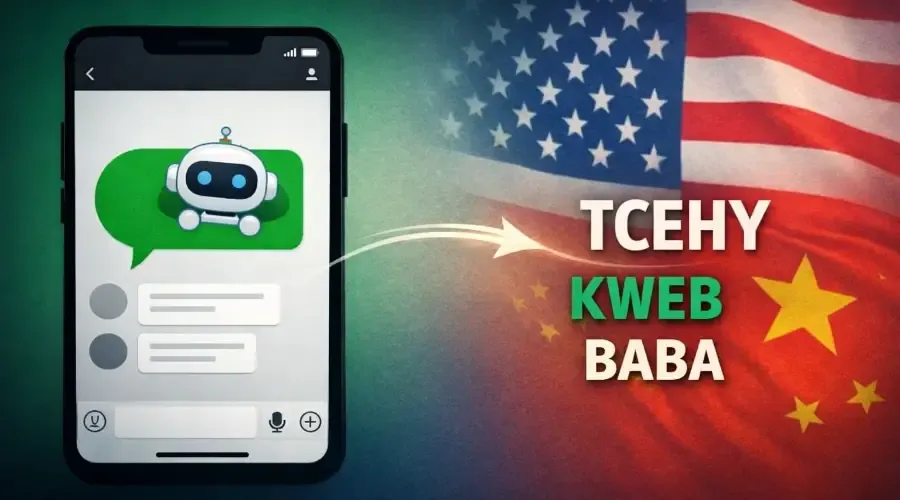
Tencent has begun internal testing of QClaw, a one-click launcher designed to bring AI agent automation directly into WeChat and QQ.
Reports surfaced through leaked internal documents only hours ago. The development is still in internal testing, not a public launch. However, the integration strategy reveals something structurally important about how China’s largest technology platforms plan to monetize artificial intelligence.
The timing is notable. Tencent’s US-listed shares (TCEHY) are currently trading down roughly 1-2%, while the Hong Kong listing 0700.HK is off 4.5-6 HKD. Positive technology news alongside negative price action highlights where this story sits today in the market’s priority stack.
The development itself may not move markets immediately. But structurally, it signals a meaningful shift in the AI distribution strategy across China’s tech ecosystem.
Facts vs Unknowns
What We Know
Tencent is testing QClaw, a launcher designed to deploy AI agents directly inside existing messaging platforms.
Key details currently confirmed:
-
QClaw is built on OpenClaw, an open-source AI agent framework.
-
The tool connects directly to WeChat and QQ accounts.
-
Users can issue natural language commands through chat interfaces.
-
Supported models include Kimi, MiniMax, GLM, and DeepSeek.
-
Users can also connect custom models.
In simple terms, OpenClaw is the engine, and QClaw is Tencent’s consumer-friendly wrapper around it.
Once installed, users could instruct the AI directly from their messaging interface with commands such as:
-
Send an email
-
Organize files
-
Schedule reminders
The importance lies in where these capabilities live. WeChat alone reaches over a billion daily users.
What We Do Not Know Yet
Several critical details remain unclear:
-
Public launch timeline
-
WeChat mobile integration vs desktop only
-
Monetization structure
-
Enterprise vs consumer positioning
Without those pieces, the revenue impact remains impossible to model.
Scenario Breakdown
1. Internal Testing Only (Current Scenario)
At present, QClaw remains an internal product test.
Market impact under this scenario:
-
No immediate revenue impact
-
Limited analyst coverage
-
Treated primarily as a technology signal rather than a catalyst
This is why TCEHY is trading lower despite the news. Macro factors currently dominate price action.
2. Public Launch Announcement
A confirmed launch date would represent the first true catalyst.
Potential consequences include:
-
Analyst upgrades for Tencent
-
Increased focus on WeChat AI monetization
-
Positive sentiment spillover to China internet stocks
Under this scenario, the narrative around Tencent shifts from AI experimentation to AI distribution leadership.
3. WeChat Mini-App Integration
This would be the structurally transformative scenario.
If AI agents integrate directly into the WeChat mini-app ecosystem, the addressable user base expands from desktop users to the entire WeChat platform.
That development would change the AI story from a feature to a platform layer.
4. Monetization Model Disclosure
The final step in the chain would be clarity on how Tencent plans to generate revenue.
Possible structures include:
-
Subscription models
-
Enterprise service fees
-
Advertising expansion within AI interactions
Until this becomes clear, QClaw remains a strategic optionality story rather than an earnings driver.
How to Monitor This Development
Investors tracking the China AI ecosystem should watch three specific signals.
1. Public launch announcement
This would be the first indication that Tencent intends to scale the product beyond internal testing.
2. WeChat integration details
Confirmation that the tool works inside WeChat mobile environments or mini-apps would dramatically increase its relevance.
3. Monetization structure
Revenue mechanisms determine whether QClaw becomes a product feature or a profit center.
Market Implications
The implications for markets appear through several indirect channels.
China Internet Sector Sentiment
A credible AI monetization pathway could improve sentiment toward the entire China internet sector.
Companies potentially benefiting from this narrative include:
-
Alibaba
-
Baidu
-
JD.com
-
Pinduoduo
These stocks often trade as a basket within China internet ETFs.
AI Infrastructure Companies
One notable detail in the QClaw architecture is the inclusion of MiniMax as a supported model.
MiniMax trades in Hong Kong under 00100.HK and has positioned itself as AI infrastructure for large platforms.
Being included in a Tencent distribution product represents a meaningful validation signal for that strategy.
Confirmation of the Distribution-First Thesis
The most important takeaway may be strategic.
China’s technology giants appear to be pursuing AI distribution rather than AI dominance.
Instead of competing directly with frontier model developers, companies are embedding AI into:
-
Messaging platforms
-
Payment ecosystems
-
Content networks
-
enterprise communication tools
This strategy leverages existing user ecosystems rather than standalone AI applications.
Trader Takeaways
For traders and short-term market participants, QClaw currently functions as a monitoring event rather than a trading catalyst.
Key points to keep in mind:
-
TCEHY price action today is macro-driven
-
The QClaw news is structurally positive but financially unquantifiable
-
Catalyst triggers remain tied to product launch and monetization clarity
The event becomes actionable only when the distribution layer moves from testing to deployment.
Bottom Line
Tencent is internally testing QClaw, an AI agent launcher designed to operate inside WeChat and QQ.
At this stage, it carries no measurable revenue impact. The market is therefore treating the development as background noise within a macro-driven trading environment.
Structurally, however, the signal is important.
Tencent is not trying to win the AI model race. Instead, it is leveraging something potentially more powerful: distribution through the largest messaging ecosystem on earth.
If QClaw eventually launches publicly and integrates deeply into WeChat, the implications could extend beyond Tencent itself-supporting the broader narrative that China’s technology platforms can monetize AI through existing user ecosystems.
For now, the development remains early, unpriced, and worth monitoring.
Disclaimer
This article is published by BreakoutBulletin for educational and informational purposes only. Nothing in this article constitutes investment advice, a recommendation to buy or sell any security, or a solicitation to trade.
All information is based on publicly available sources and is believed to be accurate at the time of publication. Markets are volatile and past performance is not indicative of future results.
BreakoutBulletin does not hold positions in any securities mentioned. Always conduct your own research and consult a qualified financial advisor before making investment decisions.
The analytical frameworks referenced are educational tools designed to help interpret market developments. They should not be interpreted as financial forecasts or investment recommendations.
© 2026 BreakoutBulletin | breakoutbulletin.com | All rights reserved.