
Market Hours | U.S. Information Technology Sector
The market’s weakness today is not evenly distributed.
By midday, major U.S. indexes were lower, but the pressure remained concentrated in technology. The Nasdaq fell more than 1.5%, while broader benchmarks showed comparatively limited damage. That divergence matters. It continues to point toward sector rotation, not a full-market unwind.
Technology stocks are once again leading the move.
Where the Selling Is Actually Coming From
The decline is being driven by growth-heavy technology names, particularly those tied to artificial-intelligence investment cycles. Investors are reassessing the timing, scale, and returns of elevated AI-related capital expenditures, pressuring valuations across the sector.
This is not a story about collapsing earnings.
It is a story about duration risk. High-growth stocks, priced on long-dated cash flows, tend to reprice when confidence around near-term profitability softens. That sensitivity is clearly visible in today’s tape.
Why This Still Looks Like Rotation, Not Breakdown
Despite the Nasdaq’s drawdown, other parts of the market are holding up better. Industrials, financials, and selected defensive areas continue to show relative resilience.
That dispersion matters. In broad risk-off environments, correlations rise and selling becomes indiscriminate. That is not what price action is showing today.
Capital appears to be moving within the market, rotating away from expensive growth and into steadier, cash-generative sectors. For now, the move remains controlled.
Technical Context: A Potential Support Test
The technical setup is now aligning with the narrative.
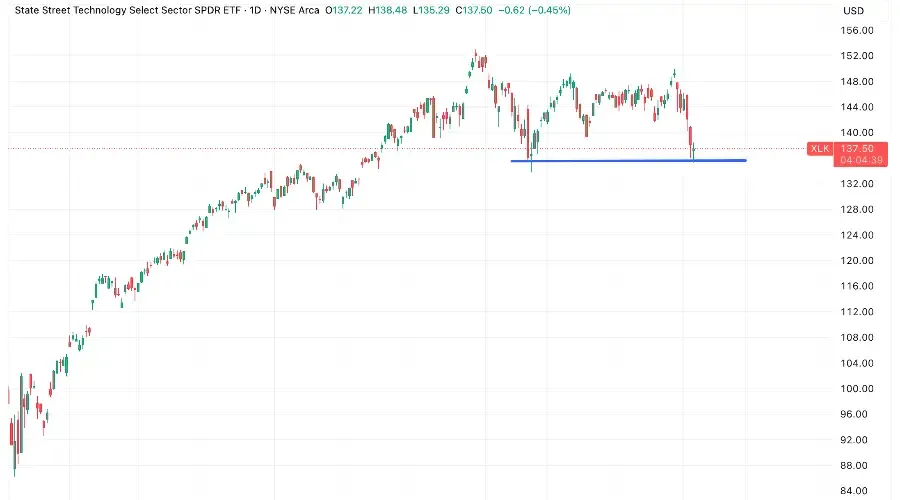
On the daily chart, the U.S. Information Technology sector proxy is revisiting the November 21, 2025 low, and today’s candle is forming a potential double bottom at that level. The November 21 session did not produce a hammer candle, suggesting price acceptance rather than panic selling.
That detail is important.
Markets often respect areas where selling previously stabilized without capitulation. A second test of that zone, especially without expanding volatility, increases the probability that participants are watching it as potential support.
If volume expands near this level, it would strengthen the case that buyers are stepping in and that this area is being defended. A failure to hold, particularly with rising volume, would suggest the correction is broadening beyond a simple rotation.
This is not a signal on its own. It is context, and context matters when sentiment is fragile.
The AI Capex Question Hanging Over Tech
A recurring theme in recent sessions has been concern around the scale and persistence of AI investment. While the long-term opportunity remains intact, markets are increasingly focused on near-term margins and capital efficiency.
When expectations are high, even modest uncertainty around execution timelines can pressure stocks. Today’s action reflects that recalibration more than a rejection of the AI thesis itself.
What to Watch Into the Close
Two factors remain key.
First, volume behavior near the current support zone. Rising participation would confirm that this level is being actively contested.
Second, mega-cap stability. If the largest technology names stabilize, broader index downside may remain limited even if rotation continues.
Bottom Line
Today’s decline is being led by technology, not by the market as a whole.
The combination of sector rotation, AI capex reassessment, and price testing a prior support zone suggests controlled pressure rather than disorder. Whether this remains a rotation or develops into something broader will depend on how price and volume behave around this level.
This blog is for educational and informational purposes only. It is not financial, investment, or trading advice, and it does not recommend buying or selling any security, asset, or strategy. Markets are uncertain and can move in ways that differ from historical patterns or examples discussed here. Always do your own research, consider your personal risk tolerance and financial situation, and, if needed, consult a qualified financial advisor before making any investment decisions.