
BREAKOUTBULLETIN · COMMODITIES / SECOND-ORDER SIGNAL
By Manish T. · August 12, 2026
Commodity markets are usually analyzed one metal at a time.
Uranium analysts watch mine output. Nickel analysts watch ore grades and quotas. Copper analysts focus on copper treatment charges, smelter utilization and concentrate availability.
But one cheap industrial chemical quietly connects all three:
sulphuric acid.
It barely trades on financial screens and rarely appears in equity models. Yet sulphuric acid is becoming an increasingly important constraint on ISR uranium and HPAL nickel production, while copper smelter cutbacks threaten to reduce the very supply of acid those industries depend on.
The result is a feedback loop the market is largely treating as three separate stories.
It isn't.
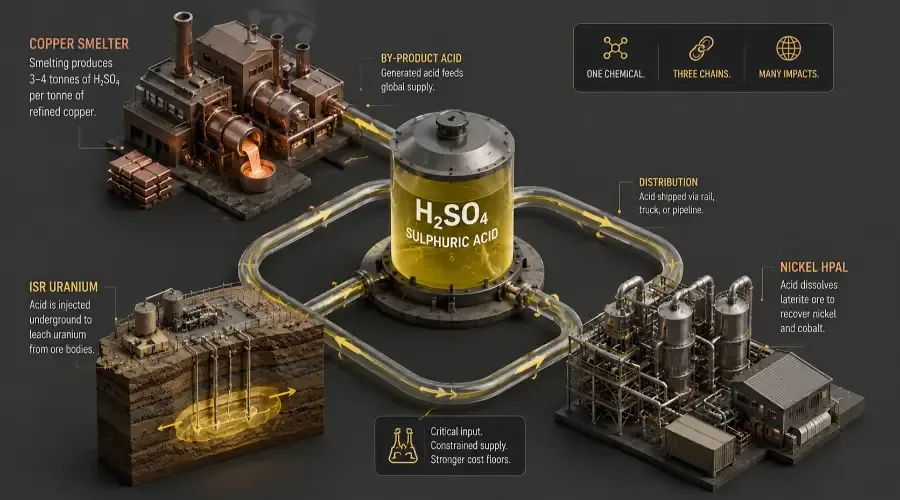
Sulphuric Acid Connects Uranium, Nickel and Copper
Sulphuric acid plays three very different roles across the mining industry.
In in-situ recovery (ISR) uranium, an acidic solution is injected underground to leach uranium from the ore body.
In high-pressure acid leach (HPAL) nickel, acid is used to process laterite ore and recover nickel and cobalt.
Copper sits on the other side of the equation. Copper smelting generates sulphuric acid as a major by-product, producing roughly three to four tonnes of acid for every tonne of refined copper.
But the relationship is more complicated.
Roughly 20% of primary copper production comes from solvent extraction-electrowinning (SX-EW) operations, which consume sulphuric acid as a leaching reagent. SX-EW operations consume approximately 2.5-3 tonnes of acid per tonne of copper produced.
Copper is therefore both a major producer and consumer of sulphuric acid.
That makes acid a hidden transmission mechanism across multiple commodity markets.
Kazatomprom and Uranium ISR Constraints
Kazakhstan's Kazatomprom accounts for more than 40% of global mined uranium production and has repeatedly cited acid availability when discussing ISR output constraints.
The company is financing an 800,000-tonne-per-year sulphuric-acid plant to reduce that bottleneck.
But the relief is not immediate.
The plant is expected to be commissioned in phases, with full capacity not reached until late 2026 or mid-2027.
That means the acid constraint could persist for at least another 6-12 months, even as additional supply eventually comes online.
For uranium investors focused on mine development, reactor demand and ore bodies, the constraint can therefore sit one layer below the headline fundamentals.
HPAL Nickel: Falling Grades Increase Acid Demand
Indonesia's HPAL nickel industry faces a similar problem from a different direction.
Acid consumption rises as ore quality deteriorates because more material must be processed to recover the same amount of nickel.
Indonesian laterite deliveries are increasingly averaging around 1.43–1.44% nickel, compared with ore priced around a 1.50% assumption.
Indonesia's dependence on imported sulphuric acid creates another vulnerability.
The country imported approximately $111 million of sulphuric acid in the first half of 2026, at an average price of around $199 per tonne, exposing HPAL operators to both price volatility and supply disruptions.
The pressure comes at an important moment for nickel. LME nickel has rallied roughly 37% from late December 2025 to April 2026.
Further increases in production costs could therefore reinforce an already stronger price environment.
The chain is straightforward:
Lower grade → more processing → more acid → higher cost per unit of nickel.
China's Sulphuric Acid Export Controls Add Another Constraint
The supply problem doesn't stop at Indonesia.
China has introduced a quota-management system for sulphuric-acid exports, effectively restricting much of the material available to overseas buyers, while copper smelters are excluded from export allocations.
That matters because Chinese copper smelters are among the world's largest acid producers.
Acid generated by Chinese copper smelting increasingly remains inside China rather than flowing toward import-dependent markets.
And the domestic market has another powerful competitor:
phosphate fertilizer.
The global phosphate fertilizer sector consumes approximately 25–30 million tonnes of sulphuric acid annually, creating a major demand pool that competes directly with mining applications.
Chinese policy has also prioritized domestic fertilizer production, with acid supply directed toward fertilizer companies through longer-term arrangements.
The result is a three-way squeeze:
Chinese smelters produce acid → domestic fertilizer demand absorbs supply → import-dependent HPAL markets compete for what remains.
This illustrates a broader feature of critical-mineral markets: governments do not need to impose an outright ban to influence physical availability. Export licensing, quotas and domestic allocation rules can redirect critical inputs toward preferred industries while leaving overseas buyers to compete for the residual supply.
Copper Smelting and Treatment Charges Close the Loop
Chinese copper smelters are already operating under severe concentrate pressure, with copper treatment charges falling into negative territory.
That concentrate squeeze is not just a smelter-margin story. When copper inventories rise in one market while treatment charges collapse, the location of the metal and the availability of concentrate become more important than the headline stockpile. Record copper inventories can therefore coexist with a genuine upstream supply problem.
If smelters respond by cutting production, the immediate market focus is naturally copper.
But there is another consequence.
Less copper smelting means less sulphuric acid production.
Every tonne of copper that isn't smelted removes roughly three to four tonnes of potential by-product acid from the market.
So a copper smelter curtailment can tighten the reagent pool for:
-
ISR uranium;
-
HPAL nickel; and
-
phosphate fertilizer production.
The causal chain becomes:
Copper concentrate shortage → smelter cuts → less acid production → tighter acid market → higher uranium and nickel production costs.
This is where the connection to the broader critical minerals complex becomes important: a bottleneck in one commodity's processing chain can raise the cost floor of another.
Sulfur Supply and the Strait of Hormuz
The upstream problem is also becoming more expensive.
The Strait of Hormuz disruption has affected nearly 40% of global sulfur maritime transport, driving sulfur prices higher and increasing the cost of producing sulphuric acid.
That compounds the squeeze.
The market is therefore facing pressure at multiple levels:
less acid availability + stronger competing demand + higher sulfur input costs.
This is why sulphuric acid scarcity can matter far more than its modest headline price would suggest.
Why the Market Misses Sulphuric Acid
The problem is organizational.
The uranium analyst models pounds.
The nickel analyst models ore grades, quotas and refining capacity.
The copper analyst models treatment charges and smelter economics.
The fertilizer analyst models phosphate demand.
Sulphuric acid sits between them.
This is the essence of commodity market plumbing: the most important signal can sit in a processing input, freight flow, inventory location or regional price differential rather than in the headline commodity itself. Following those physical connections can reveal a tightening market before the metal price fully reflects it.
It is a cost input rather than a headline commodity, and its signals often appear in company guidance, technical reports, trade flows and regional pricing rather than on the screens most investors follow.
That makes it easy to overlook.
It may also make it useful.
What Sulphuric Acid Means for Commodity Investors
The acid story is less about predicting whether uranium, nickel or copper prices rise tomorrow.
It is about where production costs are moving.
Producers with captive or secured acid supplies gain an advantage over operators dependent on merchant markets.
Chinese copper-smelter curtailments therefore become more than a copper signal. They can become an early warning indicator for uranium and nickel production costs.
Merchant acid prices may offer a cleaner read on the physical squeeze than the metal futures curves themselves.
What to Watch
1. Kazatomprom: commissioning progress at its 800,000-tonne-per-year acid plant.
2. Indonesia: HPAL acid imports, RKAB decisions and changes to Chinese sulphuric-acid export policy.
3. China: copper-smelter run cuts, acid export quotas and fertilizer-sector acid allocation.
4. Sulfur: prices and maritime flows through the Strait of Hormuz.
5. Asian merchant acid prices: the most direct gauge of tightening physical availability.
The Bottom Line
The most important input in several tight commodity markets may not be a metal at all.
It is a cheap industrial chemical that rarely gets its own headline.
Copper smelters produce it. Copper SX-EW consumes it. Uranium and nickel producers depend on it. Fertilizer producers compete for it.
And when copper smelters cut production to survive a concentrate shortage, they don't just reduce refined copper supply.
They can also remove sulphuric acid from the market tightening a reagent that uranium and nickel producers increasingly depend on.
The market is watching the metals. The constraint may be sitting in the chemical between them.
Related BreakoutBulletin Research
Beyond Copper: How Computing Metals Constraint AI
The AI build-out is creating another hidden materials squeeze in tin, tungsten, tantalum and indium.
Use the link:
Beyond Copper: How Computing Metals Constraint AI
S&P 500 Sector Rotation Strategy & Execution Blueprint
Track where institutional capital is moving using a systematic multi-timeframe relative-strength framework.
Use the link:
S&P 500 Sector Rotation Strategy & Execution Blueprint
BreakoutBulletin publishes analytical research and education for informed investors. Nothing here is a buy or sell recommendation or personalized investment advice; the author is not a registered investment adviser. Figures are based on information available at publication and may be revised. Readers should conduct their own research and verify material claims against primary sources.