
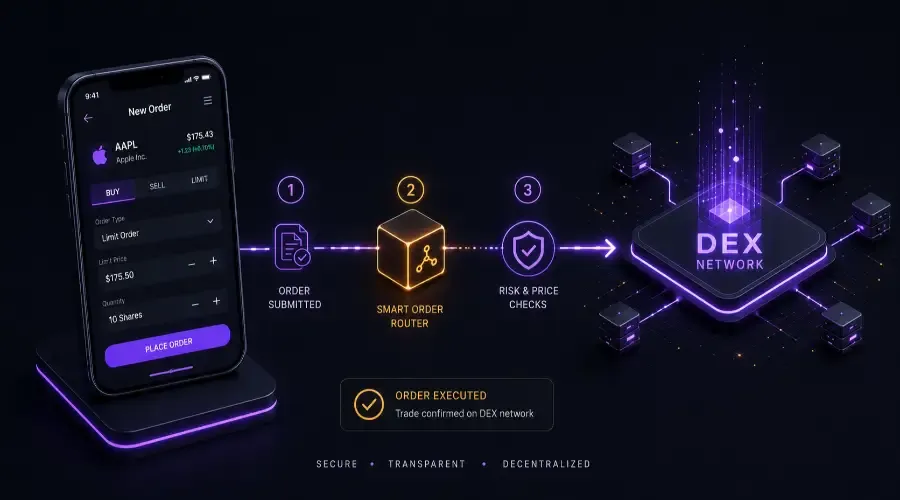
Trading is the mechanical side of investing – the execution layer between your decision and your ownership. Most new investors learn the basics by trial and error, encountering settlement violations, PDT restrictions, or bad fills before understanding why they happened. This guide covers the complete trading infrastructure: how orders work, what happens between execution and settlement, the regulatory rules that constrain active trading, and how to match your trading approach to your actual situation.
How Stocks Are Actually Bought and Sold
When you place a stock order through a brokerage app, four parties are involved: you, your broker, an exchange (or market maker), and a counterpart seller or buyer.
You submit the order through your platform. Your broker routes it – to the exchange where the stock is listed, or to a market maker who can fill it from their inventory. The market maker or exchange matches your order with a counterpart. The trade executes – typically within a second on liquid stocks. Shares transfer to your account; cash transfers to the seller.
Execution is nearly instant. Settlement – the legal transfer of ownership – takes one business day (T+1). This is the current standard, effective as of May 2024. Prior to that date, settlement took two business days (T+2). Your account shows shares immediately because your broker fronts them; the official clearinghouse accounting completes on the settlement date.
The path of a trade in practice: You open your brokerage app and search for Tesla (TSLA). You see the current price, tap buy, enter quantity, select order type, review the order summary, and confirm. Your broker receives the order, routes it to NASDAQ or to a market maker like Citadel Securities, which matches it with a counterpart order. Fill confirmation arrives in your account. The entire sequence takes one to three seconds on a liquid stock.
Ticker symbols: Every publicly traded company has a unique ticker – a one to five letter abbreviation identifying it on the exchange. AAPL is Apple. TSLA is Tesla. NKE is Nike. GOOGL is Alphabet's Class A shares. Before placing any trade, verify the ticker independently – similar company names can produce similar-looking tickers (Disney is DIS; Discovery was DISCA before its name change). Searching the company name on Google Finance or Yahoo Finance and confirming the exchange label (NYSE: or NASDAQ:) takes 30 seconds and eliminates a category of error.
Order Types: The Two That Matter Most
Market Orders
A market order instructs your broker to execute immediately at the best available price. Execution is nearly certain – on any liquid stock, the order fills within seconds – but price is not guaranteed.
The price you pay (buying) or receive (selling) is the best available ask or bid at the moment your order reaches the market. On large-cap stocks with tight spreads during normal market conditions, the execution typically matches the quoted price within pennies. During volatile sessions, at market open (9:30 AM ET) or close (4:00 PM ET), or on thinly traded securities, slippage – the gap between expected and actual execution price – can be material.
When market orders make sense: Liquid stocks (trading more than 1 million shares daily) with tight bid-ask spreads during mid-session (roughly 10:00 AM to 3:30 PM ET). When immediate execution matters more than extracting the last cent of price improvement.
When to avoid market orders: On illiquid stocks with wide spreads. During the first and last 15 to 30 minutes of the trading session when volatility and spreads spike. On any order placed outside regular market hours – a market order placed at 7:00 PM executes at the following morning's open at whatever price materializes.
Limit Orders
A limit order specifies the exact price at which you're willing to transact. A buy limit at $48 on a stock trading at $50 executes only if the price reaches $48 or below. A sell limit at $55 executes only if the stock reaches $55 or above.
Limit orders guarantee price but not execution. If the stock never touches your limit price, the order sits unfilled.
When limit orders make sense: Any stock with a bid-ask spread above 0.5% of price. Volatile stocks during earnings periods or other high-movement events. Any order placed outside regular market hours. Larger position sizes where a few cents of price improvement across many shares produces meaningful savings.
The limit at market price: A practical middle-ground approach – place a limit order at the current ask price (buying) or bid price (selling). You get near-market-order execution speed while retaining protection if the price gaps before your order reaches the market.
Why Spreads Matter
The bid-ask spread is an implicit transaction cost embedded in the difference between what you pay and what the stock last traded at. On Apple with a $0.04 spread, a 10-share purchase costs $0.40 more than the last printed price – negligible. On a $2.50 stock with a $0.40 spread, a 100-share purchase costs $40 more than the midpoint – a 16% implicit tax before the stock moves at all.
Before placing any trade, checking the bid and ask prices takes five seconds. The spread percentage – spread divided by mid-price, multiplied by 100 – tells you the actual cost of executing and potentially reversing the trade.
Order Duration: Day Orders vs. GTC Orders
Every limit order requires a duration setting. Most investors accept the default without thinking about it – which is fine until a forgotten order fills weeks later under conditions that no longer match the original reasoning.
Day Orders
A day order expires automatically at 4:00 PM ET on the day it's placed if it hasn't executed. Day orders are the default at most brokerages.
The primary advantage: no order can fill at a stale price if you haven't actively renewed it. Each trading session starts fresh – orders reflect current thinking, not last month's thesis.
The practical downside: if you're building a position over several weeks at a target price that hasn't been reached, you either remember to re-enter the order each morning or you miss the fill when the stock eventually touches your level.
Day orders fit: Trades with time-sensitive setups where the rationale is specific to today's conditions. Volatile situations where targets can change quickly after news or earnings. Investors who check accounts daily and want fresh orders each session.
GTC Orders (Good-Till-Canceled)
A GTC order remains active until it fills or you manually cancel it – typically up to 90 days depending on the broker. Once placed, it works for you continuously without daily intervention.
The risk is equally clear: a GTC order can fill weeks after placement under conditions that no longer support the original reasoning. An earnings miss, a sector rotation, a macro development – any of these can change the investment case between placement and fill. An order set at what seemed like an attractive entry level six weeks ago may no longer be attractive today.
GTC orders fit: Patient value-oriented strategies where the target price may take weeks or months to reach. Investors who check accounts weekly rather than daily. Price levels significantly below the current market.
The forgotten order problem: Maintaining a list of open GTC orders and reviewing it at a fixed weekly interval prevents the surprise of a fill that reflects last month's thinking. Most brokerage platforms display open orders in a dedicated section. A five-minute Sunday review eliminates this category of risk.
Earnings and GTC orders: If you have a GTC buy limit near the current price and a company reports a significant earnings miss, the stock may gap down at the open and fill your order before you've processed the news. Reviewing and adjusting GTC orders before known earnings dates prevents buying into a deteriorating story simply because the price happened to touch your level.
Settlement: T+1 and Why It Matters for Active Investors
When you buy a stock, shares appear in your account almost immediately. When you sell, cash appears within seconds. Neither update represents the legal completion of the transaction. The actual transfer of ownership – shares from seller to buyer, cash from buyer to seller – happens one business day later. This is T+1 settlement, the current standard effective as of May 2024. Prior to that date, settlement took two business days (T+2).
A stock purchased on Monday settles on Tuesday. A stock purchased on Friday settles the following Monday – weekends don't count, and market holidays extend the timeline.
Why it matters: For investors who buy and hold for weeks, months, or years, settlement is invisible. You see shares immediately, hold them as long as you want, and sell whenever you choose. The one-day delay never creates a practical constraint.
Settlement creates constraints primarily for investors making multiple trades with the same capital in a short window – specifically in cash accounts.
The Good Faith Violation: Consider this sequence in a cash account: You sell Stock A on Monday for $2,200. That cash appears immediately but is "unsettled" until Tuesday. You use that $2,200 to buy Stock B later that same Monday. Stock B rises, and you sell it on Monday afternoon – before the Monday sale of Stock A has settled (which happens Tuesday).
This sequence – using unsettled proceeds to buy a stock and then selling that stock before the original proceeds settled – constitutes a Good Faith Violation. Most brokerages issue a warning on the first occurrence. The second violation typically triggers a 90-day restriction limiting your account to closing existing positions only. A third can result in account closure.
The practical rule: After selling a stock, wait until the next business day (when settlement completes) before using those proceeds to make a quick round trip (buying and selling within a short window). By that point, the original sale has fully settled. Or maintain a cash buffer – enough settled cash that you're never forced to trade with unsettled funds.
Cash accounts vs. margin accounts: Settlement rules apply specifically to cash accounts. Margin accounts operate differently – your broker extends credit, allowing you to trade with unsettled funds without triggering settlement violations. However, margin accounts introduce the Pattern Day Trader rule instead.
The Pattern Day Trader (PDT) Rule
The Pattern Day Trader rule is a FINRA regulation that applies specifically to margin accounts. It's one of the most commonly violated rules by new investors who don't know it exists.
The definition of a day trade: Buying and selling (or selling short and covering) the same security on the same calendar day. Buying 10 shares of Tesla at 10:00 AM and selling those 10 shares at 2:30 PM is one day trade. Buying in three lots during the morning and selling the combined position in the afternoon still counts as one day trade.
The trigger: Four or more day trades within any rolling five-business-day period in a margin account with under $25,000 in equity.
The rolling window: The window shifts forward each day rather than resetting on a fixed schedule. If you make day trades on Monday, Tuesday, and Wednesday of one week, then another on the following Monday, all four fall within the same rolling five-day window. The fourth triggers the PDT flag.
What happens when you trigger PDT: Your broker marks your account as a Pattern Day Trader. You must deposit funds to bring your account above $25,000 by the following trading day, or your account enters a 90-day "closing-only" restriction – you can sell existing positions but cannot open new ones. The 90-day restriction is the outcome most investors want to avoid.
The $25,000 exemption: Accounts with $25,000 or more in equity at the end of each trading day can execute unlimited day trades without restriction. However, if your account is flagged as a Pattern Day Trader and equity later drops below $25,000, the closing-only restriction applies until equity is restored above the threshold.
Cash accounts are different: The PDT rule applies only to margin accounts. Cash accounts are not subject to PDT restrictions. However, cash accounts face settlement constraints instead – proceeds from sales are unsettled for one business day, creating Good Faith Violation risk for rapid buy-and-sell cycles.
Why the rule exists: FINRA adopted the PDT rule in 2001 following concerns about inexperienced retail investors making rapid, frequent trades during the dot-com boom – often with borrowed margin funds – and suffering significant losses. The $25,000 threshold serves as a proxy for financial capacity. Whether it effectively achieves its protective purpose is debated; it primarily discriminates by account size rather than actual trading ability.
Working within PDT under $25,000:
Limit day trades to high-conviction setups – three per five-day window is a constraint that forces selectivity. Holding a position overnight is not a day trade, which preserves access to swing-trading approaches without PDT restrictions. Switching to a cash account avoids PDT entirely, but requires managing the settlement calendar carefully. Or accumulate toward the $25,000 threshold to trade freely.
Trading Timeframes: Day Trading, Swing Trading, and Position Trading
Three distinct approaches differ primarily in how long positions are held – from minutes to years. Each has different capital requirements, time demands, skill prerequisites, and realistic success rates. The right one depends on your actual situation, not your aspirational one.
Day Trading
Day traders open and close positions within a single trading session. No positions are held overnight. The goal is to capture intraday price movements – typically 0.5 to 2% – across multiple trades per session.
Day trading requires continuous attention during market hours: 9:30 AM to 4:00 PM ET. Traders monitor real-time price action, news flow, and technical signals without interruption. Missing a position for 30 minutes can mean missing the entire move – or holding through a reversal that turns a gain into a loss.
The regulatory requirement: effective day trading in a margin account requires $25,000 or more in equity to avoid PDT restrictions.
Research and industry data consistently document high failure rates among retail day traders. The SEC's own investor education resources include specific disclosures about day trading risk. This doesn't mean profitable day trading is impossible – it means the bar for consistent profitability is substantially higher than most newcomers expect, and the infrastructure required (fast data feeds, direct access platforms, real-time news) represents an ongoing operating cost.
Day trading fits: Full-time traders with $25,000 or more, continuous market-hour availability, documented profitability over at least six months of paper or small-size trading, and genuine technical analysis skill.
Day trading doesn't fit: Anyone with a full-time job or school schedule, accounts under $25,000, or investors without sustained experience reading intraday price action.
Swing Trading
Swing traders hold positions for two days to several weeks, attempting to capture medium-term price movements driven by technical patterns, earnings catalysts, or sector trends. The holding period sidesteps PDT restrictions – a position held overnight is not a day trade – allowing investors with under $25,000 to participate actively without account restrictions.
Swing trading typically requires 30 to 90 minutes of research and monitoring per day rather than continuous screen attention, making it more compatible with school schedules or full-time employment than day trading.
Overnight gap risk is the primary added complexity: news released after hours can cause a position to open significantly higher or lower than the previous close. Stop-loss orders and position sizing are the practical tools for managing this risk.
Swing trading fits: Investors with $1,000 to $25,000 who can dedicate 30 to 60 minutes daily, have studied basic technical analysis (support and resistance levels, chart patterns, volume), and can accept moderate overnight risk.
Position Trading (Long-Term Investing)
Position trading – which most people call investing – involves holding positions for months to years based on fundamental analysis of the underlying business. Positions are built with a thesis about the company's long-term trajectory and held through short-term volatility.
The time requirement is minimal relative to the other approaches. Monthly portfolio reviews are adequate; quarterly is sufficient for passive index investors. The analytical focus shifts from price momentum to business fundamentals: revenue growth, profit margins, competitive positioning, and management quality.
Historical data favors this approach. Broad market index funds have outperformed the majority of professionally managed active funds over 15-year periods. Tax treatment also favors longer holding periods: positions held more than one year qualify for long-term capital gains rates, substantially lower than ordinary income rates applied to short-term gains from day and swing trading.
Position trading fits: Virtually every investor at every account size and experience level. The PDT rule doesn't apply. Settlement constraints rarely interfere. The historical success rate in diversified index funds exceeds 70% over long periods. Starting point: $50 to $100 in VOO or VTI, automated monthly contributions, quarterly reviews.
Matching Timeframe to Situation
An honest assessment of your actual situation – capital, available time, current knowledge, and income needs – determines which approach is appropriate.
For investors with under $5,000, a full school or work schedule, and less than one year of market experience: position trading in diversified index funds is the highest-probability path. PDT restrictions effectively eliminate day trading access, time constraints eliminate effective swing trading, and the base rate of success is strongest with long-term, diversified ownership.
For investors with $1,000 to $25,000 who can dedicate 30 to 60 minutes daily and have studied basic technical analysis: swing trading with a small subset of capital is worth exploring alongside a core position-trading portfolio. Paper trading for three to six months before risking real capital is informative rather than performative.
For investors with $25,000 or more, full-time availability during market hours, and documented profitability over at least six months: day trading becomes accessible as a complementary activity, though position trading should still anchor the portfolio.
The blended approach: Many experienced investors maintain a core portfolio (70 to 80% of assets) in long-term positions and a smaller active component (20 to 30%) used for swing trades or occasional day trades. The core provides compounding stability; the active component develops skills and generates engagement without risking the foundational portfolio.
Short Selling: Understanding the Mechanics
Short selling profits from stock price declines rather than rises. Most investors never short a stock, but understanding how it works illuminates market dynamics that affect positions you hold.
The mechanics: You borrow shares from your broker, sell them immediately at the current price, and the proceeds are held in your margin account as collateral (you don't have free access to that cash). Your account shows a negative share position – you owe shares back. To close the position, you buy shares back on the open market and return them to the broker. If the price declined during the interval, you profit. If it rose, you absorb the loss.
The asymmetric risk: Maximum gain on a short is 100% – if the stock goes to zero. Maximum loss is unlimited – if the price keeps rising, so does your loss. A stock shorted at $50 that rises to $500 produces a 900% loss on the position.
Short squeezes: When a heavily shorted stock rises, short sellers must buy shares to limit losses. That buying increases demand, pushing the price higher, forcing more short sellers to cover, pushing the price higher still. GameStop in January 2021 ran from approximately $20 to a peak near $483 within three weeks – driven by coordinated retail buying against a short position that exceeded 100% of float. Melvin Capital, a hedge fund heavily short GameStop, lost 53% of its fund value in January 2021 alone and required a $2.75 billion emergency infusion from other funds. The firm closed in 2022.
High short interest as a signal: Short interest measures total shares sold short as a percentage of shares outstanding. High short interest (20% or more of float) indicates significant bearish positioning and – more practically – signals squeeze potential if positive news emerges.
Borrowing costs: Borrowed shares carry an annualized fee. On large-cap stocks, borrowing costs may be 0.5 to 2% annually. On heavily shorted names where available inventory is scarce, borrowing costs can reach 20 to 100% annually – eroding returns even when the thesis is correct.
Short selling requires margin accounts, active monitoring, and the discipline to hold through adverse moves. The structural risk profile makes it unsuitable for most investors. Understanding the mechanics remains useful for reading market dynamics without requiring participation.
Circuit Breakers: When Markets Pause
Markets have built-in pause mechanisms for extreme volatility. Understanding them removes a category of panic when trading halts mid-session.
Market-wide circuit breakers are measured as S&P 500 declines from the prior-day closing level.
Level 1 at 7% triggers a 15-minute halt. Active only before 3:25 PM ET. Has triggered four times total – all in March 2020.
Level 2 at 13% triggers another 15-minute halt. Same time restriction. Has never triggered.
Level 3 at 20% closes markets for the remainder of the day. No time restriction. Has never triggered.
Individual stock halts (LULD) occur when a stock moves more than 5% (for stocks above $3) or 10% (for stocks between $0.75 and $3) within a five-minute window. Trading pauses for 5 minutes while participants assess the move.
The right response to any halt: Use the pause to read the news, check the company's investor relations page, and determine what triggered the move. Market orders placed into a post-halt reopening auction can fill at prices substantially different from the pre-halt level – limit orders provide more control.
The S&P 500 bottomed on March 23, 2020, recovered all losses by August 2020, and was at new all-time highs by early 2021. Investors who sold into the three March 2020 circuit breaker days locked in losses that a holding position would have recovered within five months.
Building Your Trading Framework
A coherent trading approach starts with matching method to situation, then adds consistency rules that prevent emotional decision-making.
Determine your account type: Cash or margin. Cash accounts avoid PDT but face settlement constraints on rapid trades. Margin accounts provide flexibility but require $25,000 to day trade freely.
Establish your default order type: Limit orders on anything outside liquid large-cap stocks during regular market hours. Market orders only when execution speed genuinely outweighs the marginal cost of not controlling the price.
Set your duration rules: Day orders for time-sensitive setups. GTC orders for patient value targets with a weekly review calendar.
Match your timeframe to your life: Day trading requires full-time availability and $25,000. Swing trading requires 30 to 60 minutes daily and $1,000 or more. Position trading requires almost nothing except the discipline to stay invested.
Track what matters: For active traders, keep a log of every day trade with dates – not to admire the wins but to monitor PDT exposure in the rolling five-day window. Most brokerage platforms now display a "day trades remaining" counter on the account page; use it as a backup check. A fourth day trade by mistake costs 90 days of access. For position investors, monthly or quarterly review of portfolio performance versus the S&P 500 tells you whether your selection is adding value.
The mechanics of trading are genuinely simple. The challenge is discipline – using the right order type for each situation, staying within regulatory constraints, and maintaining the patience that long-term compounding requires.
This content is for educational purposes only and does not constitute investment, legal, or tax advice. Investing in securities involves risk, including possible loss of principal. Past performance does not guarantee future results. Always conduct your own research and consult a licensed financial professional before making investment decisions.
Related reading on BreakoutBulletin.com:
This guide covers the complete trading layer - how orders work, what settlement means, which regulatory rules constrain active trading, and how to match your timeframe to your actual situation. The sections below go further on each area. Start with orders if you're new to placing trades, or with trading styles if you're figuring out your approach.
→ How Orders Work → Covering market orders, limit orders, settlement, and timing - www.breakoutbulletin.com/article/how-stock-orders-work-placing-executing-settling-trades
→ Trading Timeframes and Strategies → Covering day trading, swing trading, and long-term investing - www.breakoutbulletin.com/article/trading-timeframes-strategies-day-swing-investing
→ Market Order vs. Limit Order → When each makes sense and where market orders go wrong - www.breakoutbulletin.com/article/market-order-vs-limit-order-explained
→ The PDT Rule Explained → The regulation that limits accounts under $25,000 to 3 day trades per week - www.breakoutbulletin.com/article/pdt-rule-explained-the-25k-day-trading-limit-
→ Understanding Settlement (T+2) → Why unsettled cash can lock you out of trades - www.breakoutbulletin.com/article/understanding-settlement-tplus2
→ Day Trading vs. Swing Trading vs. Position Trading → Matching the timeframe to your life - www.breakoutbulletin.com/article/day-vs-swing-vs-position-trading-teens
New to stocks entirely? Start with what you’re actually trading before focusing on how to trade it.
→ The Complete Guide to Stocks → Pillar: ownership, share types, market cap, and how companies use equity - www.breakoutbulletin.com/article/how-stocks-work-beginners-guide