
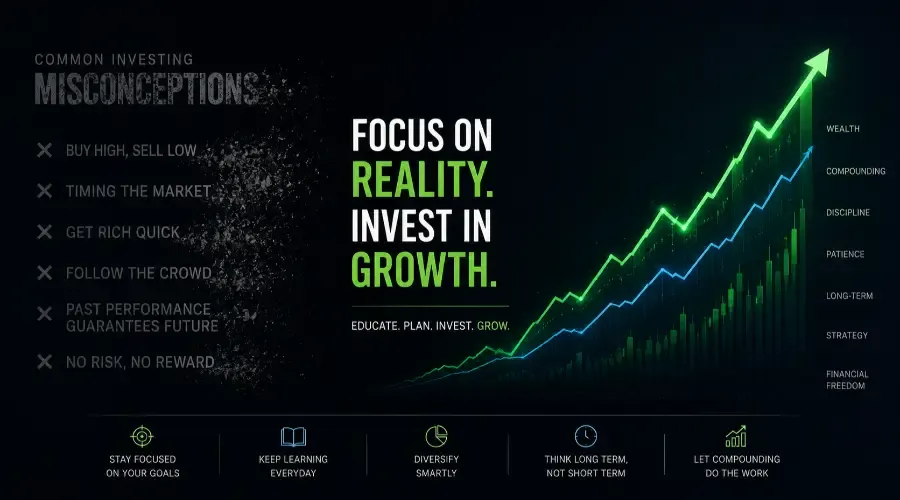
Several widely held beliefs about investing are demonstrably false. They persist because they sound logical, get repeated by people who've never tested them against data, and feel intuitive even when decades of evidence contradict them. Each one costs people money – either by delaying a start, encouraging panic selling, or directing capital toward worse outcomes.
Myth 1: You Need a Lot of Money to Start
The practical minimum to open a brokerage account at Fidelity, Schwab, or similar platforms is zero. Fractional shares allow you to invest $10 or $20 in any stock or ETF regardless of its per-share price. A $10 investment in VOO buys a proportional slice of all 500 S&P 500 companies.
This belief was more accurate 30 years ago, when brokerage minimums of $1,000 to $3,000 were common and fractional shares didn't exist. The investing infrastructure has changed substantially. The belief hasn't updated.
The cost of the myth is delayed compounding. An investor who waits until they've saved $5,000 to begin investing – believing that's the threshold – loses the compounding returns on whatever they could have invested at $50 or $100 per month during the waiting period. Over a decade, that gap is substantial.
Myth 2: The Stock Market Is Gambling
Gambling is a zero-sum transfer – every dollar won by one party comes directly from another party's loss. The house's structural edge means aggregate players lose over time.
The stock market is positive-sum over long periods because publicly traded companies generate real economic output: revenue, earnings, dividends, and asset growth. Shareholders participate in that growth proportionally. Over any 20-year period in U.S. market history, the S&P 500 has produced positive returns. In roughly 75% of individual calendar years, the index has closed higher than it opened.
Individual stock picking does carry meaningful risk, and most actively managed funds underperform the index over 15-year periods. But a broadly diversified index fund is not a bet on an outcome – it's ownership of productive economic activity across hundreds of businesses.
Myth 3: You Need to Time the Market to Succeed
Research consistently shows that missing the 10 best trading days in any given decade roughly halves long-term returns compared to staying fully invested throughout. The best days and the worst days cluster near each other during volatile periods – investors who exit during volatility often miss the recovery days that follow.
Time in the market has historically produced better outcomes than timing the market. The best time to invest a fixed amount is when you have it – not after waiting for a more favorable moment that may not materialize or may already have passed.
Dollar-cost averaging – investing a fixed amount at regular intervals regardless of market conditions – mechanically buys more shares when prices are low and fewer when prices are high, producing a favorable average cost over time without requiring any prediction about market direction.
Myth 4: Investing Is Only for Financial Experts
The S&P Indices Versus Active (SPIVA) scorecard, published by S&P Dow Jones Indices, documents the percentage of actively managed funds that underperform their benchmark index over various time periods. Over 15-year periods, approximately 85 to 90% of actively managed U.S. large-cap funds have underperformed the S&P 500.
This means that buying and holding a low-cost S&P 500 index fund – the strategy requiring the least expertise – has historically beaten most professional stock pickers over long time horizons. The barrier to participating in broad market returns is not financial expertise. It's opening an account and maintaining the discipline to stay invested.
Myth 5: You Should Wait Until Your 30s or 40s to Invest
This belief is the most expensive. The mechanism that makes early investing valuable is compound growth – returns generating returns on themselves over time. The effect is nonlinear: the early years of compounding matter disproportionately because they have the most time to multiply.
An investor who puts $100 per month into a diversified index fund from age 18 to 65 at a 10% average annual return accumulates approximately $1.2 million. An investor who waits until 28 to start the same monthly contribution over the same return assumption accumulates approximately $470,000 – less than 40% of the earlier starter's result. The 10-year head start, with the same monthly contribution, produces roughly $730,000 more by retirement.
Waiting doesn't reflect prudence. It reflects misunderstanding of how compounding works.
How to Evaluate Any Investing Claim
The pattern across all five myths: they feel true, they're repeated by people with authority or experience, and they've never been tested against actual data. The antidote is straightforward – ask what the historical evidence shows over long periods, and distinguish between anecdote and systematic data.
If someone asserts an investing belief without being able to point to data that extends across multiple market cycles, treat it as opinion rather than fact. Long-run market data is publicly available from multiple sources and generally accessible to anyone who looks for it.
This content is for educational purposes only and does not constitute investment, legal, or tax advice. Investing in securities involves risk, including possible loss of principal. Always conduct your own research and consult a licensed financial professional before making investment decisions.
The five myths covered here are the most expensive beliefs in retail investing - not because they're unusual, but because they're widely held and lead to specific, quantifiable decisions that underperform the data.
→ Trading Timeframes and Strategies → The evidence on day trading, swing trading, and long-term investing - www.breakoutbulletin.com/article/trading-timeframes-strategies-day-swing-investing
→ Bull vs. Bear Markets → The historical record on staying invested through both phases - www.breakoutbulletin.com/article/bull-vs-bear-markets-for-teens
→ The S&P 500 Deep Dive → The SPIVA data on active vs. passive investing over 15 years - www.breakoutbulletin.com/article/sp-500-for-teens-guide