
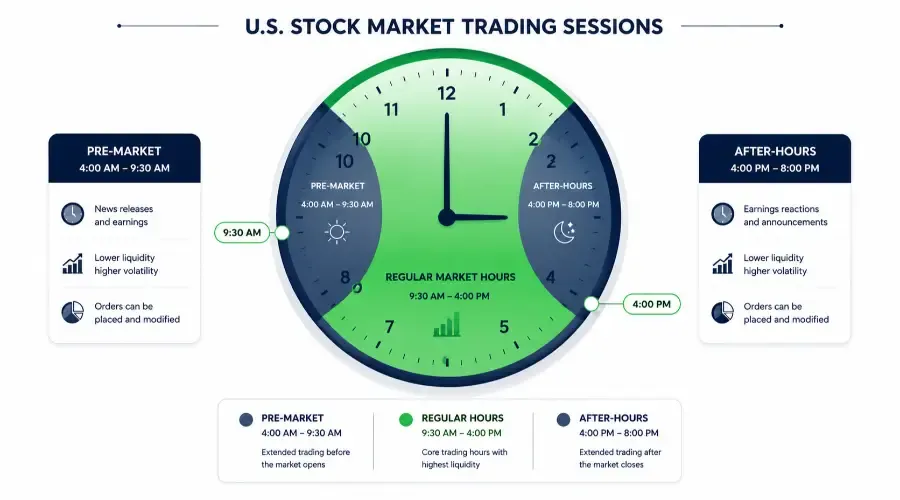
The stock market doesn't run continuously. It operates on a fixed schedule, and orders placed outside those hours behave differently than most new investors expect. Knowing the schedule prevents frustrating surprises and helps you place smarter trades.
Regular Trading Hours
U.S. stock markets – NYSE and NASDAQ – are open from 9:30 AM to 4:00 PM Eastern Time, Monday through Friday. The 9:30 AM start is the "opening bell." The 4:00 PM end is the "closing bell." Both have become cultural shorthand for the market's daily rhythm.
Markets are closed on U.S. federal holidays: New Year's Day, Martin Luther King Jr. Day, Presidents Day, Good Friday, Memorial Day, Juneteenth, Independence Day, Labor Day, Thanksgiving, and Christmas. Some holidays see early closes at 1:00 PM ET rather than full closures.
For investors outside the Eastern Time Zone:
-
Pacific Time: 6:30 AM to 1:00 PM
-
Central Time: 8:30 AM to 3:00 PM
-
Mountain Time: 7:30 AM to 2:00 PM
What Happens to Orders Placed Outside Hours
An order placed at 7:00 PM on a Tuesday doesn't execute until 9:30 AM Wednesday at the earliest. The order queues and waits for the market to reopen.
This creates a specific risk with market orders placed after hours: by the time the market opens, conditions may have changed significantly. If news breaks overnight, other investors react the moment trading starts, and the price at the 9:30 AM open can differ substantially from where it closed the previous day.
A market order placed at 7:00 PM saying "buy at whatever the current price is" becomes "buy at whatever the opening price turns out to be" – which could be higher or lower than expected.
Extended Hours Trading
Two extended sessions exist outside regular hours:
Pre-market runs from 4:00 AM to 9:30 AM ET. After-hours runs from 4:00 PM to 8:00 PM ET. Both are available through most major brokerages, though not all accounts have access by default.
Extended hours come with important limitations. Volume is dramatically lower than during regular hours - sometimes a fraction of the regular-session volume. Lower volume means wider bid-ask spreads, which translates to less favorable prices. A stock that closed at $50.00 might show an after-hours quote of $50.50 bid and $51.25 ask - a spread that would be fractions of a cent during regular trading.
After-hours prices also reflect a smaller number of participants, meaning they can swing sharply on limited activity. A price that shows $55 at 7:00 PM may look nothing like the 9:30 AM open if institutional investors haven't weighed in yet.
The Practical Risk: Overnight Gaps
Stocks can "gap" at the open - meaning the first trade of the day prints at a significantly different price than the previous close. This happens because news, earnings, and economic data often releases outside of market hours. By the time regular trading begins, buyers and sellers have already adjusted their expectations, and the opening price reflects that revision.
Gaps can run in either direction. A company reporting strong earnings after hours may open 10% higher. A company issuing a profit warning overnight may open 15% lower. Investors holding those positions overnight experience the full move.
The Limit Order as a Safeguard
For any trade placed outside of regular market hours, a limit order provides better protection than a market order. A limit order specifies the maximum price you'll pay (if buying) or the minimum you'll accept (if selling). If the market opens at a price outside that range, the order doesn't fill – which may be frustrating, but it prevents executing at an unexpected price.
For example: if you want to buy a stock and place a limit order at $48 before the market opens, and the stock gaps up to $52 at the open, your order simply doesn't execute. That's a better outcome than a market order filling at $52 when you expected something near $48.
Price Alerts as an Alternative
Rather than placing orders overnight and hoping the price holds, setting a price alert in your brokerage app or on a platform like Yahoo Finance accomplishes the same goal with less risk. When the stock hits your target price during regular hours, you receive a notification and can place the order with full visibility into current conditions.
This content is for educational purposes only and does not constitute investment, legal, or tax advice. Investing in securities involves risk, including possible loss of principal. Always conduct your own research and consult a licensed financial professional before making investment decisions.
Knowing when the market is open is the baseline. Understanding how order timing affects execution - and why the spreads widen dramatically outside regular hours - changes how you actually place trades.
→ How Orders Work → Market orders, limit orders, settlement, and the right time to trade - www.breakoutbulletin.com/article/how-stock-orders-work-placing-executing-settling-trades
→ Market Order vs. Limit Order → Why a market order placed overnight is a different trade than one placed at midday - www.breakoutbulletin.com/article/market-order-vs-limit-order-explained
→ The Role of Market Makers → How market maker activity drives the spread differences between regular and extended hours - www.breakoutbulletin.com/article/market-makers-explained-bid-ask-spread-liquidity