
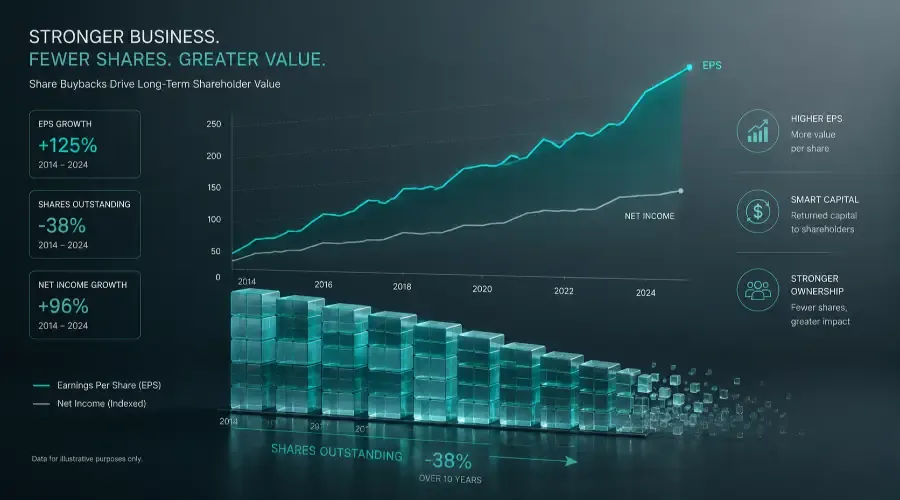
When a company generates more cash than it needs for operations, capital expenditures, and growth investment, it faces a decision about what to do with the surplus. One option is distributing it as dividends. Another is repurchasing its own shares from the open market – a buyback.
The Basic Mechanism
A share repurchase program works as follows: the board authorizes a specific dollar amount for buybacks over a defined period. The company then purchases shares in the open market, like any other buyer, and retires them – permanently removing them from the count of shares outstanding.
With fewer shares outstanding, each remaining share represents a larger fractional ownership of the same company. If a company has 100 million shares and buys back 5 million, each remaining share now represents 1/95th of the company instead of 1/100th – a 5.3% increase in proportional ownership for all remaining shareholders.
The EPS Effect
Earnings per share is calculated by dividing total net income by total shares outstanding. A buyback that reduces shares outstanding, all else equal, increases EPS even if net income stays flat. If a company earns $1 billion with 100 million shares outstanding, EPS is $10. If buybacks reduce shares to 80 million while earnings hold at $1 billion, EPS rises to $12.50 – a 25% increase without any improvement in the underlying business.
This is both the appeal and the criticism of buybacks. When used to return genuine excess cash from a thriving business, EPS growth from buybacks reflects real value creation. When used by a company with flat or declining earnings to mechanically inflate EPS – the figure most tied to executive compensation – buybacks serve management's interests more than shareholders'.
Apple's Decade-Long Buyback Program
Apple provides the most studied example of buyback impact at scale. In 2013, Apple held more than $100 billion in cash and began a repurchase program after sustained shareholder pressure. From 2013 through 2023, Apple repurchased and retired approximately 40% of its then-outstanding shares, spending over $550 billion in total.
The effect on per-share metrics was substantial. Apple's total net income roughly doubled over that period. But because shares outstanding fell significantly, earnings per share grew roughly four times over – meaning shareholders captured more earnings per share than raw profit growth would have produced. Apple's stock price, which reflected this per-share earnings growth, returned approximately 14 to 15% annually over the decade.
The critical enabling condition: Apple's buybacks were funded by genuine free cash flow from one of the most profitable businesses in history. The program worked because the underlying business performed strongly, not because the buybacks themselves created value in isolation.
When Buybacks Destroy Value
The same mechanics that create value when buybacks are funded by excess cash can destroy value when buybacks are funded by debt or when shares are repurchased at prices well above intrinsic value.
A company borrowing at 6% to buy back stock yielding 3% in EPS is taking on risk to fund a transaction that doesn't produce adequate return. If business conditions deteriorate, the debt remains while the earnings that justified the buyback disappear. Several major airlines conducted large buyback programs before 2020, leaving themselves with high debt loads entering the pandemic – when revenue collapsed. The buybacks, funded partly by debt, reduced the financial flexibility those companies needed most.
Timing also matters. Buybacks conducted at 30 times earnings on an expensive stock effectively overpay for shares on behalf of remaining shareholders. The same capital deployed at 15 times earnings would have bought twice the ownership stake per dollar spent.
Evaluating a Buyback Announcement
Three factors determine whether a buyback announcement is worth treating as a positive signal.
Size relative to market cap: a $500 million buyback authorized by a $200 billion company represents 0.25% of outstanding shares annually – immaterial. A $2 billion buyback on a $10 billion company represents 20% of shares over the program's life – substantial.
Funding source: buybacks drawn from consistent free cash flow generation are structurally healthier than those requiring new debt issuance or the liquidation of core assets.
Valuation at time of purchase: companies executing buybacks consistently at below-average valuation multiples generate better per-share value creation than companies that buy back shares primarily during periods of peak market enthusiasm.
This content is for educational purposes only and does not constitute investment, legal, or tax advice. Investing in securities involves risk, including possible loss of principal. Always conduct your own research and consult a licensed financial professional before making investment decisions.
Buybacks and dividends serve the same goal - returning cash to shareholders - through different mechanics with different implications. Understanding both helps you evaluate management's capital allocation decisions more completely.
→ How Companies Return Value to Shareholders → Dividends and buybacks as complementary return mechanisms - www.breakoutbulletin.com/article/how-dividends-and-buybacks-pay-shareholders
→ Dividend Basics → The direct cash return mechanism and how to evaluate yield sustainability - www.breakoutbulletin.com/article/dividends-explained-for-beginners
→ Understanding Shareholders → How buybacks increase your ownership percentage without any action on your part - www.breakoutbulletin.com/article/shareholders-explained-what-it-means-to-own-stock