
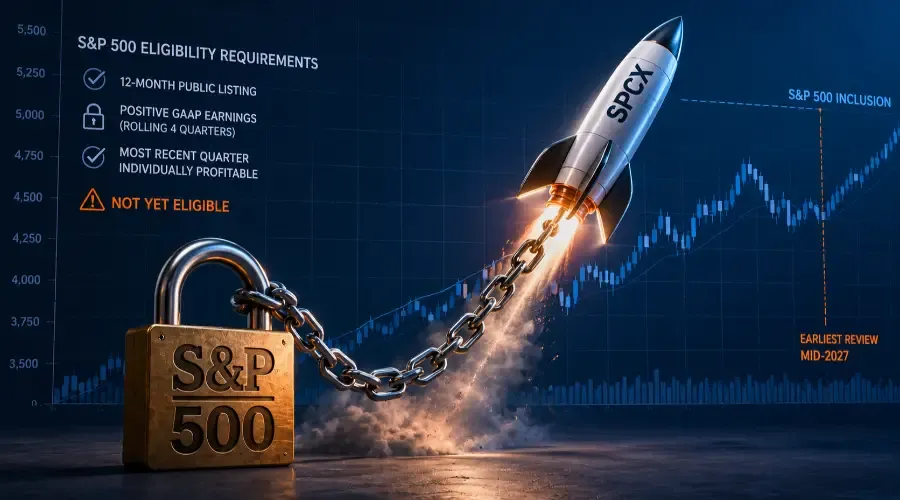
When one of the largest IPOs on record trades up 43% in three sessions, retail assumes every major index follows immediately. That assumption is wrong for SpaceX. S&P Dow Jones Indices kept its existing eligibility requirements intact rather than rewriting rules to accommodate the mega-IPO. Nasdaq and FTSE Russell modified their rules. S&P did not. The forced-buying wave from the largest passive fund complex in the world is delayed, not imminent – and the reason is sitting in a Reuters data point that most IPO coverage skipped entirely.
All figures in this post are based on publicly available data. Derived thresholds are labelled as such. Actual outcomes can differ materially.
What the Retail Narrative Gets Wrong
The Nasdaq-100 and Russell 1000 inclusions triggered mechanical buying the week of SpaceX's June 12, 2026 listing. Passive funds tracking both indices were required to purchase SPCX shares as part of rebalancing. Retail extrapolated from that: if Nasdaq and Russell moved quickly, S&P would follow.
That extrapolation skips one material fact. Per Reuters, S&P 500 candidates must satisfy a 12-month public listing period, demonstrate that the sum of as-reported GAAP earnings across the most recent four quarters is positive, and show that the most recent quarter is individually profitable. S&P explicitly declined to fast-track the SpaceX listing under those rules.
Reuters also reported that SpaceX posted a net loss of $4.94 billion in 2025 and has never been GAAP profitable. That is the eligibility baseline at listing: not a company approaching the threshold, but one starting the GAAP clock from a loss position. Under current rules, the earliest possible S&P 500 inclusion review falls no sooner than mid-2027, and only if the profitability criteria are met by that point.
The retail trap is treating Nasdaq-100 inclusion buying as a preview of S&P 500 inclusion, then pricing that expectation into SPCX today. The two events have different timelines, different eligibility gates, and different passive fund AUM behind them.
The Eligibility Gap in Plain Numbers
GAAP (Generally Accepted Accounting Principles) net income differs from operational cash flow and segment-level profitability. A company can generate strong operating cash flow while reporting a GAAP net loss because of non-cash charges, stock-based compensation, depreciation on capital-intensive assets, and acquisition-related amortisation.
SpaceX's capital structure involves reusable rocket manufacturing, Starlink satellite production and launch, and xAI integration costs following the early 2026 acquisition. Each category generates depreciation, amortisation, or integration charges that run through the GAAP income statement. The S&P profitability test applies to the bottom-line GAAP figure, not to adjusted EBITDA or free cash flow – the two metrics most frequently cited by pre-profitable technology companies.
One technical point on the four-quarter rule: S&P's methodology tests the rolling sum of the four most recent quarters, not four individually positive quarters in sequence. Given the $4.94 billion 2025 net loss, multiple consecutive profitable quarters are required before that aggregate clears the threshold regardless of how the rule is applied.
As a derived valuation comparison: at the IPO price of $135, a reported market capitalisation in the $1.75 trillion range, and 2025 revenue estimated at approximately $18.7 billion by third-party sources, the implied price-to-revenue multiple sits in the 90–95x range. This is a derived figure, not sourced market consensus. It matters for one reason: at that multiple, the valuation embeds a material Phase 2 passive buying premium. If S&P inclusion is delayed beyond 2027, that premium has less structural support, increasing downside sensitivity to any earnings disappointment in the interim.
Two-Phase Catalyst Structure
The Nasdaq-100 and Russell 1000 rebalances represent Phase 1. That buying is already partially in the price. Phase 2 – S&P 500 inclusion – is the larger event by passive AUM, and it is not yet in the price in any concrete way, only in sentiment.
S&P 500 passive exposure across SPY, VOO, IVV and related funds runs into the trillions. When a stock enters the S&P 500, every tracking fund must purchase shares proportional to that stock's index weight. At SPCX's market cap, that weight would sit among the largest in the index at inclusion – producing a mechanical buying wave larger than what Nasdaq-100 rebalancing generated. That wave is conditional on SpaceX clearing the GAAP profitability test and completing the 12-month seasoning period. Both remain unmet at the time of listing.
Historical precedent shows S&P has occasionally accelerated inclusion for prior mega-caps – Google entered in 2006 roughly 18 months after its 2004 IPO, Meta entered in 2013 approximately 12 months after its IPO. S&P has explicitly stated it will not apply that flexibility to SPCX. A rule change is the lowest-probability scenario, not an impossible one, but it runs against a stated position.
The Ripple: QQQ Holders Already Own SpaceX, SPY Holders Do Not
Retail traders holding QQQ already carry SPCX exposure through the Nasdaq-100 inclusion. The rebalance that funded that purchase required selling Apple, Microsoft, Nvidia, and every other Nasdaq-100 constituent proportionally to create room for SpaceX's index weight.
SPY holders carry zero SPCX exposure until S&P inclusion occurs. In periods when SPCX outperforms the broader market, QQQ will outperform SPY on that weight differential alone. When SPCX underperforms or corrects, the reverse applies. A trader holding both ETFs runs net long SpaceX exposure through QQQ without a corresponding offset in SPY – and that net exposure scales with the ratio of QQQ to SPY in the portfolio.
The divergence also has a mean-reversion component. When S&P inclusion eventually occurs, SPY-tracking funds will be forced buyers of SPCX at whatever price it trades at inclusion. QQQ-tracking funds already own it at lower average cost. The basis differential between the two fund complexes compresses at inclusion. That compression is the mechanism behind the Phase 2 buying wave thesis.
Risk Management: The Line in the Sand
The following is a hypothetical illustration for educational purposes only and does not constitute a trade recommendation.
For an equity share holder with a longer-duration thesis built on the two-phase inclusion structure: if SpaceX posts consecutive GAAP-profitable quarters and the rolling four-quarter sum turns positive by mid-2027, the seasoning period completes and S&P inclusion enters the formal review queue. Passive front-running of the anticipated rebalance would likely begin 30–60 days before the effective inclusion date. LEAPS with late 2027 expiry are the instrument structure commonly associated with a thesis where the catalyst has a defined but delayed timeline – this is not a trade recommendation.
This thesis may be invalidated if S&P Dow Jones Indices announces a rule modification removing or shortening the profitability requirement for SPCX. At that point the Phase 2 timeline compresses, the delay premium disappears, and the setup no longer applies.
The thesis also weakens if SpaceX's first post-IPO 10-Q shows GAAP net income already positive and growing faster than the $4.94 billion 2025 loss baseline implies. Watch the Q2 2026 10-Q – it is the first public GAAP data point. The rolling four-quarter aggregate sum in each subsequent filing is the eligibility clock.
This analysis is for educational purposes only and does not constitute investment advice. All figures are based on publicly available data as of June 2026. Derived thresholds and hypothetical scenarios are for educational illustration only and do not constitute trade recommendations. Instrument type references are educational context, not personalised financial advice. Please consult a qualified financial advisor before making investment decisions. BreakoutBulletin does not hold positions in any securities mentioned.