
IPO ANALYSIS · SECTOR RE-RATING · BREAKOUTBULLETIN
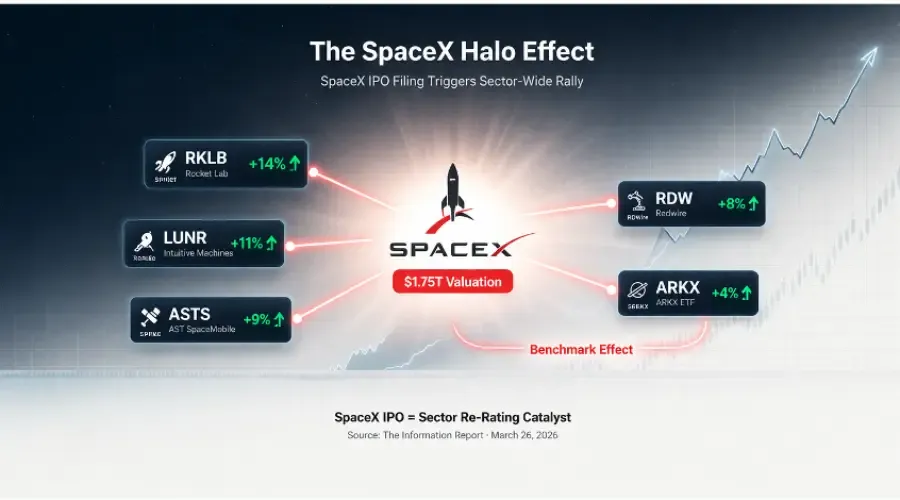
SpaceX is reportedly preparing a confidential S-1 filing, with a $75 billion raise target that would make it the largest IPO in history. The expected $1.75 trillion+ valuation is already driving a sharp move across space-related equities, with several names rallying double digits intraday.
In practical terms, this is not just an IPO—it is a sector re-rating catalyst. What changed is that private market valuations are now being translated into a potential public benchmark, forcing investors to reassess listed space companies.
The Breaking Development
Sources indicate that SpaceX may file confidentially within days, with a potential June–July 2026 listing window. The deal is expected to be led by Goldman Sachs, JPMorgan, and Morgan Stanley, with a dual-class structure preserving founder control.
The timing reflects a convergence of three major catalysts:
Starship Progress – Rapid iteration toward full reusability, with recent test flights demonstrating improved booster recovery and orbital insertion.
NASA Alignment – Deep integration with the “Ignition” lunar programme, positioning SpaceX as a primary contractor for lunar delivery and crew transport.
Starlink Scaling – Transitioning from a growth-phase investment to a recurring revenue model, with subscriber numbers surpassing 5 million.
Together, these factors support the company’s aggressive valuation framework.
Market Reaction: The “Halo Effect”
Listed space stocks responded immediately following the news. Intraday moves included:
Rocket Lab (RKLB) → +14%
Intuitive Machines (LUNR) → +11%
AST SpaceMobile (ASTS) → +9%
Redwire (RDW) → +8%
ARKX ETF → +4%
This reaction follows a familiar pattern. Previous SpaceX valuation rumours triggered multi-day rallies across the same group of stocks, suggesting that markets treat SpaceX developments as a sector-wide validation event. The current move is amplified by the prospect of a definitive public benchmark.
Why the Valuation Matters
The implied $1.75 trillion valuation is anchored in three core revenue streams:
Starlink – Scaling toward multi-billion recurring revenue, with high-margin satellite internet services.
Launch Services – Driven by reusability economics, with SpaceX commanding a dominant share of the global commercial launch market.
Government Contracts – Deeply integrated NASA and Department of Defense programmes, providing stable, long-term cash flow.
What matters is not just current revenue, but margin expansion potential. As Starlink scales and launch costs decline, the business model shifts toward operating leverage, supporting higher valuation multiples.
Spillover to Public Space Stocks: The Benchmark Effect
The IPO acts as a pricing benchmark for listed peers. If SpaceX is valued at a premium multiple, public companies with similar exposure—particularly in launch, satellite infrastructure, and lunar logistics—are likely to be reassessed.
Companies most sensitive to this shift include:
Rocket Lab (RKLB) – Direct launch competitor; the “SpaceX halo” compresses perceived risk discounts.
Intuitive Machines (LUNR) – Lunar logistics and delivery; directly comparable to SpaceX’s lunar ambitions.
AST SpaceMobile (ASTS) – Satellite connectivity; aligned with the constellation-scale narrative driven by Starlink.
Others with indirect exposure, such as Lockheed Martin and Northrop Grumman, may see more moderate impact due to diversified revenue streams.
Historical Context: IPO Spillover Effects
Past large-cap IPOs provide a useful reference. Following Tesla’s IPO, electric vehicle stocks experienced sustained valuation expansion—not because all were profitable, but because a credible public benchmark was established.
Similarly, the 2021 space SPAC wave lacked a clear industry leader, leaving valuations unanchored. A SpaceX IPO could provide that anchor, potentially enabling a more durable sector re-rating.
Risks That Could Reverse the Move
Despite strong momentum, several factors could limit or reverse the sector reaction:
Filing delay – Any postponement of the S-1 would weaken near-term momentum.
Starship test outcomes – Technical setbacks could undermine the valuation narrative.
NASA budget constraints – Future funding may not align with projected contract growth.
IPO pricing – A valuation below expectations could trigger multiple compression across the sector.
The current rally is narrative-driven. Sustained performance will depend on confirmation of these catalysts.
Timeline to Watch
- S-1 filing confirmation
- Upcoming Starship milestones
- FY2027 NASA budget release
- IPO roadshow and pricing signals
These events will determine whether the rally evolves into a sustained re-rating or remains a short-term reaction.
The Bigger Picture
This development represents more than a single IPO. It is a validation event for the entire space economy, linking private capital, government spending, and commercial execution into a single narrative.
The key question is whether the IPO converts valuation expectations into a durable benchmark. If it does, listed space companies may enter a multi-year re-rating phase. If it does not, the sector may revert to fundamentals-driven performance.
Engagement Question
If SpaceX IPOs below expectations, which public space stocks face the greatest multiple compression risk—and which have fundamental catalysts strong enough to offset it?
Disclaimer
This article is for informational and educational purposes only and does not constitute financial, investment, or trading advice. You are solely responsible for your own investment decisions and should consult a licensed financial professional before acting on any information in this post.