
BlackRock Gates $26B Private Credit Fund: What the First Major Crack in a $1.8 Trillion Industry Actually Means
BreakoutBulletin | Market Intelligence | March 7, 2026
Educational analysis only. Not investment advice. Data sourced from Reuters, Bloomberg, WSJ, and HPS fund filings.
Here's a funny thing about private credit. For the better part of a decade, it was Wall Street's favorite story. Lend money to mid-market companies that banks won't touch, collect 10–12% yields, package it up for institutional investors and—more recently—high-net-worth retail clients. The pitch was so compelling the asset class ballooned to $1.8 trillion.
Friday, the story got complicated.
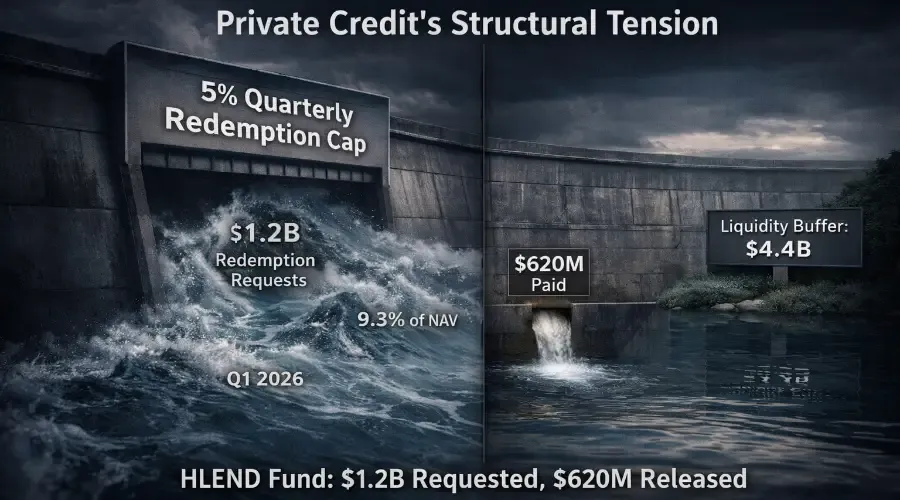
BlackRock's $26 billion HPS Corporate Lending Fund-HLEND is the ticker, acquired in last year's $12 billion HPS deal-capped withdrawals after redemption requests hit $1.2 billion in Q1. That's 9.3% of net asset value. The fund paid out $620 million, which is exactly the 5% quarterly cap that business development companies operate under. The rest? Gated. BlackRock shares fell 4.6% on the session.
This isn't a collapse. But it's the clearest signal yet that private credit's structural vulnerabilities-long understood by analysts, consistently downplayed by marketers-are now visible to the broader market.
The Numbers Behind the Gate
Let's be precise about what happened.
HLEND's $1.2 billion in Q1 redemption requests came in well above that 5% quarterly withdrawal cap. The fund approved $620 million in payouts, consistent with the rule. The remainder was held back under a provision that the fund's own prospectus explicitly disclosed as a foundational feature of the structure.
BlackRock notes the fund still holds a $4.4 billion liquidity buffer and received $840 million in new commitments during the same period. The fund isn't insolvent. It's not in distress in any conventional sense. It's exercising a contractual right that most retail investors who bought the product hadn't seriously expected to encounter.
The HPS statement frames the gate as preserving capital for "perceived opportunities amid market stress." That framing may be accurate. It also happens to be the framing every gated fund manager uses regardless of the underlying reality.
Not an Isolated Event
If HLEND were the only fund facing redemption pressure, maybe you'd call it an anomaly. It's not.
Blackstone's $82 billion BCRED-the largest private credit BDC in existence-raised its own quarterly withdrawal cap to 7.9% after facing $3.7 billion in outflows, partially offset by $400 million in firm and employee capital being put back in. Blue Owl deferred payouts in its own vehicle. Record short interest is building across private credit names simultaneously.
Three of the largest managers in the space-BlackRock, Blackstone, Blue Owl-experiencing similar stress in the same quarter? That's not coincidence. It reflects a common structural dynamic: retail investors who entered private credit funds in a lower-rate, risk-on environment are reassessing their exposure now that alternatives like public credit, money market funds, and short-duration Treasuries offer meaningfully competitive yields without the liquidity constraint.
The Structural Problem Private Credit Has Always Had
None of this is new. The mechanics that triggered Friday's gate are features, not bugs—disclosed in every prospectus, understood by institutional allocators from day one.
The liquidity mismatch is the core issue. Private credit funds hold loans with three- to seven-year durations that can't be sold quickly without significant price concessions. They offer quarterly redemption windows to investors. The structural gap between "when can I get my money back?" (quarterly, subject to caps) and "when can the fund actually liquidate its holdings?" (years) is the defining feature of the asset class.
That was always the trade-off. Investors accepted illiquidity in exchange for the yield premium. The question now is whether that premium—typically 10–12%—still feels like enough compensation given where we are: rising base rates compressing the relative advantage of private credit yields, increasing loan stress in sectors like auto parts and commercial real estate, and valuation opacity that comes from assets not marked daily.
That last point matters. Private credit portfolios aren't marked to market like public bond funds. Distress in underlying loans can be absorbed into valuation models gradually, or sometimes not acknowledged until a borrower defaults outright. No daily marks doesn't mean no risk—it means the risk is less visible until it's unavoidable.
What the Market Reaction Tells You
The equity market moved fast and directionally. BlackRock fell 4.6%. Blackstone dropped 3.3%. Ares Capital and peer BDC names declined 1–2%.
These moves reflect a specific concern: the asset management business model for private credit depends on capital staying invested. Management fees are calculated on assets under management. When redemption gates activate and new inflows slow-RA Stanger now forecasts roughly 10% year-over-year decline in BDC formations for 2026-the revenue growth assumptions embedded in asset manager valuations require revision.
The broader implication extends beyond individual stocks. Private credit represents about 15% of the alternative assets universe. Stress signals here raise questions about the stability of the $20 trillion private markets complex at a moment when the market is already navigating a Fed policy pause, elevated oil prices from the Iran conflict, and a deteriorating labor market.
That -92,000 payroll print from this morning? It lands differently when private credit is also flashing yellow.
The Framing That Matters
BlackRock's characterization of the gate as a "foundational feature" is technically accurate. The prospectus disclosed it. Institutional investors understood it.
The more relevant question is whether the retail investors who accessed HLEND through the democratization of private credit-the wealth management channel push that brought BDCs to high-net-worth individuals over the past five years-understood it with the same clarity. The volume of redemption requests suggests some portion of that capital entered with liquidity expectations the product structure was never designed to accommodate.
That mismatch between product design and investor expectation is the systemic risk concern. Not because any single fund is failing, but because the resolution of that mismatch-as investors gradually reprice their liquidity expectations and reduce exposure-is a multi-quarter process that affects capital availability across the entire private credit ecosystem.
The Bigger Picture
Private credit's fundamental proposition-lending to mid-market companies that banks no longer serve, at yields that compensate for illiquidity and credit risk-remains structurally valid. The asset class isn't going away.
What Friday's gate may mark is the end of the period where private credit was treated as a near-risk-free yield enhancement by retail allocators who underweighted the liquidity risk in their analysis. The recalibration of that assumption-slower inflows, higher redemption rates, more cautious underwriting-is the adjustment the industry is now beginning to navigate.
Whether that adjustment is orderly or disruptive depends on factors not yet visible: the pace of further redemption requests across the industry, the credit quality of underlying loan books as the macro environment softens, and whether institutional capital maintains its commitment through the current stress period.
Friday was a signal. The interpretation of what it signals will take several more quarters to resolve.
For the asset managers, it's about earnings revisions. For the institutional allocators, it's about whether the illiquidity premium still compensates. For the people who bought HLEND expecting quarterly liquidity like a mutual fund, it's the moment they found out the fine print actually matters.
The industry is now finding out what that means in real time.