
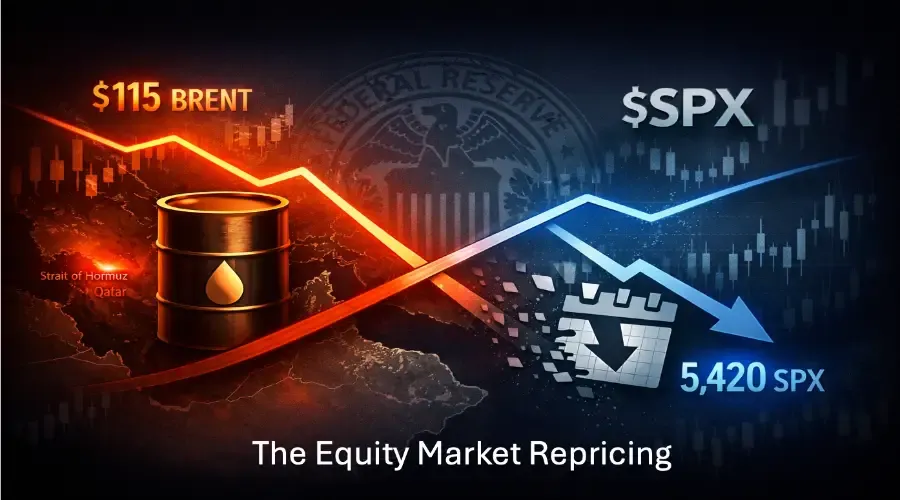
The S&P 500 falling to a year-to-date low is not a standalone equity event-it is the direct result of an oil-driven macro repricing cycle that is removing Federal Reserve flexibility. Brent crude sustaining above $115, following the Qatar LNG infrastructure strike, has forced markets to reassess inflation risk and, more importantly, the timeline for Fed rate cuts and S&P 500 valuations. What changed this week is not sentiment alone, but the removal of the rate-cut premium that had supported equity valuations into 2026.
The index closed at 5,420, down 1.8% on Thursday, marking its third consecutive weekly decline. This is not sector-specific weakness. It is a broad, cross-asset repricing event tied to a macro input that equity markets cannot internally resolve. When oil becomes the dominant driver, recovery depends not on earnings or positioning, but on external developments such as supply normalization or geopolitical de-escalation.
Quick Hits: The Repricing in Five Questions
Why did the S&P 500 hit a new year-to-date low of 5,420?
The index dropped 1.8% on Thursday, marking its third consecutive losing week, as the market repriced for a world without near-term Fed rate cuts due to sustained high energy prices.
What was the specific catalyst for the most recent spike in energy prices?
While Iran-Hormuz disruptions were ongoing, a confirmed strike on Qatar’s LNG infrastructure extended the shock from crude oil into liquefied natural gas, pushing Brent crude to $115.20.
How does oil at $115 impact Federal Reserve policy?
Historically, oil sustained above $110–$115 for 4–6 weeks adds 0.5+ percentage points to headline CPI, likely forcing the Fed to further reduce its 2026 rate-cut projections.
Why did the Russell 2000 underperform the broader market?
The Russell 2000 fell 2.4% because small-cap companies are highly sensitive to floating-rate credit and face increased pressure when rate-elevation and growth concerns strike simultaneously.
Is the current market selling driven by sector-specific issues?
No, the selling is broad and cross-sector; it is a fundamental repricing event tied to a macro geopolitical input that the market cannot resolve internally without an external catalyst like de-escalation.
What Changed This Week - The Catalyst
The defining catalyst was the Qatar LNG strike, which expanded the existing Iran-Hormuz disruption into a dual energy shock affecting both crude oil and natural gas markets. Brent crude moved to $115.20, reinforcing a supply-driven inflation scenario that extends beyond a single commodity.
In practical terms, this matters because the shock is no longer confined to oil alone. Crude feeds into transportation and fuel costs, while LNG disruptions affect industrial and utility pricing across Europe and Asia. When both markets are disrupted simultaneously, the inflationary impact becomes broader and more persistent.
That shift matters because it directly feeds into Federal Reserve policy expectations. Historically, oil sustained above $110–$115 for several weeks adds meaningful pressure to headline inflation, making it difficult for the Fed to justify easing. The current environment is forcing markets to reconsider whether even one rate cut in 2026 is achievable under these conditions. For deeper context, see Oil Shock Series - Why the Fed Cannot Cut When Oil Is at $90.
Why the S&P 500 Is Falling
The decline in equities is best understood through a simple transmission chain. Oil rises, inflation expectations increase, and the Federal Reserve becomes constrained. As rate-cut expectations are reduced, equity valuations adjust lower because the discount rate applied to future earnings rises.
The S&P 500’s drop to 5,420 reflects this process in real time. The market is not reacting to earnings disappointments or sector-specific weakness. Instead, it is removing the assumption of monetary policy support that had been embedded in valuations. This is the direct impact of oil inflation on Fed rate cuts and equity pricing dynamics.
This is why the selling is broad. Technology, consumer, and industrial sectors are all under pressure simultaneously. The only area showing consistent strength is energy, which directly benefits from higher oil prices. This narrow leadership is a hallmark of macro-driven stress rather than rotation within a healthy market.
Russell 2000 Underperformance - A Credit Signal
The Russell 2000 declined 2.4%, underperforming the broader index. This divergence is important because small-cap companies are more sensitive to credit conditions. Many rely on floating-rate borrowing and shorter refinancing cycles, making them vulnerable when interest rates remain elevated.
What changed in this environment is that two pressures are hitting simultaneously. Growth concerns are emerging due to higher energy costs, while interest rate expectations are rising. When both forces act together, small caps typically underperform, which is exactly what current data reflects.
This underperformance is not isolated. It is a signal that credit-sensitive segments of the market are beginning to feel the impact of a prolonged higher-rate environment.
The Role of Oil in Fed Repricing
Oil at $115 is not just a commodity story-it is a policy constraint. The Federal Reserve cannot control supply disruptions, but it must respond to inflation expectations. When energy prices rise sharply, they feed into CPI through both direct and indirect channels.
In practical terms, sustained high oil prices delay the timeline for rate cuts. Earlier in the year, markets were pricing multiple cuts in 2026. That expectation has now been reduced significantly, with probabilities shifting toward fewer or delayed cuts. For a deeper macro breakdown, see Intermarket Analysis Guide: Oil, Yields, and Equities.
This shift matters because equity markets had been priced for a supportive policy environment. As that assumption is removed, valuations adjust accordingly. This is the core driver behind the current decline.
Cross-Asset Confirmation - A Unified Signal
The equity selloff is being confirmed across asset classes. Treasury yields have risen sharply, reflecting inflation expectations and reduced likelihood of easing. The dollar has strengthened, indicating a move toward liquidity preference. Volatility, as measured by the VIX, has moved higher, signaling increased hedging demand.
Energy remains the only consistent outperformer, supported by direct earnings leverage to higher crude prices. This narrow market breadth reinforces the view that the current move is not rotational but structural.
What is notable is that traditional diversification is not functioning effectively. Both equities and bonds are under pressure, creating a challenging environment for balanced portfolios.
Is This a Sector Issue or a Structural Repricing?
The current selloff is not driven by sector-specific developments. It is a macro-driven repricing event. When losses occur across multiple sectors and persist over consecutive weeks, it suggests that the market is adjusting to a new set of assumptions rather than reacting to temporary news.
In this case, the assumption being adjusted is the availability of monetary policy support. The market is recalibrating for a scenario where the Fed remains restrictive for longer than previously expected.
That distinction matters because it changes how recovery occurs. Sector-driven declines can reverse with earnings or positioning changes. Macro-driven declines require changes in the underlying driver-in this case, oil prices or geopolitical conditions.
Non-Obvious Insight - What Makes This Episode Different
What makes this episode structurally different is that energy is not only raising inflation expectations but also tightening financial conditions simultaneously. Oil is acting as both an inflation driver and a liquidity constraint, accelerating the repricing cycle across equities, bonds, and credit markets at the same time.
What the Market Is Watching Now
The next phase of this narrative depends on three observable variables.
Oil Price Stability
If Brent begins to decline meaningfully, inflation expectations may ease, allowing rate-cut expectations to return.
Federal Reserve Communication
Any shift in tone regarding inflation persistence or policy flexibility would influence market expectations.
Real-Time Supply Signals
Tanker movement and energy flow data will provide early indications of whether the supply disruption is resolving or extending.
These variables form the framework through which markets will interpret incoming data.
The Bigger Picture
The week ending March 20 represents a clear transition into a stagflation-watch environment. Equities are declining, yields are rising, and inflation pressures are being driven by energy supply constraints. This combination is historically challenging because it limits policy flexibility while simultaneously pressuring growth.
What makes this episode distinct is the clarity of the causal chain. Oil above $115 leads to inflation concerns. Inflation concerns constrain the Fed. A constrained Fed removes support for equities. This sequence is visible, measurable, and currently unresolved.
Bottom Line
The S&P 500’s move to a year-to-date low is not an isolated event—it is the outcome of a macro repricing driven by energy markets. The removal of the Fed rate-cut premium is the central driver, and oil remains the key variable controlling that process.
For market participants, the focus is not on predicting short-term moves but on tracking the chain of signals that define this environment: oil prices → inflation expectations → Fed policy → equity valuations.
Until oil stabilizes, the market remains in a Fed-constrained regime, not a growth-supported one.
DISCLAIMER:
This article is for informational and educational purposes only and does not constitute financial, investment, or trading advice. You are solely responsible for your own investment decisions and should consult a licensed financial professional before acting on any information in this post.