
BREAKOUTBULLETIN · PRE-MARKET BRIEF
Friday, March 13, 2026 | 5:00 AM ET
Pre-Market Snapshot
US equity futures are carrying Thursday's losses into Friday’s open.
The latest pre-market readings show:
-
S&P 500 futures (ES): 6,690 / −1.32%
-
Nasdaq 100 futures (NQ): 24,585 / −1.59%
-
Dow futures (YM): 46,794 / −1.38%
All three indices are declining at similar magnitudes. When futures move together across major indices, the selling typically reflects macro positioning rather than sector-specific news.
The practical interpretation is straightforward: traders are reducing exposure broadly, not rotating between sectors.
A headline-driven move remains possible before the 9:30 AM ET open.
One-line takeaway: Risk reduction, not rotation.
→ Complete Pre-Market Trading Guide | breakoutbulletin.com/pre-market-trading-guide
Overnight Global Market Moves
Asian equity markets closed broadly lower, extending Thursday’s weakness in US markets.
-
Nikkei 225: −1.3%
-
Hang Seng: −0.8%
-
Shanghai Composite: −0.6%
The common catalyst across regions is oil trading near $100 while coverage of the Iran–Hormuz conflict continues.
European equity futures were still forming at briefing time. Traders typically check DAX, FTSE, and CAC levels closer to the US open to determine whether Europe is stabilizing or extending overnight weakness.
When Asia and Europe both show risk-off behaviour on the same catalyst, it signals a global macro driver rather than a localized market event.
→ Global Markets Framework for Equity Traders | breakoutbulletin.com/global-markets-framework
Today's Primary Catalyst
Friday carries no major scheduled US data release.
-
CPI: released Wednesday
-
Jobless Claims: released Thursday
The dominant catalyst today is geopolitical news flow.
Overnight reporting indicates Iranian vessels attacked two fuel tankers in Iraqi waters, while Iranian leadership signalled the Hormuz closure remains in place. Oil is consolidating near $100 per barrel.
This creates a market environment where the primary catalyst is unscheduled.
Traders cannot preview the next development. Instead, markets react to real-time geopolitical headlines.
The transmission chain is consistent:
Oil headline → crude price move → energy sector repricing → inflation expectations → Treasury yields → growth-stock valuation
Understanding that sequence helps traders focus on the initial signal rather than the secondary reaction.
→ Geopolitical Risk and Markets — Trading Framework | breakoutbulletin.com/geopolitical-risk-framework
→ Oil Shock Series: Phase Map and Exit Signals | breakoutbulletin.com/oil-shock-trading
Key Reference Levels
Reference levels function as behavioural zones, not exact price lines.
SPY
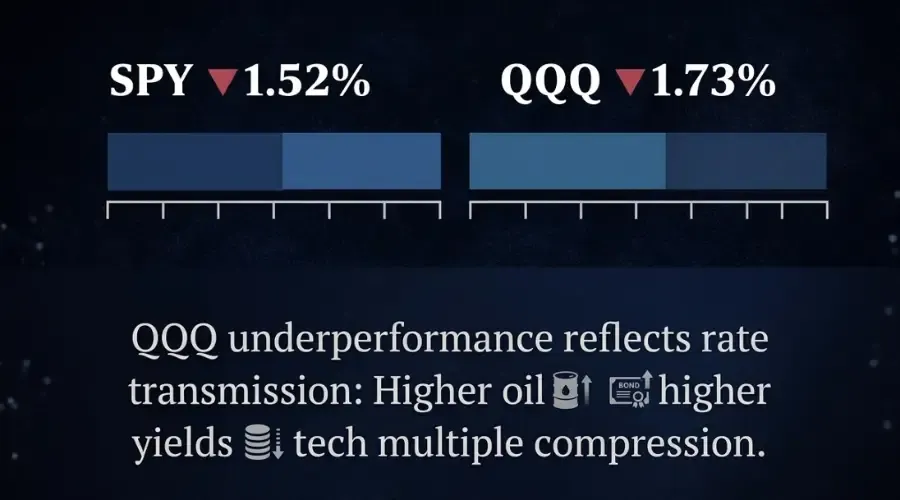
Thursday closed approximately −1.52%.
Holding above the 6,650–6,670 futures zone suggests institutional absorption rather than breakdown.
Opening below that zone and failing to recover within the first 30 minutes would indicate follow-through selling.
QQQ
Thursday closed approximately −1.73%, underperforming SPY.
The relative weakness reflects the rate-transmission mechanism:
Higher oil → higher CPI expectations → higher yields → multiple compression for technology stocks.
A recovery toward Thursday’s opening level would suggest the rate component of the selloff is stabilizing.
VIX
The volatility index is elevated following Thursday’s selloff.
-
VIX near 20: markets comfortable with current risk level
-
VIX above 28–30: increasing fear premium
→ Support and Resistance Master Guide | breakoutbulletin.com/support-resistance-guide
→ VIX Framework for Equity Traders | breakoutbulletin.com/vix-framework
Portfolio Positioning Frameworks
Different portfolios approach the same market conditions using different logic.
Tech-Heavy Portfolios
A −1.73% QQQ session produces noticeable portfolio impact.
Key question: whether positions are supported by earnings durability or primarily dependent on valuation multiples.
If oil remains near $100, yield pressure may continue affecting technology valuations.
Value-Tilted Portfolios
Energy and defensive sectors held relatively better during Thursday’s session.
Investors in value frameworks typically monitor whether the energy vs. growth leadership trend continues.
Airlines and consumer discretionary often act as early signals of stabilization.
Balanced Portfolios
Balanced allocations are watching gold and energy exposure, which partially offset equity declines earlier this week.
If geopolitical uncertainty extends into next week, portfolios often increase exposure to consumer staples and healthcare as temporary defensive allocations.
→ Position Size Calculator | breakoutbulletin.com/position-size-calculator
→ Portfolio Allocation Guide | breakoutbulletin.com/portfolio-allocation-guide
Three Intraday Structures
Markets often organize themselves into recognizable intraday structures.
Scenario A — Continued Risk Reduction
Trigger: No Iran de-escalation signal and oil remains near $100.
Structure:
-
SPY and QQQ extend losses early in the session
-
Energy stocks outperform
-
Volume increases into the close as traders reduce weekend exposure
Key signal: whether selling remains orderly or becomes accelerated.
Scenario B — Stabilization
Trigger: No new escalation headlines and crude holds steady.
Structure:
-
SPY opens lower but stabilizes near Thursday’s lows
-
Trading range remains narrow
-
Volume declines through the session
Key signal: QQQ stabilizing relative to SPY, indicating the rate component of the selloff is pausing.
Scenario C — Diplomatic Reversal
Trigger: credible diplomatic or de-escalation headline.
Structure:
-
Oil falls $5–10 rapidly
-
SPY and QQQ reverse higher
-
Airlines and consumer discretionary rally sharply
The critical test is whether the move holds beyond 30 minutes.
→ Scenario Planning Framework for Active Traders | breakoutbulletin.com/scenario-planning-framework
→ Oil Shock Series — Phase Map and Entry Signals | breakoutbulletin.com/oil-shock-trading
Other Market Events to Monitor
Federal Reserve Communication
No scheduled Fed speech appears on today’s calendar.
In quieter policy days, unscheduled commentary from Fed officials often carries greater weight.
Even informal remarks regarding oil-driven inflation can influence rate expectations.
Corporate Earnings
Peak earnings season has already passed.
No major S&P 500 or Nasdaq 100 mega-cap company is scheduled to report today.
Mid-cap results may provide sector signals but are unlikely to drive index movement on a geopolitically driven session.
Weekend Risk
Weekend exposure matters because markets cannot adjust positions until Monday’s futures open.
Geopolitical developments during that window can create opening price gaps.
→ Federal Reserve Policy Analysis Guide | breakoutbulletin.com/federal-reserve-guide
→ Post-Market Framework and Weekend Positioning | breakoutbulletin.com/post-market-framework
Bottom Line
Friday’s session begins with the market carrying Thursday’s losses into a day without scheduled macro catalysts.
The dominant variable remains Iran-related geopolitical developments.
Two reference signals are guiding positioning:
-
QQQ relative stability vs SPY, indicating whether rate pressure is moderating
-
Crude oil near $100, indicating whether supply disruption concerns persist
Position sizing becomes the central decision on a Friday with geopolitical weekend risk.
Professional traders often focus on gradual exposure adjustments rather than wholesale portfolio shifts.
The objective is simple: maintain positions at a size that can be held through a weekend headline without forcing a reaction at Monday’s open.
Focus on structure.
Allow price action to confirm the narrative.
— BreakoutBulletin Pre-Market Desk
DISCLAIMER
This pre-market brief is published for informational and educational purposes only. It does not constitute financial or investment advice. Trading and investing involve substantial risk. Always conduct independent research and consult a licensed financial professional before making investment decisions.