
Pre-Market, Monday, February 23, 2026
U.S. stock futures are modestly lower in early trading as investors position ahead of February’s Flash PMI data, renewed tariff uncertainty, and Nvidia earnings later this week.
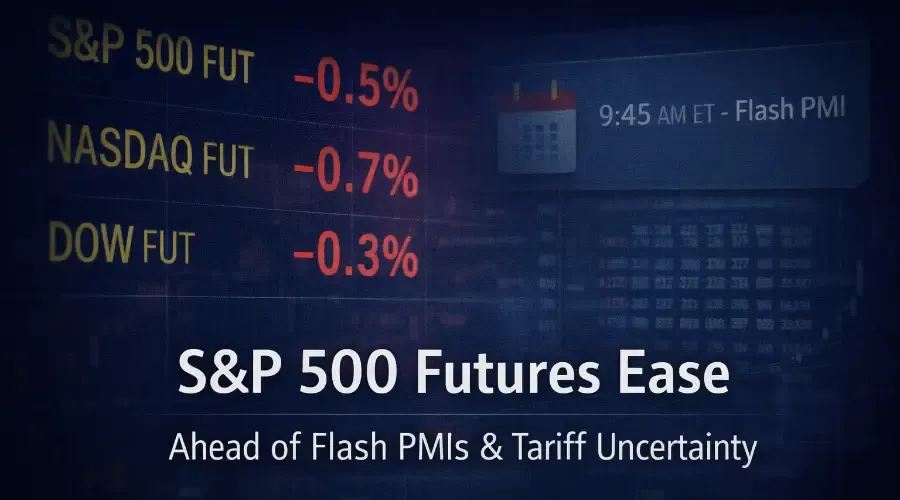
S&P 500 futures are down approximately 0.4–0.5%, Nasdaq 100 futures are lower by 0.5–0.7%, and Dow Jones futures are off 0.25–0.4%. The move follows Friday’s close, where the S&P 500 settled at 6,909.51.
The pullback reflects cautious positioning into a catalyst-heavy session, with growth stocks showing the most immediate pressure.
Global Markets: Asia Mixed, Europe Lower
Overnight markets offered a mixed but cautious backdrop.
In Asia, the Hang Seng rose approximately 2.5%, as traders interpreted the Supreme Court challenge to prior U.S. tariffs as potential relief for Chinese exporters. The Nikkei 225 and Shanghai Composite were closed for holiday, though their prior sessions showed pullbacks near 1%.
European equities opened lower, with the DAX down 0.7%, the CAC 40 off 0.4%, and the FTSE 100 lower by 0.2%.
The divergence highlights how U.S. tariff headlines are producing regional dispersion while U.S. stock futures remain under pressure.
9:45 AM ET Catalyst: S&P Global Flash PMIs
The primary domestic catalyst arrives at 9:45 AM ET with the release of February’s S&P Global Flash PMIs for Manufacturing, Services, and Composite activity.
These high-frequency indicators provide real-time insight into business activity, demand trends, and input cost pressures. Equity markets typically react through the rates channel, making Treasury yield movement an important confirmation signal.
If PMI data is weaker than expected, such as services below 52 or manufacturing contracting, Treasury yields often ease as growth expectations moderate. Rate-sensitive sectors including Utilities (XLU) and Real Estate (XLRE) may stabilize. Traders then evaluate whether defensive rotation emerges.
If PMI data is stronger, for example services above 55 or elevated prices paid components, expectations for Federal Reserve rate cuts may shift further out. That may place upward pressure on yields. Higher-multiple technology names, particularly within the Technology Select Sector SPDR (XLK), may face valuation compression.
Initial reaction often defines early momentum. Afternoon follow-through determines durability.
Key Technical Levels to Watch
These are structural reference areas where institutional positioning may adjust.
For SPY, the 6,880–6,900 zone represents the prior session low and recent consolidation area. Holding this range suggests dip-buying is absorbing early selling pressure. Sustained trade below 6,860 may accelerate downside toward the next structural support zone.
For QQQ, the $600–$602 area represents psychological and technical support from prior swing lows. A hold here signals potential resilience in growth names. A decisive break below $600 often triggers technical selling toward the low $590s.
A reclaim above $608 reduces near-term downside pressure. A move through $610 would suggest pre-market weakness was a false start.
Price behavior at these levels offers more reliable guidance than headlines alone.
How Different Portfolios May Approach the Session
Portfolio positioning frameworks differ depending on exposure.
For tech-heavy portfolios with elevated mega-cap allocations, managers face dual considerations: near-term weakness in Nasdaq futures and the binary event risk of Nvidia earnings later this week. Exposure calibration becomes central. If NVDA rallies following earnings, participation sizing matters. If QQQ breaks $600, downside risk parameters must already be defined.
For tech-light or value-oriented portfolios, immediate action may not be required. The focus shifts to whether tariff concerns spread into cyclicals such as Industrials (XLI) and Financials (XLF), and whether selling remains contained or broadens across the index.
Balanced portfolios monitor sector rotation for institutional conviction. If defensive sectors such as Health Care (XLV) and Consumer Staples (XLP) outperform cyclicals, it confirms a defensive tilt. Uniform declines across sectors suggest broader de-risking rather than rotation.
Adjustments are typically incremental rather than directional. Capital preservation remains central amid policy ambiguity.
Three Intraday Structures to Prepare For
Professionals prepare for structural possibilities rather than predictions.
In a data-driven reversal scenario, a significant PMI surprise triggers an initial sharp move followed by reassessment. Traders monitor Treasury yields for confirmation, evaluating whether rate movement aligns with equity response.
In a tariff drift scenario, in-line data combined with continued policy uncertainty produces a low-volatility grind lower. Sellers lean on key levels, and buyers remain patient. Reaction at QQQ $600 and SPY 6,880 becomes instructive.
In a tech-led absorption scenario, resilience in mega-cap names such as NVDA and GOOGL allows the AI complex to stabilize even if cyclicals remain soft. Breadth within semiconductors (SOXX) determines whether strength is narrow or expanding.
Other Events to Monitor
Existing Home Sales (10:00 AM ET) provides insight into housing turnover and impacts homebuilders such as XHBand ITB.
Nvidia earnings later this week continue to influence positioning across the growth complex, even with a modest pre-market move of approximately +0.2%.
Ongoing tariff headline risk remains a potential intraday catalyst, particularly for trade-sensitive sectors including Industrials (XLI) and Semiconductors (SOXX).
After-hours developments will influence the following session’s structure more than intraday fluctuations.
Bottom Line
Today’s setup reflects the convergence of U.S. trade policy uncertainty, Flash PMI economic data, and anticipation surrounding Nvidia earnings.
This is a session defined by structure rather than prediction.
The key behavioral zones remain:
-
QQQ: $600
-
SPY: 6,880
How price behaves around these areas will shape the tone of the session.
U.S. stock futures are indicating a softer open, but durability depends on data response, yield confirmation, and sector rotation.
Institutional focus remains on defined reference levels, exposure calibration, and incremental adjustments rather than large directional shifts.
Let price confirm the narrative.
Educational Disclaimer
This article is provided for educational and informational purposes only and does not constitute financial advice, investment advice, or a recommendation to buy or sell any security. It reflects analysis of publicly available market data and structural scenarios, not forecasts or guarantees. All investing involves risk, including the potential loss of principal. Past performance does not guarantee future results. Readers should consult a qualified financial professional before making investment decisions. The views expressed are subject to change based on evolving market conditions.