
BreakoutBulletin | Pre-Market Desk | March 7, 2026
Educational commentary only. Not investment advice.
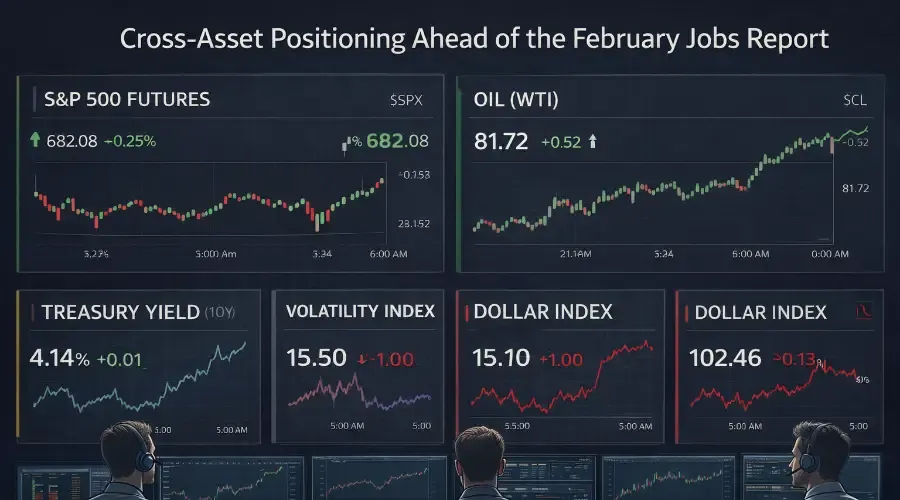
Two forces are shaping today's U.S. session: the February labor market report and an ongoing geopolitical oil shock linked to Iran. Equity futures are modestly lower ahead of the 8:30 AM ET data release, while Treasury yields remain elevated and volatility has been climbing throughout the week. Markets are entering the session with mixed positioning rather than directional conviction.
Pre-Market Snapshot
U.S. index ETFs are trading slightly below their pre-market averages ahead of the economic data block.
Pre-Market Levels
SPY: 682.08 — 0.2% below pre-market VWAP (683.64)
QQQ: 607.45 — 0.3% below VWAP (609.21)
DIA: 481.85 — 0.1% below VWAP (482.36)
The divergence between the Dow and Nasdaq remains the dominant signal. Dow-linked cyclicals are under pressure. Nasdaq tech continues to hold relative strength. This is rotation under stress, not a broad liquidation. Oil-linked cost pressure is weighing on cyclicals while technology remains supported.
Overnight Moves
Global markets entered the U.S. session with elevated risk sentiment. Asian equities are experiencing their worst weekly performance in six years, with regional markets down more than 6% for the week as oil and geopolitical headlines pressured risk appetite. Chinese mainland equities remain comparatively stable at around −1% weekly, supported by policy announcements and new growth targets.
European equities opened marginally higher Friday after a sharp decline earlier in the week. Earlier sessions saw sharp declines: Euro Stoxx 50 −3.6%, DAX −3.4%, CAC −3.5%. Today's green open reflects stabilization, not reversal. Institutional flows exiting Asia frequently affect U.S. futures positioning, particularly in technology and semiconductor companies with regional revenue exposure.
The 8:30 AM Data Block
The February labor market report arrives into a market already dealing with elevated oil prices and geopolitical risk.
Key releases arriving simultaneously at 8:30 AM ET:
-
Non-Farm Payrolls: 150k consensus vs 130k prior
-
Unemployment Rate: 4.3%
-
Average Hourly Earnings: 3.7% YoY
-
Retail Sales: −0.3% MoM (separate release)
-
Core Retail Sales: 0.1% (separate release)
The transmission mechanism follows a familiar sequence: NFP → Rate Expectations → Treasury Yields → Equity Valuation. However, today that chain interacts with a second driver: oil-driven inflation risk.
Possible structural reactions include:
Weaker payrolls: Rate-cut expectations move forward, Treasury yields ease from 4.14%, technology stocks receive relief bids.
Stronger payrolls: Yields extend above 4.14%, rate-cut expectations shift, growth equities face valuation pressure.
Retail sales introduce a secondary signal about consumer demand conditions prior to the oil shock. Early reaction typically occurs immediately after 8:30 AM, but sustained directional moves usually emerge between 9:45–10:30 AM ET.
Key Levels to Watch
Levels represent behavioral zones, not predictive signals.
SPY — 682.08
Key areas:
-
683.64: Pre-market VWAP
-
680: Lower weekly boundary
Acceptance below 680 would represent a break of the week's trading range.
QQQ — 607.45
Important areas:
-
609.21: VWAP reclaim threshold
-
604–605: Prior positioning support
-
600: Structural downside level
DIA — 481.85
The Dow remains the weakest index. Key levels:
-
480: Structural support
Industrial and energy-sensitive names remain vulnerable to oil-cost pressure.
How Different Portfolios May Think
These examples illustrate positioning frameworks rather than investment guidance.
Tech-Heavy Portfolio: Technology-focused portfolios review exposure ahead of the labor report because data releases can move Nasdaq futures 1–2% within minutes. The mild pre-market bid in Nasdaq futures suggests tentative demand, but trading below VWAP indicates limited conviction.
Cyclical Portfolio: Dow-weighted sectors face three simultaneous pressures: higher energy input costs, potential consumer slowdown, and elevated interest rates. Portfolio managers are watching whether the labor data changes the yield trajectory around 4.14%.
Balanced Portfolio: Balanced allocations monitor cross-asset signals simultaneously: technology resilience, cyclical weakness, elevated volatility, and rising yields. Managers typically adjust sector exposures gradually rather than reacting to the initial data print.
Three Intraday Structures
Relief Rally
Trigger: weak labor data and easing yields. Possible structure: QQQ reclaims 609.21, tech leads recovery, Dow lags but stabilizes. Professionals watch for volume confirmation.
Stagflation Interpretation
Trigger: weak labor combined with elevated oil prices. Possible structure: recession narrative emerges, cyclicals weaken further, Nasdaq gives back gains.
Hawkish Data Reaction
Trigger: stronger payrolls and rising wages. Possible structure: yields extend above 4.14%, tech faces pressure, Dow declines slow but remain sensitive to oil costs.
Other Events to Monitor
Federal Reserve Communication: Fed Governor Waller speaks at 6:30 PM ET—his comments on the labor data and oil inflation will be watched closely.
Pre-Market Movers: TTD +17% following reports of potential OpenAI advertising partnership discussions. VEEV +11% after strong guidance. Neither company materially affects index positioning but provides insight into enterprise software demand conditions.
Geopolitical Developments: Iran signaled it's not seeking war but also sees "no reason to negotiate" —leaving markets guessing on escalation. Geopolitical headlines remain capable of overriding macro data reactions.
Bottom Line
Two forces entered the trading floor this morning: labor data and oil risk. By 9:00 AM, one will emerge as the dominant narrative. The market's job is to decide which. The trader's job is to watch the levels—680 on SPY, 609 on QQQ—and react to what actually happens, not what was expected.
Process over prediction. That's how professionals navigate days like this.
*BreakoutBulletin | Pre-Market Desk | March 7, 2026*
Educational commentary only. Not investment advice. All market data reflects observed pre-market indications and should be independently verified. No content constitutes a recommendation to buy or sell any security.