
Published: March 21, 2026
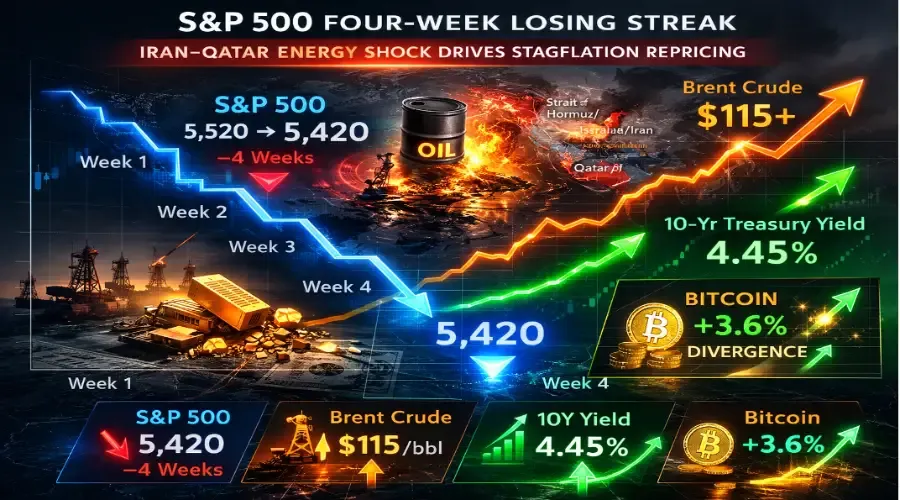
The S&P 500’s fourth consecutive losing week is not an isolated equity event-it reflects a systematic repricing driven by the Iran-Qatar energy shock 2026. Brent crude sustaining above $115 has reinforced inflation pressure while simultaneously removing the Federal Reserve’s ability to ease policy. What changed this week is the continued erosion of the Fed rate-cut premium repricing, which had supported equity valuations through 2025 and into early 2026. The index closed near 5,420, marking a year-to-date low and extending a four-week decline. This is not sector-specific weakness but a broad, cross-asset repricing event tied to a macro driver markets cannot internally resolve. When energy becomes the dominant input, valuation frameworks shift and recovery becomes dependent on external developments such as supply normalization or geopolitical de-escalation.
Key Takeaways
The S&P 500 fourth consecutive losing week confirms a macro-driven repricing rather than a temporary correction. The Qatar LNG infrastructure strike expanded the energy shock beyond crude into natural gas, reinforcing inflation pressure across global markets. The 10-year Treasury yield at 4.45% reflects the bond market adjusting to fewer rate cuts. The gold safe-haven breakdown highlights the dominance of real yields and dollar strength over traditional risk-off behavior. Energy sector outperformance (XLE) remains the only consistent positive allocation, while Bitcoin equity divergence adds a new dimension to the macro framework.
What Changed This Week - The Catalyst
The defining catalyst was the expansion of the energy shock from crude oil into liquefied natural gas following the strike on Qatar’s infrastructure. This development matters because it introduces a dual disruption across two critical energy markets. Crude oil feeds directly into transportation and fuel costs, while LNG disruptions influence industrial production and electricity pricing across major economies. In practical terms, inflation expectations are no longer theoretical-they are being priced into markets in real time. That shift matters because it directly constrains Federal Reserve policy. With inflation risks rising, the ability to cut rates is reduced, forcing markets to adjust to a higher-for-longer rate environment.
Why the S&P 500 Is Repricing
The decline in equities follows a clear transmission mechanism. Oil rises, inflation expectations increase, and the Federal Reserve becomes constrained. As rate-cut expectations are reduced, the discount rate applied to equity cash flows rises, compressing valuations. The move to 5,420 reflects this process in real time. The market is not reacting to earnings weakness but to the removal of monetary policy support embedded in valuations. This explains the broad-based selling across sectors, with only energy showing consistent strength due to direct earnings leverage from higher oil prices.
Sector Dynamics - A Narrow Leadership Market
Sector performance reflects a macro stress configuration rather than a traditional rotation. Energy sector outperformance (XLE) is driven by rising crude prices and direct revenue leverage. Defensive sectors such as utilities and consumer staples held relatively stable as capital rotated out of growth. Technology faced the sharpest pressure due to its sensitivity to higher discount rates, while consumer discretionary and industrials were impacted by rising input costs and growth concerns. This narrow leadership indicates a market driven by macro forces rather than internal sector dynamics.
Cross-Asset Signals - When Diversification Fails
The week delivered a rare and important signal across asset classes. Equities declined, the 10-year Treasury yield rose to 4.45%, and gold fell toward $4,720. This combination reflects a breakdown in traditional diversification. Bonds are not providing a hedge because inflation expectations are eroding real returns, while gold is under pressure from rising real yields and dollar strength. This is the classic 60/40 portfolio diversification failure, where both equities and fixed income decline simultaneously. In this environment, oil is not a hedge-it is the cause.
Emerging Market Stress - The Hidden Layer
While US markets dominated headlines, a structurally important development occurred in emerging markets. Rising oil prices triggered a sharp increase in India’s bond yields alongside currency weakness. This matters because emerging market financial stress feeds back into global growth expectations. When major energy-importing economies face tightening financial conditions, it adds pressure to global demand and amplifies the growth concerns already affecting US equities.
Bitcoin Divergence - A New Signal
Bitcoin rose during the same period that equities and gold declined, creating a notable divergence. This Bitcoin equity divergence challenges traditional correlations and suggests that digital assets may be responding to a different set of drivers. One interpretation is that Bitcoin is acting as a macro hedge against currency debasement and inflation. Another is that it reflects a separate investor base less affected by traditional portfolio pressures. This divergence introduces a new variable into the macro framework that requires continued observation.
The Macro Regime - Stagflation in Motion
The current environment reflects a clear market stagflation regime defined by three simultaneous conditions: an energy-driven inflation shock, a Federal Reserve constrained in its ability to ease, and an equity market adjusting to a higher discount rate environment. What is notable is the orderly nature of the decline. This is not panic-driven selling but a systematic repricing of valuations. Such repricing typically persists until the underlying driver-in this case, oil prices-changes direction.
Bottom Line
The S&P 500 fourth consecutive losing week is the result of a macro repricing driven by energy markets. The removal of the Fed rate-cut premium is the central driver, and oil remains the key variable shaping market behavior. For market participants, the focus remains on the transmission chain: Oil → Inflation → Fed policy → Discount rates → Asset valuations. As long as oil remains elevated, markets remain in a Fed-constrained, inflation-driven regime where traditional diversification and valuation assumptions do not hold.
Disclaimer
This article is for informational and educational purposes only and does not constitute financial, investment, or trading advice. You are solely responsible for your own investment decisions and should consult a licensed financial professional before acting on any information in this post.