
Weekly Scoreboard
| Asset | Open | Close | Weekly % | Key Driver |
|---|---|---|---|---|
| S&P 500 | 6,909.51 | 6,878.88 | −0.45% | Jobs Shock | War Premium |
| Nasdaq 100 | 22,886.07 | 22,668.21 | −0.95% | Tech Profit-Taking | AI Re-Rating |
| Dow Jones | 49,626.00 | 48,977.92 | −1.30% | Cyclical | Financial Weakness |
| Russell 2000 | 2,663.78 | 2,632.37 | −1.18% | Small-Cap Credit Sensitivity |
| 10Y Yield | 4.05% | 4.15% | +10 bps | Inflation Re-Pricing on Oil Spike |
| DXY | 99.32 | 99.03 | −0.29% | Growth Fear Offsets Dollar Bid |
| Gold | — | — | Modest Gain | Safe-Haven Bid | Data Uncertain |
| WTI Crude | ~$72 | ~$90 | +20–25% | Hormuz Shipping Halt |
| Bitcoin | ~$68,500 | ~$68,800 | Flat / Slightly Lower | Risk-Off | Crypto Sideways |
In practical terms, the market faced two powerful catalysts simultaneously this week: a sharp geopolitical oil shock and the first negative payroll print in years. Together, they forced investors to reassess both inflation expectations and growth assumptions.
The Week's Dominant Narrative
Markets began the week already reacting to developments that unfolded over the weekend. Escalation involving Iran and disruption of shipping through the Strait of Hormuz pushed oil prices sharply higher before U.S. markets even opened.
WTI crude quickly moved above levels last seen during the early-2025 supply shock. That shift revived questions investors had largely set aside in recent months: what sustained $90 oil means for inflation, for consumer spending, and for the Federal Reserve's policy flexibility.
During the first half of the week, markets wrestled with competing narratives. On one side was the inflationary implication of higher oil prices. On the other was a growing sense that economic momentum might be softer than headline indicators suggested.
Friday's Bureau of Labor Statistics release shifted that balance. The report showed minus 92,000 payrolls against expectations of plus 60,000, breaking the assumption that employment strength would continue to support the soft-landing narrative.
The reaction across markets reflected this shift. Equities declined. Treasury yields initially fell before reversing higher by the end of the week. The VIX moved from the low-20 range into the high-20s.
What changed here was the pattern of sector and asset performance. Defensives held relatively steady, energy remained strong, and growth-sensitive sectors such as technology and financials weakened.
From a structural standpoint, that combination describes a market pricing slower growth alongside higher inflation pressures.
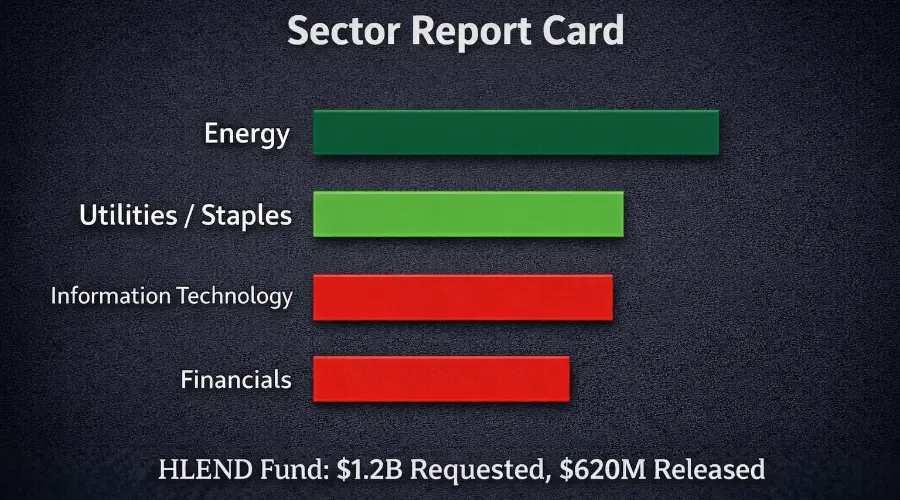
Sector Report Card
Sector performance this week reflected a clear regime rotation rather than random movement.
| Sector | Performance | Key Driver |
|---|---|---|
| Energy | 🟢 Leading | Direct beneficiary of crude surge to $90 |
| Utilities | 🟢 Resilient | Capital rotation to defensives |
| Consumer Staples | 🟢 Resilient | Stable demand in uncertain macro |
| Technology | 🔴 Lagging | Valuations adjust to rising rates |
| Financials | 🔴 Weak | Yield curve pressure + private credit concerns |
Energy led the market, benefiting directly from crude oil's rapid rise toward $90. Higher oil prices translate quickly into revenue expectations for producers, explaining the sector's relative strength.
Utilities and Consumer Staples followed closely behind. Their resilience did not reflect improving fundamentals but rather capital rotation. In uncertain macro environments, investors often seek sectors with stable demand and predictable earnings.
The lagging sectors tell the broader story.
Information Technology declined as valuations adjusted to a more complicated macro backdrop. Much of the sector's expansion since late 2024 relied on a stable rate environment and strong consumer demand.
Financials weakened for different reasons. Rising long-term yields pressure lending margins, while renewed attention on private credit risks added another layer of concern.
Taken together, the sector pattern was clearly defensive. Market leadership concentrated in energy and defensive sectors while growth-oriented industries lagged.
Cross-Asset Report
Cross-asset behaviour this week revealed several notable divergences.
| Asset | Movement | Signal |
|---|---|---|
| WTI Crude | ▲ +20–25% | Geopolitical shock dominant |
| Dollar (DXY) | ▼ −0.29% | Growth fears > inflation concerns |
| 10Y Yield | ▲ +10 bps | Inflation risk being repriced |
| Gold | ▲ Modest | Cautious safe-haven flow |
| Equities | ▼ Broadly lower | Risk-off dominates |
Crude oil's 20–25% weekly surge was the dominant signal. It lifted energy equities but simultaneously pressured rate-sensitive and growth-sensitive assets.
Typically, an oil shock of this magnitude strengthens the U.S. dollar through safe-haven demand and inflation expectations. This week, however, the DXY fell slightly.
That divergence matters. A weaker dollar during an oil spike suggests currency markets may be assigning greater weight to potential U.S. growth weakness than to inflation pressures.
Treasury yields moved higher alongside oil prices, reinforcing the idea that inflation risk is being repriced. At the same time, equities declined.
Gold's modest gain fits within this environment. It reflects cautious positioning rather than an aggressive flight to safety.
The Story Mainstream Media Missed
The most widely reported themes of the week were oil and employment data. Less attention was given to developments within the private credit market.
BlackRock restricted withdrawals from its $26 billion HLEND private credit vehicle after redemption requests exceeded the 5% quarterly cap. The restriction was contractual and not unexpected in structure.
However, the event highlights an important structural feature of the private credit industry.
Retail capital has flowed into business development company (BDC) structures offering periodic liquidity. The underlying loans supporting those vehicles, however, often carry multi-year maturities and limited price transparency.
That mismatch between investor liquidity expectations and underlying asset liquidity has always been present. The HLEND redemption cap illustrates how that structure functions when redemption requests exceed the permitted threshold.
For investors, this serves as a reminder: liquidity terms matter. Vehicles offering quarterly withdrawals while holding illiquid assets create structural risk that only becomes visible during stress.
Crypto Weekly
Bitcoin finished the week largely unchanged, moving from the upper $68,000 range to just below $69,000.
In absolute terms, that movement was minimal. In relative terms, it was notable given the broader market environment.
Equities experienced their weakest week since October, the VIX climbed into the high-20 range, and oil recorded one of its largest weekly moves in years.
Despite those developments, Bitcoin remained broadly stable. It neither rallied strongly as a safe-haven asset nor declined sharply alongside risk assets.
The correlation story is shifting. Bitcoin's 30-day correlation with the Nasdaq currently sits at 0.42, down from 0.68 in January. This week's divergence—Nasdaq down nearly 1% while BTC held flat—suggests spot buyers are absorbing macro selling pressure. It also hints at capital rotating out of tech equities into hard assets and alternative stores of value.
Ethereum traded slightly weaker earlier in the week, broadly following the tone of the wider crypto market before stabilizing.
The overall takeaway is that crypto assets currently appear to be behaving as neutral macro assets, showing limited correlation with either traditional safe-haven flows or risk-on sentiment.
What This Week Tells Us About the Macro Regime
This week did not establish a new macro regime by itself. It did, however, highlight the vulnerabilities within the prevailing narrative.
The soft-landing framework relied on three assumptions:
-
Continued disinflation
-
Steady employment growth
-
Sufficient policy flexibility from the Federal Reserve
Each of those assumptions faced pressure this week.
Oil prices near $90 challenge the disinflation trend. Negative payroll growth challenges the assumption of persistent labour market strength. Together, they complicate the policy environment for the Federal Reserve.
Market behaviour by the end of the week reflected these tensions.
Energy and defensive sectors led performance. Technology and financials weakened. The dollar softened despite higher oil prices. Volatility moved higher.
These cross-asset signals suggest investors are reassessing the macro environment in light of new information.
Whether that reassessment proves temporary or persistent will depend on future economic data.
Tactical Takeaways
For traders positioning into next week, several signals warrant attention:
-
Defensive rotation likely continues until the VIX shows sustained signs of peaking below 25.
-
Energy strength may persist but traders should monitor whether crude holds $85+ or begins mean-reverting.
-
Tech remains vulnerable to multiple compression if the 10-year yield pushes toward 4.30%.
-
Bitcoin's decoupling from equities bears watching—if it holds while Nasdaq weakens, it signals genuine capital rotation.
ETF traders may consider: monitoring XLP (Staples) and XLE (Energy) for relative strength holds, while reducing exposure to XLK (Tech) until volatility settles. These are observations on sector behaviour, not specific recommendations.
Looking Ahead
Next week's CPI print will be the first major test of whether the oil shock is feeding into core inflation.
-
If core CPI surprises higher: Expect the defensive rotation to accelerate. Yields push higher, growth sectors face additional pressure, and the Fed's policy path becomes more constrained.
-
If core CPI remains contained: Markets may attempt a relief rally in beaten-down growth names, though the payroll damage will limit enthusiasm.
Additionally, watch for further private credit headlines. The BlackRock HLEND story has introduced a new variable into market psychology. Any additional redemption caps or liquidity concerns could amplify financial sector weakness.
DISCLAIMER :
This article is for informational and educational purposes only and does not constitute financial, investment, or trading advice. You are solely responsible for your own investment decisions and should consult a licensed financial professional before acting on any information in this post.