
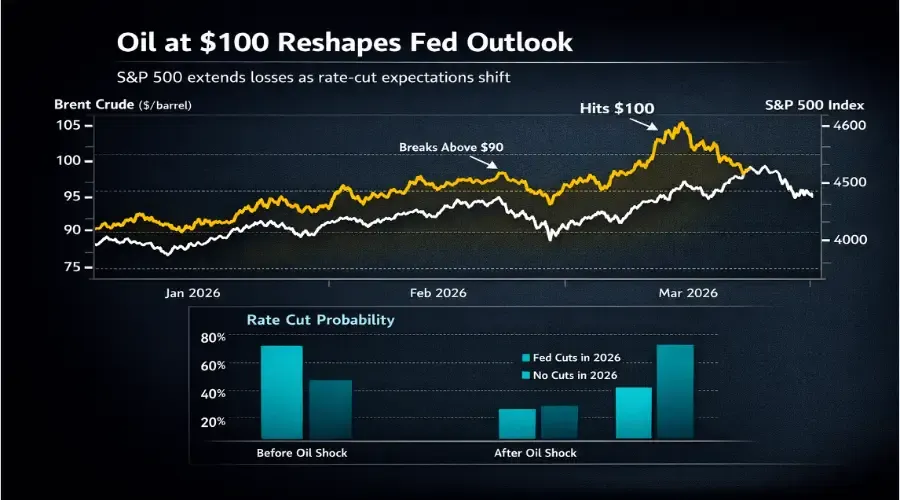
US equities ended the week under pressure as crude oil's surge toward triple-digit territory began reshaping how markets price the Federal Reserve's policy path. The S&P 500, Nasdaq, and Dow are navigating a macro environment that has shifted quickly from a "rate cuts ahead" narrative to a more complicated reality: an oil-driven inflation shock that could delay monetary easing.
This is not simply a story about a weak trading session. It is a story about a potential macro regime shift. When crude oil sustains levels above $100 because of real supply disruptions rather than speculative trading, the assumptions behind the market's interest-rate outlook change rapidly.
The current shock originates in escalating tensions around Iran and the Strait of Hormuz. Tanker attacks in Iraqi waters, operational suspensions at key export terminals, and disruptions to Gulf shipping routes have created a situation where oil markets are reacting to physical supply risk, not just geopolitical headlines. Brent crude briefly moved back above $100 this week while WTI followed close behind, triggering a chain reaction across financial markets.
Why Oil Above $100 Pressures Stocks
The stock market's reaction is not simply about energy prices rising. The real issue is what oil does to inflation and, by extension, to Federal Reserve policy. The consensus entering the year assumed that inflation would continue drifting lower, allowing the Fed to begin cutting interest rates during 2026.
That assumption depended heavily on energy prices remaining stable.
When oil climbs from roughly $70 to above $100, the inflation math changes. Historical estimates from the Federal Reserve and international policy institutions suggest that every $10 increase in oil can add roughly 0.25–0.30 percentage points to headline CPI. The current move therefore implies close to 0.8 percentage points of additional inflation pressure if the price shock persists.
Markets immediately begin adjusting expectations. If inflation risks remain elevated, the Federal Reserve may not be able to cut rates as soon as investors anticipated. That forces a repricing across equity markets because the value of stocks depends heavily on the discount rate applied to future earnings.
Tech and growth stocks are particularly sensitive to this mechanism. Their valuations depend on earnings far into the future, meaning higher interest rates reduce the present value of those cash flows. That is why the Nasdaq has been especially vulnerable during the recent selloff.
The Market Signal: This Is an Inflation Shock, Not a Growth Scare
One of the most telling signals this week came from the macro data itself. Jobless claims and housing starts both surprised to the upside, suggesting the US economy remains resilient. In a normal environment, stronger economic data would support equities.
Instead, stocks continued to decline.
This reaction indicates that investors are not worried about a recession. The dominant concern is that inflation could stay higher for longer, preventing the Federal Reserve from easing policy. When positive economic data fails to lift markets, it usually signals that monetary policy expectations—not growth fears—are driving price action.
Cross-asset markets reinforce that interpretation. Treasury yields initially fell as investors sought safety but then reversed higher as inflation expectations were repriced. The US dollar strengthened as markets reduced expectations for rate cuts, tightening global liquidity conditions.
At the same time, volatility increased. The VIX moved higher as investors priced in geopolitical risk and the possibility of continued market swings heading into the weekend. Energy stocks remained the clear outperformance zone while rate-sensitive sectors such as technology, airlines, and consumer discretionary stocks faced pressure.
This pattern is characteristic of an oil-driven inflation shock rather than a financial-system event. The economy itself is not collapsing; instead, the macro environment is becoming less friendly to valuations.
Positioning vs. Repricing: Two Different Market Reactions
A useful framework for understanding the current moment is the distinction between positioning adjustments and fundamental repricing.
The market is currently in a positioning phase. Investors who built exposure based on expectations of a 2026 Fed cutting cycle are reducing those positions. This can resolve relatively quickly—if oil retreats toward $85 and geopolitical tensions ease, the rate-cut narrative could revive just as rapidly as it faded.
A repricing phase would be more consequential. That would require confirmation from economic data that the inflation shock is durable. If the next two CPI reports show accelerating headline inflation driven by energy components, markets would need to reconcile equity multiples with a genuinely higher-for-longer rate environment, not just a delayed cut.
For now, markets are adjusting positions while waiting for data that will determine whether a deeper repricing is warranted.
Why Energy Is the Only Clear Winner
When oil prices surge due to supply disruption, sector performance tends to narrow dramatically. Energy companies benefit directly from higher crude prices through increased revenue and cash flow. Meanwhile, industries that rely heavily on fuel—airlines, transportation firms, and logistics companies—face immediate cost pressure.
Consumer sectors can also struggle because higher energy prices act like a tax on household spending. When gasoline and energy bills rise, discretionary consumption often falls. That dynamic can gradually slow economic momentum even if the initial shock originates outside the domestic economy.
The result is a market with narrow breadth. When only one sector is consistently outperforming, it usually reflects macro stress rather than broad investor confidence.
A Divergent Signal: Private Credit Valuations
A separate risk factor—operating on a different timeline and transmission mechanism than the oil shock—also emerged this week. Glendon Capital Management publicly challenged the valuation practices of Blue Owl Capital's private credit portfolios, raising questions about how certain assets are marked during periods of economic uncertainty.
Why this does not drive today's index moves: private credit valuation disputes resolve over months, not sessions. The mechanism from "valuation question raised" to "market-moving repricing" involves regulatory responses, auditor reviews, and investor redemption cycles. The oil shock mechanism, by contrast, updates at every crude futures tick.
Why it matters on the margin: if energy-driven inflation begins to pressure corporate borrowers—through higher input costs or reduced consumer spending—credit quality could deteriorate. In that scenario, valuation disputes in private credit markets might attract greater scrutiny.
For now, this risk remains structural rather than immediate, but it is worth monitoring as a potential amplifier of broader market stress.
What This Means for Different Portfolios
For growth-heavy portfolios, the primary issue is valuation compression. Technology and AI companies have not suddenly become less profitable this week. What has changed is the discount rate investors apply to those future earnings streams. If the expected timeline for Fed rate cuts moves further into the future, growth valuations face continued pressure.
Defensive portfolios have fared better in the current environment. Energy stocks, gold, and certain consumer staples have held up relatively well as investors rotate toward assets that historically perform better during inflation shocks.
Balanced portfolios face a more difficult challenge because the traditional diversification benefit between stocks and bonds has weakened. Global bond markets have also declined as inflation expectations rise, meaning the classic 60/40 portfolio structure provides less protection during an oil-driven inflation episode.
What Investors Should Watch Next
The market is now focused on three critical signals that will determine whether the current selloff evolves into a lasting regime shift or fades as geopolitical tensions ease.
First is the trajectory of crude oil prices. If Brent remains above roughly $95–$100, the inflation impact will begin appearing in upcoming CPI data. If oil retreats back toward $85, the inflation shock could dissipate quickly.
Second are diplomatic developments around the Strait of Hormuz. Any signs of de-escalation could restore confidence that the disruption is temporary rather than structural.
Third are the next two US inflation reports. If CPI data begins to show renewed upward pressure from energy costs, the market may need to adjust to a genuinely higher-for-longer interest-rate environment.
The central question facing investors is whether the current situation resembles the 1990 Gulf War oil spike, which reversed relatively quickly once geopolitical tensions eased, or the 2022 Russia-Ukraine energy shock, which reshaped global supply chains and inflation dynamics for years.
*What signals are you watching to determine whether this becomes a 1990-style reversal or a 2022-style structural shift?*
DISCLAIMER :
This market narrative is published for educational and informational purposes only. It does not constitute financial advice. All references to market conditions reflect conditions as of the timestamps noted. Trading involves substantial risk of loss. Always conduct independent research.