
US Market Insights | July 22, 2026 | By Manish T., BreakoutBulletin
While headlines stay fixed on mega-cap tech and semiconductors, a historic shift is underway beneath the surface. The Russell 2000 is having its strongest year in more than two decades, pushing institutions to re-examine how concentrated their portfolios have become. With a wide valuation discount and a projected earnings inflection, the open question is whether small caps are taking genuine leadership or staging a rally that fades when reported numbers arrive.
Key Takeaways
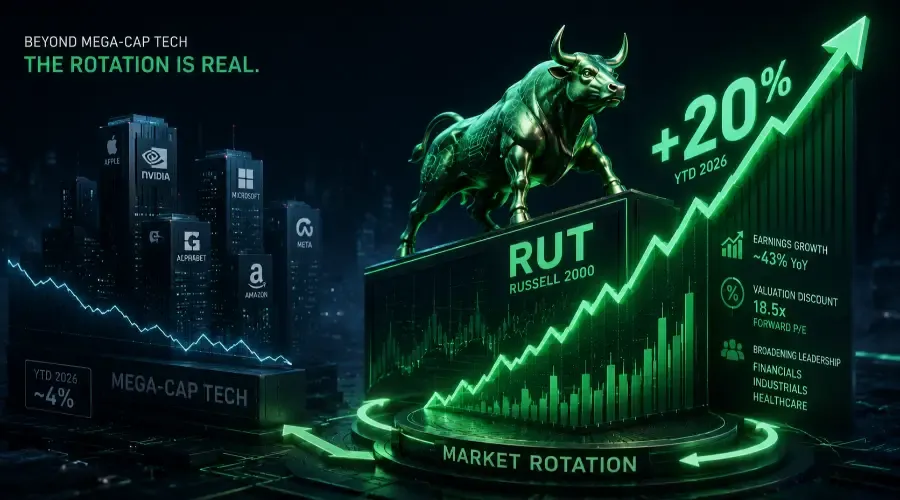
Historic run: The Russell 2000 is up ~20% YTD in 2026, its best pace since 2003, versus ~11% for the S&P 500 and ~4% for the Magnificent 7.
Earnings acceleration: Consensus projects the Russell 2000 to grow earnings ~43% YoY over the coming twelve months, against ~11% for the S&P 500.
The bear case is named: Goldman Sachs has called the small-cap consensus too optimistic, expecting full-year returns similar to the S&P 500, not decisively ahead.
Junk is leading: Unprofitable Russell 2000 names have gained ~154% since mid-2025 (HSBC data) versus ~34% for profitable peers, a warning sign about rally quality.
Valuation gap: The Russell 2500 trades near 18.5x forward earnings versus 23.0x for the S&P 500. The Russell 2000 alone screens higher once unprofitable companies are counted.
| Metric | Small / Mid Caps | S&P 500 | Why It Matters |
|---|---|---|---|
| YTD 2026 | ~20% (Russell 2000) | ~11% | Best small-cap year since 2003 |
| Projected EPS growth | ~43% YoY | ~11% YoY | Earnings inflecting after the 2023–24 trough |
| Forward P/E | ~18.5x (Russell 2500) | ~23.0x | Discount cleaner on the broad small/mid group |
| Sector tilt | Financials, Healthcare, Industrials | Tech-heavy | Greater domestic economic exposure |
Labeling note: the 43% growth figure is the Russell 2000; the 18.5x multiple is the Russell 2500. The small-cap index alone screens more expensive once negative-earnings companies are included, so the discount is real on the broad group but narrower on the Russell 2000 by itself.
The Drivers Behind the Rotation
Small caps trailed large-cap tech for years as higher rates pressured companies leaning on short-term and floating-rate debt. Three catalysts have flipped that in 2026.
The earnings-growth gap inverts. Through 2024 and 2025, S&P 500 earnings growth concentrated in mega-cap technology. Consensus now projects small-cap EPS growth near 43% YoY against roughly 11% for the S&P 500, giving price appreciation a fundamental basis rather than a purely sentiment one.
A wide valuation disconnect. Before the pandemic, small caps traded at a premium to large caps to reflect faster growth. That inverted. The broad small/mid group now sits at a deep discount to the S&P 500, a gap that widened on the exceptional earnings power of the largest index names. For managers running concentration risk, that discount is a re-entry point.
The rotation is broadening, and the numbers are historic. This is not a marginal blip. The Russell 2000 is up roughly 20% YTD, on pace for its best year since 2003, while the Magnificent 7 have advanced just ~4%. Leadership has widened into financials, industrials, healthcare, and biotech, the domestically exposed corners that benefit most as rate-cut expectations firm. The theme tends to accelerate on two triggers: firmer rate-cut odds, or a stumble in Big Tech earnings that sends concentrated money looking elsewhere.
The Case for a Trap: The Bar and the Quality Problem
An honest version of this story cannot skip two warnings.
First, the bar itself is the risk. The same 43% projection that supports the bull case is a high hurdle to clear. Goldman Sachs called consensus small-cap estimates too optimistic and projected the Russell 2000 to deliver roughly 10% over the full year against about 12% for the S&P 500, similar performance, not decisive leadership. Elevated expectations are already embedded in valuations, so if reported results undershoot, multiple compression can be swift, particularly if long-term yields stay firm.
Second, and more pointed: the 2026 rally has been led by exactly the names a quality screen is built to avoid. HSBC data shows unprofitable Russell 2000 companies have gained roughly 154% since mid-2025, dwarfing the ~34% return of profitable peers, as investors bid up AI-exposure stories over current earnings. This inverts the usual relationship where profitability underpins durable gains. It means the index-level strength is being propelled by its most speculative, debt-sensitive components, the textbook profile of a move that reverses hard if financing tightens or the AI-adjacency narrative cools. Broad participation and durable participation are not the same thing, and the gap between them is unusually wide right now.
Rally Quality Alert: Unprofitable Russell 2000 names have surged ~154% since mid-2025, while profitable peers gained just ~34%. The index-level strength is being propelled by its most speculative components.
Separating Quality From Junk
That backdrop makes selection the whole game. Three screens filter most of the risk:
Free-cash-flow positivity. Names funding operations from cash generation survive a tightening in financing conditions; those reliant on capital markets do not.
Debt-structure inspection. Fixed-rate profiles or manageable maturity walls hold up where floating-rate balance sheets get squeezed.
Institutional volume confirmation. Multi-day accumulation volume during a breakout separates a real bid from a thin-float pop.
The Bottom Line
The small-cap setup is genuinely improved: a historic YTD run, a wide valuation discount, and institutions with real reasons to diversify away from mega-cap concentration. But the leadership-versus-trap question is not settled, because the bull case rests on an earnings number one major desk considers too high, and the rally so far has been led by unprofitable, speculative names rather than quality.
The discipline is to treat the 43% projection as a hypothesis the quarterly prints will confirm or break, and to own the cash-generative end of the group, so a disappointment reprices the index around you rather than through you.
Concrete tell for traders: if second-half earnings reports show the Russell 2000’s profitless companies missing revenue projections, the rotation thesis is on thin ice regardless of what the index level is doing.
FAQ
Why are small caps outperforming in 2026?
An earnings inflection (~43% YoY consensus), a wide valuation discount on broad small/mid benchmarks, and institutional rebalancing out of a top-heavy S&P 500 have driven the Russell 2000 to its best year since 2003.
Is the rotation guaranteed to continue?
No. Goldman Sachs has called consensus estimates too optimistic, and the rally has been led by unprofitable names, both signs the move may be less durable than the index level suggests.
What sectors dominate the Russell 2000?
Financials, Healthcare, and Industrials lead, with a smaller technology weight than the S&P 500, giving it heavier domestic exposure.
How can a trader tell if a small-cap breakout is durable?
Durable moves show rising relative strength against the S&P 500, real institutional volume, and underlying profitability, rather than low-float squeezes in unprofitable names.
Internal link anchors:
How to Do Fundamental Stock Screening with AI – https://www.breakoutbulletin.com/article/fundamental-stock-screening-ai-workflow
How to Run Sector Rotation Analysis with AI – https://www.breakoutbulletin.com/article/how-to-run-sector-rotation-analysis-with-ai
How to Analyze Growth, Margins, and Cash Flow Using AI – https://www.breakoutbulletin.com/article/how-to-analyze-growth-margins-cash-flow-ai
Educational content only. Not investment advice. Figures are drawn from Bloomberg/Columbia Threadneedle consensus, Goldman Sachs and HSBC research, and index data providers as of mid-2026; projections change and should be verified before acting. Markets involve risk.