
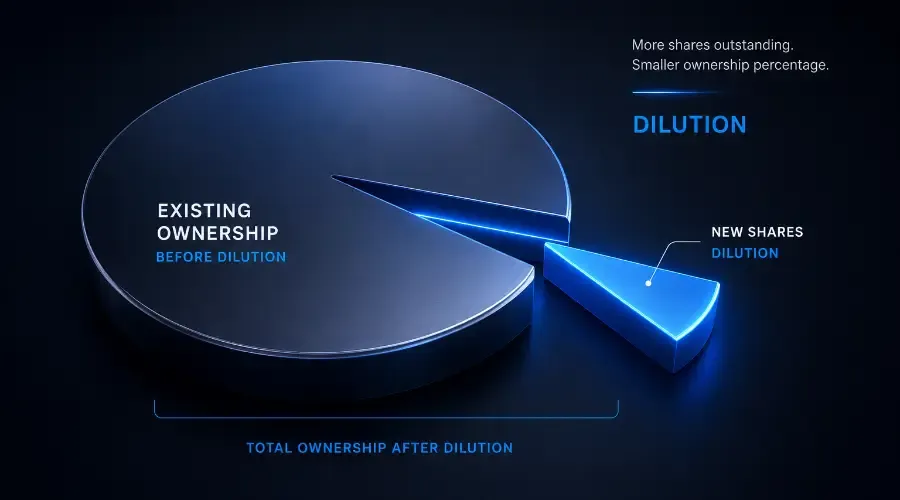
When a public company sells additional shares after its IPO, that transaction is called a secondary offering. They happen more often than most investors expect and affect shareholders differently depending on the structure. Reading a secondary offering announcement correctly separates a reactive decision from an informed one.
Two Types with Very Different Implications
A dilutive offering – also called a primary offering or follow-on – involves the company issuing new shares that didn't previously exist. The proceeds go to the company. The total share count increases, which shrinks every existing shareholder's ownership percentage proportionally. If a company has 100 million shares outstanding and issues 10 million new ones, existing shareholders own 9.1% less of the company than they did the day before.
A non-dilutive offering involves existing shareholders – typically founders, early investors, or employees with vested equity – selling shares they already own. No new shares are created. The company receives no proceeds. Total shares outstanding don't change. Your ownership percentage is unaffected. The only thing that changes is who holds those shares.
The Formula That Matters
Dilution percentage equals new shares divided by old shares plus new shares, multiplied by 100.
A 10-million-share offering on a 200-million-share base dilutes existing holders by approximately 4.8%. That's meaningful but not automatically damaging – it depends entirely on what the company does with the capital.
Why Pricing Comes at a Discount
Secondary offerings typically price 3 to 7% below the prevailing market price. Banks need to ensure institutional buyers – pension funds, mutual funds, hedge funds – find the deal attractive enough to purchase immediately. A deal that prices at or above market would struggle to attract sufficient demand. The discount is structural, not a distress signal.
The market price usually declines on announcement to close the gap with the offering price. A stock trading at $50 that announces a deal at $47 will often trade down to near $47 within hours. That's arithmetic, not a judgment about the company's quality.
Evaluating the "Use of Proceeds"
Every offering press release includes a section describing how the company plans to use the money raised. This is the most informative section for evaluating whether the dilution is worth absorbing.
Capital raised for expansion into new markets, acquisitions of complementary businesses, or R&D investment in growth areas describes a company strengthening its position. Capital raised to cover operating losses, repay debt that's come due, or sustain a cash-burning business without a clear path to profitability describes something different. The dilution math is identical in both cases. The long-term implications are not.
Snowflake's June 2021 Offering as an Illustration
Snowflake priced 10.5 million new shares at $230 against a prevailing market price of approximately $235 in June 2021 – a roughly 2% discount. The offering raised approximately $2.4 billion, which the company directed toward sales expansion and potential acquisitions. Shares declined about 5.5% on the announcement day, reflecting both the discount and market reaction to the dilution.
The offering represented 3.5% dilution on the existing share base. In the months that followed, Snowflake's revenue grew 85% year over year. Investors who sold on announcement day at $222 locked in that loss and missed the subsequent recovery. Investors who understood the purpose of the raise and held through the initial decline saw a more nuanced outcome tied to business performance.
When Non-Dilutive Insider Sales Warrant Attention
A non-dilutive offering where insiders sell significant portions of their holdings – 30 to 50% of their stake – warrants scrutiny even though it doesn't affect your ownership percentage. Large insider sales can reflect founders monetizing a legitimate personal financial need, or they can reflect insiders choosing to reduce exposure to a company whose near-term prospects they know better than the market.
Context matters: an executive selling 10% of their stake after a 10-year hold is different from a founding team selling 40% of their combined holdings 18 months after the IPO. Neither is automatically concerning, but the latter deserves a review of recent business performance.
Multiple Offerings in a Short Window
One secondary offering may be strategy. Two or three within 12 months, particularly if each follows disappointing earnings or declining guidance, suggests the company is burning through capital faster than its operations generate it and returning to equity markets repeatedly to stay solvent. That pattern is materially different from a company raising once to fund an acquisition.
Practical Response Framework
Under 5% dilution with a specific, growth-oriented use of proceeds: monitor the business and hold if the thesis is intact. Between 5 and 10% dilution with vague or defensive use of proceeds: review the original investment thesis against current business conditions. Above 10% dilution or repeated offerings within a short period: reassess whether the company's cash generation profile has changed materially from what you originally evaluated.
This content is for educational purposes only and does not constitute investment, legal, or tax advice. Investing in securities involves risk, including possible loss of principal. Always conduct your own research and consult a licensed financial professional before making investment decisions.
Secondary offerings are one of the clearest signals a company sends about its cash position and growth plans. Reading them accurately separates a routine capital raise from a warning.
→ Share Events and Structural Changes → IPOs, secondary offerings, and splits as a connected sequence - www.breakoutbulletin.com/article/corporate-share-events-ipos-secondary-offerings-stock-splits
→ The IPO Process Explained → The first equity raise and why lockup expiration matters for early shareholders - www.breakoutbulletin.com/article/ipo-process-explained-for-beginners
→ Understanding Shareholders → How new share issuance affects your ownership percentage - www.breakoutbulletin.com/article/shareholders-explained-what-it-means-to-own-stock