
BreakoutBulletin | Business & Markets Desk
What's Happening
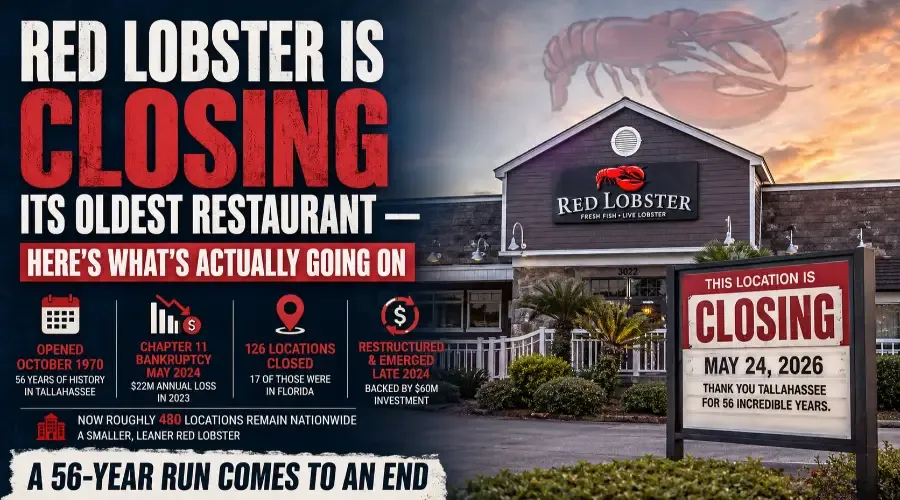
Red Lobster is permanently closing its oldest surviving U.S. location on May 24, 2026.
The store is located on North Monroe Street in Tallahassee, Florida. It opened in October 1970, has been running continuously for 56 years, and is widely reported as the longest-operating Red Lobster in the country. It closes in a few days.
Why This Location Gets Attention
A restaurant that's been open since 1970 tends to carry real history in its local community – the kind that makes a closure feel different from a routine store shutdown.
The Tallahassee location became a local landmark over five-plus decades. Longtime head grillmaster Horace Williams, who spent more than 40 years feeding generations of local families before his retirement, came to embody that institutional history. That's why this particular closure is getting more coverage than a typical corporate trimming would. The nostalgia angle is real, even if it doesn't change the underlying business decision.
What Red Lobster Says About It
The company's official position is that this is a location-specific call.
Red Lobster stated it regularly reviews restaurant performance and lease terms, and that this closure reflects the specific business conditions of that store. CEO Damola Adamolekun noted earlier this year that the company was actively reassessing its real estate footprint and lease agreements to reduce costs and focus on stronger markets.
From management's perspective, the fact that it happens to be the oldest location is secondary to the store-level economics. That may or may not be the full picture, but that's the stated corporate rationale.
The Background You Need
To make sense of this closure, you need to look at the hard metrics of where Red Lobster has been.
The chain filed for Chapter 11 bankruptcy in May 2024. The primary catalyst was a perfect storm of declining customer traffic and heavy losses tied to making its $20 Endless Shrimp promotion permanent—a gamble that underestimated consumer appetite and generated an $11 million loss in a single quarter, culminating in a $22 million annual loss for 2023.
During the initial bankruptcy wave, Red Lobster aggressively culled its footprint, closing 126 locations nationwide, including 17 in Florida alone. The chain ultimately emerged from Chapter 11 in late 2024 under a restructured plan backed by a $60 million investment from Fortress Investment Group. The business survived, but it came out significantly smaller–shrinking from over 600 locations down to roughly 480 operating restaurants today.
The Irony of the "Grand Re-Opening"
What makes the Tallahassee closure particularly telling is that it didn't fail for a lack of corporate effort. In fact, following the bankruptcy exit, the North Monroe Street location was treated as a symbol of resilience.
Under a newly appointed general manager, Nicholas Southerland, the store launched a major corporate-backed "grand re-opening." Corporate staff came in to support a pivot toward a premium, refreshed menu centered on wild-caught seafood, and Southerland publicly rallied the community, urging them to give the landmark another chance. For a brief period, it looked like it was working—but a temporary spike in local nostalgia ultimately couldn’t overcome the broader, cold math of store-level operational costs and unfavorable lease terms.
What the Turnaround Actually Looks Like
Red Lobster isn't only cutting stores – it's trying to walk an operational tightrope between bleeding costs and stimulating revenue.
On the cost side, the slashing hasn't stopped with real estate. In December 2025, Red Lobster cut roughly 1% of its restaurant-level workforce, followed by a separate 10% reduction in corporate headcount over recent months.
On the revenue side, management is frantically searching for the right formula to rebuild foot traffic. In an ironic twist, they even brought back a modified, limited-time version of the infamous "Endless Shrimp" promotion this spring – this time tightly regulated and priced higher to avoid the margin bleeding of the past. The goal appears to be stabilizing around a smaller, leaner set of profitable locations rather than maintaining a bloated legacy footprint.
Whether that combination actually works is still an open question. Casual dining turnarounds are typically slow and difficult, and the segment has been under pressure well beyond Red Lobster specifically.
The Tension Worth Naming
There's a real conflict in this story that's worth being straightforward about.
Red Lobster needs to cut costs and close underperforming stores to survive the restructuring. At the same time, brand recovery usually requires rebuilding customer trust – and closing your most iconic, longest-running location could send a complicated signal about where things stand.
It's possible the Tallahassee store couldn't be justified on the numbers alone, independent of its history. Lease terms, local traffic trends, and store-level economics may have made this a clear-cut decision for management. Companies in restructuring typically can't afford to keep locations running for symbolic reasons.
But a 56-year-old restaurant closing as part of a bankruptcy recovery isn't the kind of headline that makes a brand look like it's turning the corner. The optics and the economics are pulling in different directions here, and that tension is real.
What It Says About Casual Dining More Broadly
Red Lobster's situation isn't isolated. Casual dining as a category has been under pressure from multiple directions – rising operational costs, changing consumer habits, competition from booming fast-casual chains, and traffic levels that have been difficult to sustain post-pandemic.
Chains in this segment have generally been choosing between shrinking to a more sustainable size or trying to hold scale at thinner margins. Red Lobster is clearly taking the first path.
That could be the right call. A smaller Red Lobster with better unit economics may be more durable than a larger one running on margins that don't support the cost structure. But the path there typically involves exactly these kinds of decisions – closing stores that people recognize and have deep feelings about.
The Bottom Line
Red Lobster is closing its oldest restaurant as a direct result of the restructuring it's been running since its 2024 bankruptcy. Management has framed it as a routine performance and lease review. The broader context is that the company is still mid-turnaround, still making hard cuts to its real estate and labor force, and still working to prove the recovery is sustainable.
The Tallahassee closure on May 24 is one data point in a longer process. It doesn't tell you whether the Red Lobster turnaround works or not. What it does tell you is that the footprint is still being reduced and the restructuring isn't finished.
For the people in Tallahassee who've been going to that North Monroe Street location for decades, the business rationale probably doesn't make it feel any different. A 56-year run ending is a 56-year run ending.
Based on reports from multiple outlets covering the Tallahassee closure and Red Lobster's broader restructuring. BreakoutBulletin covers business and market developments that may be relevant to investors and traders tracking consumer and retail sectors.