
When Beijing suspended critical-mineral export restrictions after the late-2025 trade truce, markets moved on. But while visible controls were paused, the administrative and criminal enforcement machinery underneath was quietly reinforced.
BREAKOUTBULLETIN · COMMODITIES / SECOND-ORDER SIGNAL
By Manish T. · August 11, 2026 · 5 min read
30-Second Summary
- The Illusion: Markets treated Beijing's post-truce export suspensions as a full retreat from controls.
- The Reality: China built a formal criminal prosecution and whistleblower system for strategic minerals, while licensing remained highly variable and at times constrained.
- The Catalyst: Two suspended export tracks face hard expiration deadlines in November 2026, creating an unpriced snap-back risk for EV, defense, and optics supply chains.
What Actually Changed: From Policy Bans to Criminal Enforcement
In June 2026, China's commerce ministry formalized a reporting-and-handling regime for strategic-mineral export violations. Effective July 1, a new whistleblower mechanism turned diffuse export rules into a hyper-enforceable system.
Days earlier, authorities carried out what appears to be the first criminal enforcement of its kind: the chairman of a precision-optics company was placed under compulsory measures for allegedly declaring germanium-bearing lenses as ordinary optical glass to evade licensing requirements. Separately, foreign nationals were reportedly detained in related cases, following a three-year customs audit of export records.
This is not a regime standing down it is a regime building the institutional capacity to prosecute.
The Licensing Never Actually Lifted
The most important distinction is that post-truce suspensions were only partial. Licensing requirements for dysprosium, terbium, and permanent magnets remained fully in force through 2026.
For European firms, approval rates have been highly variable and have at times run well below 50%. A suspended ban and an in-force license with a constrained approval rate can produce a similar physical bottleneck. Yet the market has priced them as though they are equivalent to full resolution.
The key distinction is between the April 2025 licensing controls, which remained in force, and the broader October 2025 measures that were suspended under the trade truce; the gallium, germanium and antimony track carries its own November 27, 2026 expiry.
The broader lesson is that critical-mineral controls should be viewed as a supply-chain architecture rather than a series of isolated bans. Licensing requirements, end-use restrictions and control over downstream processing can remain economically important even when headline export restrictions are temporarily suspended.
Narrative vs. Reality Matrix
| Metric / Layer | Headline Truce Narrative (Market View) | Enforcement Reality (Ground Truth) |
|---|---|---|
| Export Restrictions | "Bans suspended; problem solved" | Whistleblower regime & criminal prosecution active |
| Heavy Rare Earths (Dy/Tb) | Priced as freely trading | Licensing in full effect; approval rates highly variable and constrained |
| Expiration Risk | Truce viewed as permanent resolution | Two hard expiry clocks ticking in November 2026 |
| Cost to Buyer | Refinement tied to spot prices | "Substantial transformation" rules trigger transshipment premiums |
The Two November Expiry Dates Nobody Is Circling
Two suspended policy tracks carry hard expiry dates:
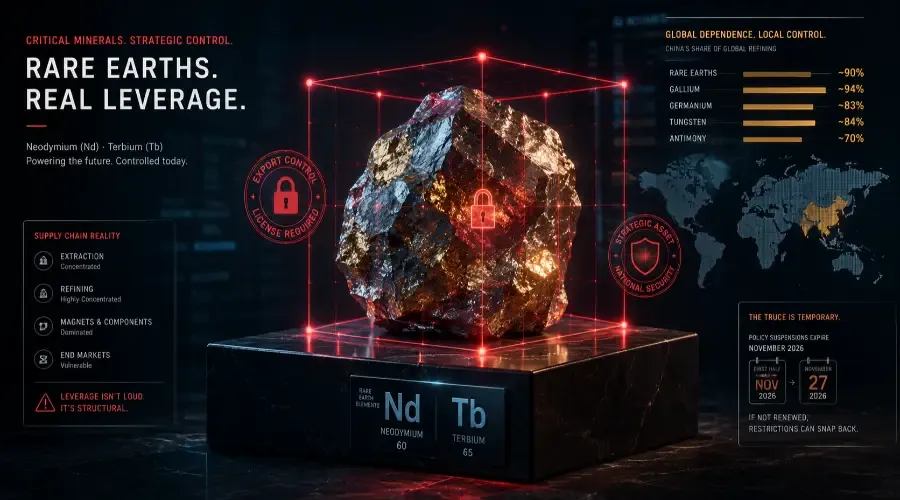
- First Half of November 2026: Initial suspended export track expires.
- November 27, 2026: Second suspended track expires.
If these suspensions lapse without renewal, U.S.-bound restrictions on gallium, germanium, and antimony, alongside tightened magnet rules could snap back. The market assigns negligible probability to this outcome because it interpreted the trade truce as a final resolution rather than a temporary reprieve with an active clock.
Why the Administrative Leverage Is Real
China controls roughly 90% of global rare-earth refining, the vast majority of refined gallium, a dominant share of germanium, and leading positions in tungsten and antimony. Beijing does not need to announce a sweeping export ban to trigger market distress; subjecting licenses to indefinite review periods creates severe friction without triggering formal trade disputes.
The implications extend into the technology supply chain. AI infrastructure depends on a wider group of specialized industrial inputs, including tin and tungsten, meaning that critical-mineral controls can eventually become constraints on computing hardware and data-center expansion rather than simply commodity-market events.
First-half 2026 commodity pricing already reflects this administrative friction, with NdPr, tungsten and antimony prices remaining sharply elevated relative to pre-control levels:
- Neodymium-Praseodymium (NdPr) Oxide: Prices rose multiple times from earlier troughs.
- Tungsten: Prices rose sharply before subsequently correcting.
- Antimony: Prices rose sharply and remained elevated.
The Transshipment "Routing Trap"
A critical second-order effect is "substantial transformation" origin scrutiny. As regulators clamp down on third-country routing, buyers face heavy transshipment premiums and compliance costs to navigate complex origin requirements. The actual cost to end-manufacturers is expanding far faster than headline spot commodity prices suggest.
This is exactly why commodity market plumbing matters. The quoted price of a mineral captures only part of the economics; origin documentation, processing routes, freight, inventories, compliance costs and delivery times can determine the actual cost and availability of physical supply.
Winners and Losers
- Winners: Ex-China developers and processors (MP Materials, Lynas Rare Earths) and U.S. antimony reshoring, already economic at elevated prices.
- Losers: EV, motor, defence and optics manufacturers facing constrained approval rates and lengthening lead times.
What to Watch
- The November 2026 Expiry Dates: The clearest snap-back triggers currently unpriced by consensus.
- Commerce Ministry Enforcement Actions: Additional detentions and criminal cases indicate the operational machinery is tightening.
- European and Japanese Approval Rates: The definitive real-time benchmark for physical supply tightness.
BREAKOUTBULLETIN TAKE
Beijing didn't loosen its grip on critical minerals it professionalized it. Whistleblower rules, criminal enforcement, customs audits, and constrained approval rates point to a system becoming far more formidable while markets celebrate a truce.
The critical-minerals story is no longer about whether China announces another dramatic headline ban. It is about whether the administrative enforcement architecture already in place becomes the primary constraint.
BreakoutBulletin publishes analytical research and education for informed investors. Nothing here is a buy or sell recommendation or personalized investment advice; the author is not a registered investment adviser. Figures are the latest available at publication, drawn largely from specialist trade and primary sources, and may be revised. Do your own research.