
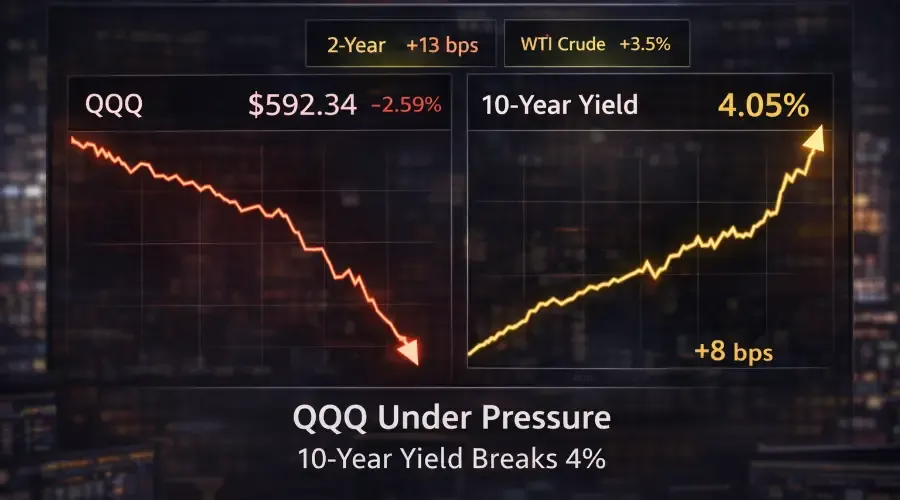
QQQ is down 2.59% to $592.34 as of 10:28 AM ET on March 3 - a move that erases nearly a week of gains in a single session. SPY is down 1.2% at $541.20. The 10-year Treasury yield has risen 8 basis points to 4.05%, while the 2-year yield is up 13 basis points to 3.62%. WTI crude is up 3.5% at $72.50 and VIX has expanded 2.1 points to 24.50.
The catalyst is not company-specific. It is macro. Understanding what is driving this QQQ selloff - and what the Nasdaq-100's structure means for how it responds to today's specific environment - is the educational focus of this analysis.
What QQQ Is and Why It Moves the Way It Does
The Invesco QQQ Trust tracks the Nasdaq-100 Index - the 100 largest non-financial companies listed on the Nasdaq exchange. With approximately 48.8% of its weight concentrated in technology stocks, QQQ is structurally the most rate-sensitive major U.S. equity ETF in regular institutional use.
Technology companies, particularly the large-cap growth names that dominate QQQ's top holdings, are analytically classified as long-duration equities. Their valuations are built on the expectation of earnings growth extending five, ten, even fifteen years into the future. When interest rates rise, those future earnings are discounted more aggressively in present-value terms, compressing the multiple the market assigns today.
The mechanism mirrors long-dated bond pricing - when yields rise, the present value of distant cash flows declines. QQQ's sensitivity to the 10-year yield is therefore structural, not incidental.
QQQ's top five holdings represent approximately 30.6% of the ETF. NVIDIA alone accounts for 8.73% of total weight. A 5% move in NVDA produces roughly a 0.44% move in QQQ's NAV from that single holding. When the top five holdings reprice together under macro pressure, the effect on QQQ is amplified.
Today's Catalyst - Geopolitics Plus Yields
QQQ closed March 2 at $606.08, down a modest 0.33%. By 10:28 AM ET on March 3, it is trading at $592.34 - a decline of approximately $13.74 per share in under 24 hours.
Overnight confirmation of U.S.-Israeli strikes on Iran facilities triggered a cross-asset repricing cascade. Oil surged 3.5% to $72.50. The 10-year Treasury yield crossed above 4% to 4.05%, up from 3.97% yesterday. The 2-year yield rose more aggressively, up 13 basis points to 3.62%.
For QQQ, the 10-year yield crossing 4% is analytically significant. Many institutional valuation models identify 4% as the threshold where multiple compression accelerates for high-growth equities. Below 4%, discount rate math remains manageable relative to earnings growth. Above 4%, valuation sensitivity increases materially.
Today's rate move is geopolitically driven rather than domestically data-driven. However, yields were already at 3.97% prior to the catalyst. The oil shock did not create a rate problem from zero - it pushed yields through a technically and psychologically important threshold that was already proximate.
YTD Context - Strength Meets Its First Serious Macro Test
QQQ entered today with a year-to-date gain of approximately 20.7%, compared to SPY's 12.3%. NVIDIA alone contributed an estimated 5-6 percentage points of that advance.
Today's 2.59% decline represents the first meaningful macro headwind of 2026 for the Nasdaq-100. The analytical question is whether this move represents a valuation reset within an intact uptrend or the beginning of a more durable multiple compression cycle tied to a structurally higher rate environment.
Geopolitically driven yield spikes have historically been shorter in duration than inflation-driven rate cycles. If Hormuz tensions de-escalate, yield pressure may moderate. However, the baseline rate environment was already near 4%, and that proximity increases the fragility of long-duration equity valuations.
Key Support Levels for QQQ Investors
Analysts are monitoring the $578-$580 support zone as the next significant technical reference. This range corresponds to prior consolidation support and previous yield-driven pullback demand.
QQQ is trading approximately 12-14 points above that zone. A move through $592 toward $585 with volume acceleration would bring $578-$580 into active play.
Resistance remains defined by broader analyst targets averaging approximately $748 over a 12-month horizon - implying roughly 19% upside from yesterday's close. However, the near-term focus is structural support defense, not long-term target projection.
Technical levels referenced from prior session highs and support zones require multi-session validation before structural confirmation.
Concentration Risk - The Structural Teaching Moment
QQQ is not a broad-market vehicle. It is a concentrated expression of the largest U.S. growth companies. That concentration amplifies both upside and downside.
With the top five holdings representing 30.6% of the ETF, simultaneous 2-3% declines across those names generate a meaningful drag before the remaining holdings are considered. This explains why QQQ tends to outperform in strong risk-on environments and underperform in rate-shock sessions.
Understanding the distinction between QQQ and SPY - which has broader sector diversification and lower technology concentration - is foundational for ETF-based portfolio construction.
What to Watch Through the Session
Three focal points define the remainder of the trading day:
JOLTS data at 10:00 AM ET. A print below 6,400K may provide modest yield relief. A print above 6,700K would reinforce rate pressure.
The $592 level. Holding this area suggests absorption. Breaking below it with accelerating volume suggests distribution toward $585 and potentially $578-$580.
Individual earnings reactions. Positive moves in Nasdaq names such as CRWD and BBY test whether macro pressure is selective or uniform across the index.
Structural Takeaway
QQQ's 2.59% decline illustrates the transmission chain from geopolitical oil shock to yield repricing to multiple compression in long-duration equities. The mechanism is clear: oil spike - inflation fear - yield rise - discount rate increase - growth valuation compression.
The 20.7% YTD gain reflects genuine earnings momentum. That backdrop does not vanish in a single session. But it is being re-priced against a macro environment that has become less supportive of extended-duration premiums.
How QQQ navigates the $578-$580 support zone over the coming sessions - and whether yields sustain above 4% - will define the Nasdaq-100 structure for the remainder of March.
DISCLAIMER:
This article is for informational and educational purposes only and does not constitute financial, investment, or trading advice. You are solely responsible for your own investment decisions and should consult a licensed financial professional before acting on any information in this post.