
PayPal (PYPL) Spikes on 7.1x Volume - Why Price Barely Moved
PayPal (PYPL) recorded a massive 83.6 million shares traded - 7.1x its normal volume - yet price rose only +3.94% to $73.02.
At first glance, this looks bullish. But professional traders immediately notice something unusual:
It took extreme volume to move price only a small amount.
When institutions truly want to accumulate, price typically moves 10–15% on this kind of participation. Instead, PYPL’s price barely advanced - signaling institutional rotation, not aggressive buying.
This analysis explains how professionals identify rotation vs real accumulation, using volume efficiency, timing behavior, and multi-timeframe technical structure.
Breakout Summary: What Actually Happened
Key Metrics
- Total Volume: 83.6M shares
- 30-Day Average: 11.8M shares
- Volume Multiple: 7.1x
- Price Change: +3.94%
- Closing Price: $73.02
- Volume Efficiency Ratio: 1.8:1 (Low)
A 1.8:1 efficiency ratio means price barely responded despite huge trading activity — a hallmark of two-way institutional flow, where funds rotate positions instead of building conviction.
This is not the signature of strong bullish accumulation.
Technical Setup: PYPL in a Battleground Zone
PYPL is currently trading in a neutral-to-bearish structure, trapped between key support and resistance levels.
Resistance Levels
- $76.50 — prior consolidation high
- $85.00 — 50-day moving average
Support Levels
- $70.00 — psychological support
- $65.00 — recent earnings-driven low
Price recently bounced from $65, but has not reclaimed $76.50, meaning the stock remains in a recovery attempt — not a confirmed uptrend.
Higher-Timeframe Technical Warning Signals
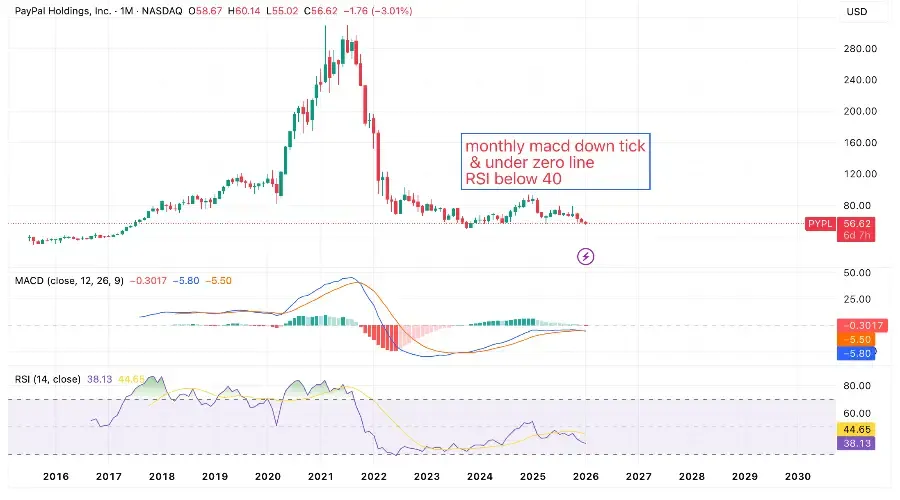
Monthly MACD: Down-Tick Below Zero
- The Monthly MACD has turned downward
- MACD remains below the zero line
- This indicates long-term bearish momentum is still dominant
A MACD down-tick below zero often signals:
- Weak institutional trend conviction
- Ongoing long-term distribution
- Low probability of sustained upside rallies
Monthly RSI Below 40
- RSI below 40 suggests higher-timeframe weakness
- Market lacks strong bullish momentum
- Indicates buyers are not in control at the macro trend level
Interpretation
The higher timeframe is NOT supporting a strong upward or downward trend — signaling a low-momentum, indecisive market phase.
This means:
- Short-term bounces may occur
- But higher-timeframe trend pressure remains weak
- Breakouts have lower follow-through probability
Volume Behavior: Rotation Signature, Not Conviction
Intraday Volume Distribution
- Opening Hour: ~42% of total volume
- Mid-Day: ~45%
- Final Hour: ~13%
What This Tells Us
Heavy early volume + weak closing volume suggests institutions repositioned early and exited into the close, rather than building long-term exposure.
Institutional Accumulation Typically Shows
- Balanced or rising volume through the day
- Strong closing activity
- Expanding price movement
Rotation / Rebalancing Typically Shows (Seen Here)
- Front-loaded morning activity
- Tight mid-day price range
- Light closing participation
- Minimal price progress
Conclusion:
PYPL’s trading pattern reflects institutional rebalancing and rotation, not committed buying.
Volume-to-Price Efficiency: The Red Flag
When institutions are accumulating:
- 2.5–4.0x efficiency is common
- Strong price movement follows volume
PYPL’s 7.1x volume produced only a +3.94% move, confirming low directional conviction.
This behavior is typical when:
- Funds are rotating between fintech names
- Portfolio managers are adjusting exposure
- Large players are selling into retail buying
Big volume alone is not bullish — price reaction matters.
Conviction Score: Low
|
Factor |
Strength |
Interpretation |
|
Technical structure |
Weak |
Below major MAs |
|
Monthly MACD |
Bearish |
Below zero & ticking down |
|
Monthly RSI |
Weak |
Below 40 |
|
Volume magnitude |
High |
Institutions active |
|
Volume efficiency |
Low |
No price expansion |
|
Volume timing |
Bearish |
Front-loaded, weak close |
|
Trend alignment |
Weak |
Downtrend intact |
Overall Conviction Score: 45 / 100
Meaning:
This is a low-conviction environment — suitable for observation, not aggressive positioning.
Professional desks typically avoid scaling positions below 50 conviction points.
Key Levels & Signals to Monitor
Price Zones
- Above $76.50: Signals strengthening recovery
- Below $70: Weakness returning
- Below $65: Bearish breakdown risk
Volume Behavior to Watch
- Sustained >30M volume + price holding $73–75 = improving conviction
- Volume fading below 20M = rotation completed
- Rising volume + price weakness = distribution warning
Higher-Timeframe Trend Filter
As long as:
- Monthly MACD stays below zero
- RSI remains under 40
→ Long-term upside probability remains limited
Key Lessons for Traders & Investors
1. Higher-Timeframe Momentum Matters
If monthly indicators stay weak, short-term rallies are less likely to sustain.
2. Volume Alone Doesn’t Equal Bullishness
Large volume must produce meaningful price movement to confirm conviction.
3. Timing of Volume Reveals Institutional Intent
Heavy morning activity + weak close often means rotation, not commitment.
4. Low RSI + Weak MACD = Trend Headwind
Macro momentum is not aligned for a strong trend move.
5. Low Conviction = Observe, Not Chase
A 45/100 conviction score means capital preservation beats speculation.
Bottom Line
PayPal’s (PYPL) 7.1x volume surge reflects institutional rotation, not strong accumulation.
The higher timeframe remains weak — with Monthly MACD trending downward below zero and RSI below 40, signaling lack of macro trend support.
Until price reclaims key resistance with stronger price efficiency and higher-timeframe confirmation, PYPL remains a watchlist stock — not a high-confidence breakout.
Smart approach:
Wait for stronger price reaction, improving momentum, and trend confirmation before treating this as a directional opportunity.
Educational Disclaimer: This content is for learning and market behavior analysis only. It is not financial advice. Trading involves risk, and past performance does not guarantee future results.