
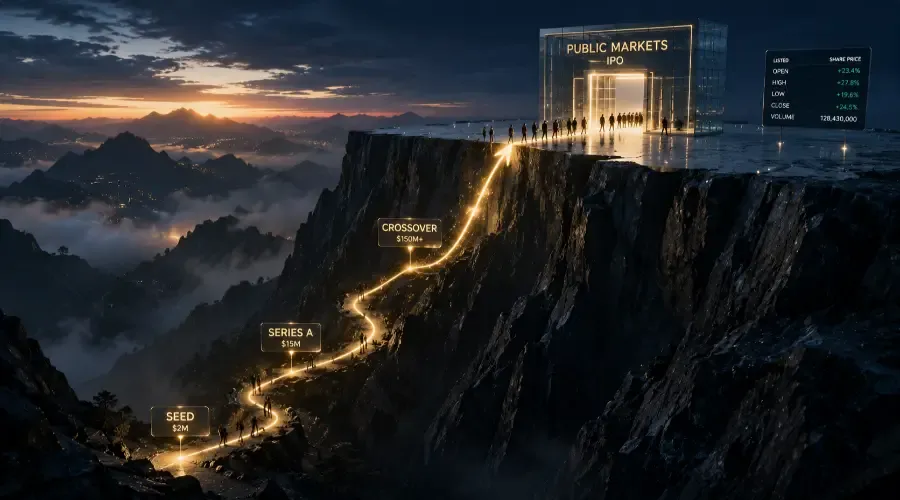
A generation of value creation now happens before a company ever lists. Understanding the late-stage capital stack explains why public investors keep arriving at the valuation plateau.
By Manish T. · August 16, 2026 · 8 min read
Editor’s note: This is educational analysis, not investment advice. Figures are as reported by company disclosures, exchange filings, and specialist data providers as of August 2026. Private valuations are self-reported or press estimates and may be revised. Nothing here is a recommendation to buy or sell any security.
The old bargain of public markets was simple: companies listed young, and public investors rode the growth from there.
That bargain has quietly inverted. The largest companies now stay private through the entire compounding phase, funded at public scale by private capital, and list – if they list at all – as fully-formed giants. By the time you can buy the stock, much of the climb is already behind it.
This is the public market as an exit, and it changes what a public share actually represents.
The difference becomes clearer when you compare the economics of private venture compounding versus IPO investing. Private investors can capture multiple funding rounds and valuation increases before a company ever reaches public markets, while public investors generally enter only after the business has already passed through much of that early compounding phase.
What Changed: The Late-Stage Capital Stack Got Deep Enough to Replace the IPO
A private company can now raise billions without going public because the funding chain deepened.
The late stage capital stack IPO no longer needs the IPO. It runs:
-
Venture capital for the earliest institutional round.
-
Growth equity for expansion before profitability.
-
Crossover funds – public-market investors buying into private rounds – for public-scale capital.
-
Sovereign wealth and private credit for the final pre-listing rounds.
The result is that the private market is no longer a waystation. For many companies, it is the destination.
Recent reported examples, as of August 2026:
-
Databricks raised $5 billion at a $190 billion valuation – its second $5 billion round in about eight months – and is deliberately staying private.
-
SpaceX listed only after decades, near a $1.77 trillion valuation.
-
OpenAI and Anthropic filed at reported valuations around $850–965 billion.
-
There are roughly 1,680 unicorns worth about $8.6 trillion, and the ten largest hold around 41% of that value, according to specialist data providers.
This is the staying private longer trend at full scale: decacorns and hectocorns now raise private rounds that would have been IPOs a decade ago.
The result is an IPO market where some of the most anticipated listings arrive only after enormous amounts of private capital have already been deployed. The AI IPO wave therefore creates a particularly important question for public investors: are they gaining access to a new growth opportunity, or simply receiving public-market access after the highest-compounding phase has already occurred?
The Value Transfer Nobody Votes On: Private Venture Compounding vs IPO
Here is the consequence for a public investor.
The compounding from seed to decacorn is captured by private holders – venture, growth, crossover funds, and employees. Public markets increasingly serve as an exit – liquidity for those early holders – rather than an entry – fresh growth for new ones.
This is the pre-IPO value creation migration. The seed to decacorn value capture happens before the S-1 is filed.
When these companies finally list, retail is often buying the valuation plateau at mega-cap prices, not the ascent.
But the plateau is not automatically flat. Some mega-caps continue compounding long after IPO. What changes is the risk/reward composition: public investors are buying mature-company execution risk, not startup venture risk. That is not inherently worse. It is fundamentally different.
It’s not a conspiracy. It’s a structural feature of how capital formation now works.
What You Actually Buy: Mega-Cap Tech IPO Mechanics
Four features determine how a late-stage listing trades. Together, they form the S-1 float scarcity playbook.
1. Low free float price distortion
Mega-IPOs often list only a small slice of total shares. When a $1 trillion company floats 5–8% of its stock, the public float is tiny relative to the market cap.
This creates low free float price distortion: early trading reflects scarcity, not fundamental supply. The price you see in the first weeks is not necessarily the price the company would trade at with a full float.
2. The 180-day IPO lockup supply cliff
Standard lockups expire about 180 days after listing. When they do, insider shares become sellable.
This is a 180-day IPO lockup supply cliff. If a company listed only a small float, the lockup expiry can more than double the tradable share count. The market reprices to the larger supply.
3. Dual-class non-voting shares
You often get capital exposure without voting control. Dual-class non-voting shares tech structures give founders and early investors outsized control while public holders carry the economic risk.
That may be acceptable in high-growth compounders. But it means “ownership” is weaker than it looks.
4. Passive index inclusion
Once a newly listed mega-cap becomes index-eligible, passive funds must buy it.
That can mean forced 401k index buying: your retirement account allocates to the stock at mega-cap prices whether or not you ever chose it. Passive index inclusion mega-cap is not optional for index investors.
This creates another layer of market mechanics that investors should distinguish from fundamental demand. When large institutions and passive funds are required to purchase newly eligible companies, institutional positioning can influence price and liquidity independently of what individual investors think about the company's valuation.
But eligibility is not automatic. S&P 500 inclusion, for example, requires positive GAAP earnings in the most recent quarter and positive cumulative GAAP earnings over the trailing four quarters. Some loss-making AI giants may not qualify immediately and would enter broader total-market or Russell indexes first.
S-1 Audit Checklist: Materiality Thresholds
| Metric | Risk Assessment Signal |
|---|---|
| Public Float < 10% | High artificial scarcity; volatile early price discovery |
| Lockup expiry doubles/triples float | Severe supply-cliff overhang at Day 180 |
| Dual-Class Ratio > 10:1 | Weak governance; economic risk without voting power |
| Delayed S&P 500 Entry | Passive inflows delayed; early price action driven by float scarcity, not fundamentals |
None of these are automatic sells. They are conditions that change what “growth” is still on the table.
The Counter-Case: When Buying the Plateau Still Works
This is not a claim that public investors lose by definition.
A public investor can still earn strong returns at high entry valuations if:
-
The company continues to grow revenue and margins long after listing.
-
The market underestimates the durability of its moat.
-
Acquisitions and new product lines extend the compounding phase.
-
Passive flows and index inclusion support the stock for years.
Amazon, Apple, Microsoft, Nvidia, and Meta all compounded enormously after their IPOs. The issue is not that the plateau cannot rise. It is that ascent vs plateau investing is now the wrong frame for most late-stage listings.
You are not buying the early climb. You are buying the larger, more mature company – and you should price it accordingly.
Secondary Markets Exist, But They Are Not Retail Access
The blog is often asked: can’t retail buy pre-IPO shares through secondary markets?
The answer is partially yes, with real limits.
-
Secondary market liquidity rounds allow employees and early holders to sell to accredited investors before IPO.
-
Tender offers let companies repurchase employee shares or allow selected institutional buyers to enter.
-
Interval funds and tokenized private shares are slowly opening narrower access.
But these channels typically require accreditation, carry holding restrictions, and offer limited transparency. They have not broadly democratized the seed-to-decacorn phase.
They are a crack in the door, not an open one.
What Could Reverse the Trend
The structure is dominant now. It is not permanent.
The public market could shift back toward entry if:
-
Higher interest rates or a private capital contraction pushes companies to list earlier and smaller.
-
Accredited-investor rules broaden, letting more ordinary investors into private rounds.
-
Interval funds and tokenization mature into real retail access.
-
Regulators or exchanges create new listing paths for earlier-stage companies.
The direction of pre-IPO value creation migration depends on the depth of private capital. When that depth shrinks, the IPO becomes necessary again.
Catalysts to Watch
-
OpenAI and Anthropic IPO pricing and timing; Databricks’ eventual S-1 decision.
-
Lockup expirations on recently listed mega-caps – the supply cliffs.
-
Approval-rate and allocation changes in secondary market platforms.
-
Any broadening of retail access to private markets – interval funds, tokenization, accredited-investor rule changes.
The Bottom Line
The public market has shifted from where most early value is created to where much of it is realized.
That does not mean public investors cannot make money. It means the entry price already embeds years of private-market compounding.
Until the structure reverses, assume an IPO is late access to a mature business – price it as the valuation plateau, understand the float, lockup and dual-class terms, and remember your index fund may buy it for you regardless.
“The question is not ‘Am I late?’ The question is ‘What am I paying for the phase I did not get to ride?’”
BreakoutBulletin publishes analytical research and education for informed investors. Nothing here is a buy or sell recommendation or personalized investment advice; the author is not a registered investment adviser. Figures are as publicly reported and may be revised; private valuations are self-reported or specialist press estimates. Do your own research.