
QUICK SUMMARY:
Trading Mechanics: Pre-market trading occurs from 4:00 AM to 9:30 AM ET via Electronic Communication Networks (ECNs). Retail access typically begins at 7:00 AM ET and requires the use of limit orders only.
Liquidity & Risk: Volume is significantly lower than regular hours, leading to wider bid-ask spreads and higher volatility. This “thin liquidity” can create false breakouts that often reverse at the 9:30 AM market open.
Decision Framework: Successful pre-market trading requires a clear catalyst (like earnings or macro news) and high relative volume. The P.R.E.M.I.U.M. framework helps traders filter high-probability setups while managing execution risk.
Most retail traders start their day at 9:30 AM ET - but by then, the market has already been moving for over five hours.
Pre-market trading is where earnings reactions, macro news, and institutional positioning begin shaping the day. Understanding this session gives retail traders a structural edge - not by trading more, but by understanding better.
What are pre-market trading hours?
Pre-market trading runs from 4:00 AM to 9:30 AM ET, with most retail brokers allowing access starting at 7:00 AM ET.
How does pre-market trading work?
Pre-market trading happens through Electronic Communication Networks (ECNs) using limit orders only, with lower liquidity and wider bid-ask spreads than regular hours.
What Is Pre-Market Trading? (Complete Guide for Retail Traders)
Pre-market trading refers to all stock trading activity that occurs between 4:00 AM and 9:30 AM ET, before the regular market opens.
Unlike regular hours, trades are executed through ECNs rather than centralized exchanges.
Key Insight:
Pre-market serves two core purposes:
-
Price discovery - adjusting prices to new information
-
Positioning - institutions preparing for the open
Retail participation increases after 7:00 AM ET, when most brokers enable access.
Pre-Market Trading Hours Explained (4:00–9:30 AM ET Breakdown)
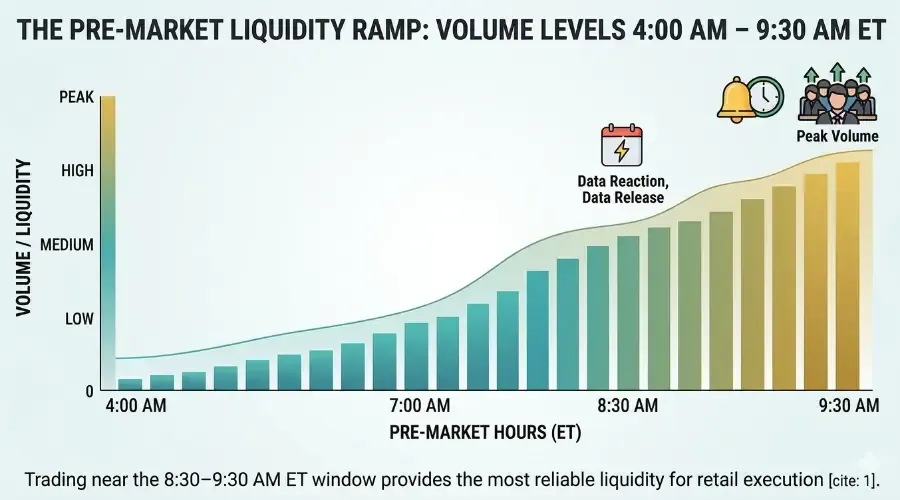
Pre-market is not a single uniform session - liquidity evolves significantly.
-
4:00 AM ET → ECNs open, very low liquidity
-
7:00 AM ET → Retail participation begins
-
8:30 AM ET → Economic data releases (CPI, jobs, Fed signals)
-
9:00–9:30 AM ET → Highest volume before open
Trader Takeaway:
The 8:30–9:30 AM window produces the most reliable signals.
What time does pre-market trading start?
Pre-market trading starts at 4:00 AM ET, but most retail traders gain access from 7:00 AM ET.
How Pre-Market Trading Works (Rules, Orders & Execution Explained)
Pre-market trading operates differently from regular market hours.
ECN Routing
Orders are matched via ECNs like ARCA, EDGX, and IEX — not centralized exchanges. This creates price fragmentation, meaning the same stock can show different prices across platforms.
Limit Orders Only
Market orders are not allowed.
Why this matters:
-
Prevents extreme slippage
-
Forces precise execution
Thin Order Books
Pre-market liquidity is limited.
Example:
A stock with 5M daily volume may have only 20K–100K shares available pre-market
Warning:
Thin liquidity can cause sharp price spikes and false signals
Can retail traders trade pre-market?
Yes, retail traders can participate through brokers offering extended hours, but only limit orders are allowed.
Pre-Market Broker Access: Which Platforms Allow 4:00 AM Trading?
Your broker determines your opportunity set.
-
Webull / Interactive Brokers → Access from 4:00 AM ET
-
Charles Schwab / Fidelity → Access from 7:00 AM ET
Key Insight:
A trader with 4:00 AM access sees opportunities before most retail traders enter
Trader Takeaway:
Execution quality depends on:
-
Broker routing
-
ECN access
-
Order timing
Which Stocks Move in Pre-Market Trading (And Why They Move)
Not all stocks are active pre-market.
High-Probability Movers
-
Earnings stocks
-
News-driven stocks (M&A, upgrades, FDA decisions)
-
Macro-sensitive large caps
-
Sector sympathy plays
What to Avoid
-
Low-volume small caps
-
Stocks without clear catalysts
Warning:
A stock moving on low volume is often unreliable.
What Causes Pre-Market Price Moves?
-
Earnings releases
-
Economic data (CPI, NFP, Fed signals)
-
Global market reactions
-
Institutional repositioning
Key Insight:
Moves with confirmed catalysts and strong volume are more reliable.
How to Find Pre-Market Movers (Best Scanners & Volume Filters)
Focus on quality over hype.
Key Filters
-
Volume ≥ 100K–500K
-
Gap ≥ 3–5%
-
Relative volume ≥ 2x
-
Confirmed news catalyst
How to find pre-market movers?
Use scanners that combine volume, gap %, and news confirmation — not just top gainers.
The P.R.E.M.I.U.M. Pre-Market Checklist (BreakoutBulletin Framework)
A structured way to evaluate setups:
-
P – Price Gap (≥3–5%)
-
R – Relative Volume (above average)
-
E – Event Catalyst (news-driven)
-
M – Market Direction (SPY/Nasdaq alignment)
-
I – Illiquidity Risk (spread size)
-
U – User Broker Access (4 AM vs 7 AM)
-
M – Momentum Quality (clean vs choppy)
Score each factor from 1–5.
Trade only setups scoring 25+.
Trader Takeaway:
This framework helps eliminate low-quality trades and emotional decisions.
Do Pre-Market Prices Predict the Market Open?
Pre-market price action helps with price discovery, but does not reliably predict full-day direction.
-
Moves near 9:00–9:30 AM ET are more reliable
-
Early moves often reverse
-
Institutional participation at open determines outcome
Key Insight:
Pre-market sets context — it does not guarantee direction.
Risk Management in Pre-Market Trading
Pre-market trading carries higher structural risk.
-
Bid-ask spreads are 15–25% wider
-
Slippage is common
-
False breakouts occur frequently
-
Lower fill certainty
Trader Takeaway:
Reduce position size and focus on high-quality setups only
Common Pre-Market Trading Mistakes
-
Chasing low-volume movers
-
Ignoring spreads
-
Assuming pre-market predicts the day
-
Overtrading
-
Ignoring broker rules
Warning:
Most losses come from execution mistakes, not strategy
Want Daily Pre-Market Movers Before the Open?
Get a curated list of high-volume pre-market stocks, earnings movers, and key levels before the market opens.
Join our free newsletter and start your day with a professional trading edge.
Final Thoughts: Should You Trade Pre-Market?
Pre-market trading offers opportunity — but only for disciplined traders.
-
Best use: context and preparation
-
Risk: low liquidity and execution challenges
Key Insight:
Smart traders use pre-market to prepare first, trade second
Frequently Asked Questions:
What are pre-market trading hours?
Pre-market trading runs from 4:00 AM to 9:30 AM ET, with most retail access starting at 7:00 AM ET.
How does pre-market trading work?
It operates via ECNs using limit orders, with lower liquidity and wider spreads.
Which stocks trade in the pre-market session?
Primarily earnings stocks, news-driven movers, and high-volume equities.
What causes pre-market price moves?
Earnings, economic data, global markets, and institutional activity.
Can retail traders participate in pre-market trading?
Yes, through brokers offering extended hours trading with limit order restrictions.
DISCLAIMER:
This article is for informational and educational purposes only and does not constitute financial, investment, or trading advice. You are solely responsible for your own investment decisions and should consult a licensed financial professional before acting on any information in this post.