
📉 Pre-Market Snapshot: The Divergence Continues
Pre‑Market, 5th Feb - 2026
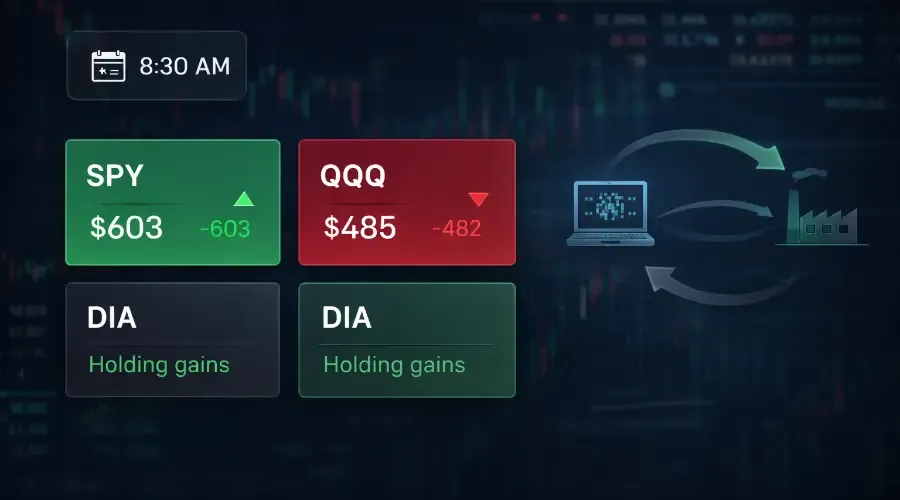
- SPY (S&P 500 ETF): Slightly green → ~$603
- QQQ (Nasdaq 100 ETF): Under pressure again → ~$485
- DIA (Dow ETF): Holding gains → still firm
Translation: money continues to leak out of expensive, growth‑heavy tech and into steadier, cheaper sectors like financials and industrials. This still looks like a rotation, not a full‑market breakdown.
🌍 Overnight Moves: A Global Tech Tantrum
- Asia leaned on tech: Japan roughly ‑0.7%, Hong Kong around ‑1.2%.
- Europe followed with red across major indices and pressure in growth names.
Why it matters: this isn’t just a U.S. wobble. The global tape is increasingly asking the same question: can AI and tech earnings actually live up to the expectations baked into current prices?
🕗 The 8:30 AM Jobs Report: Key Intraday Catalyst
At 8:30 AM ET, jobless claims hit. It’s not the only thing that matters today, but it is likely to set the first tone for how the market trades into the open.
Broadly:
- If claims are weaker than expected (more people unemployed):
- That leans toward a more dovish Fed path.
- Tech and other long‑duration names often catch a bid in that kind of print.
- A bounce in QQQ toward the $488–490 area would fit that script.
- If claims are stronger than expected (fewer people unemployed):
- That leans hawkish and suggests the Fed can stay restrictive longer.
- High‑multiple tech typically struggles in that backdrop.
- A test of support down toward the $480 zone on QQQ would not be surprising.
The first reaction at 8:30 often shapes the next 60–90 minutes, but markets can still fade that move later in the day if other headlines or flows take over.
🎯 Key Levels to Watch (Reference Points, Not Guarantees)
Think of these as areas where behavior changes, not magic lines.
For SPY (overall market tone):
- Holding above $600 → the market is absorbing tech weakness without broad damage.
- A break and acceptance below $598 → suggests the correction is broadening beyond growth.
For QQQ (tech’s battleground):
- Holding above $482 → tech is under pressure but still defending key support.
- A clean break below $480 → warning sign that sellers are gaining control, with room toward the mid‑$470s.
- A reclaim and hold above $495 → would be a strong signal that this leg of the selloff is likely exhausted for now.
🚨 How Different Traders Might Think About the Next Hour
These are example playbooks, not instructions. The idea is to show how different positioning can shape decisions around the same data.
1) Tech‑Heavy Portfolio (around 40%+ in tech)
Before 8:30 AM, many risk‑conscious traders:
- Review their most speculative positions (unprofitable AI names, software that’s already down big) and decide if they want that much exposure into a binary macro print.
- Some will lighten up or hedge in those names to reduce the impact of a negative surprise.
After 8:30 AM:
- If claims come in weak and QQQ bounces:
- A common response is to hold core mega‑caps (AAPL, MSFT, etc.) and selectively add only to the strongest names, rather than chase everything.
- If claims come in strong and QQQ breaks below key support (like 482 with real volume):
- Many pros would gradually reduce risk, especially in the weakest charts, and shift part of their exposure toward value and cyclicals (financials/industrials via ETFs like XLF or XLI).
2) Tech‑Light Portfolio (under ~20% in tech)
- Traders who are underweight tech often prefer to wait for either real capitulation (for example, a 3%+ down day in QQQ or a move 10% off the recent highs) or a clear reclaim of broken support before buying dips.
- In practice, that might mean keeping a shopping list (QQQ, MSFT, NVDA, etc.) with price zones where they’d be comfortable scaling in, rather than nibbling every small move.
3) Balanced Portfolio (roughly 25–35% in tech)
- Balanced investors often do very little into a single data print—maybe trimming a bit from persistent under‑performers rather than making big shifts.
- They watch reference levels like SPY $600 and QQQ $482:
- If those hold, they may sit tight.
- If both start to break down together, they might tilt modestly more defensive (adding to value/defensives, reducing weaker growth).
Across all three profiles, the common thread is position sizing and risk control, not trying to nail the exact tick.
📊 Three Broad Intraday Scenarios
These are not precise odds—just a way to organize thinking around what’s more vs less likely.
- Relief Rally (higher probability if claims are clearly weak)
- Jobless claims come in softer than expected.
- Yields drift lower, and tech/QQQ bounce as rate‑cut hopes get a small boost.
- In this case, many traders focus on adding to quality growth on strength, not chasing second‑tier names that are only bouncing mechanically.
- Data don’t change the macro story much.
- Tech continues to bleed slowly as money rotates into value, energy, or defensives (XLF, XLE, XLU, etc.).
- Here, traders often stay patient and selective, favoring relative strength and avoiding over‑trading chop.
- Claims are strong and Fed speakers lean hawkish later in the day.
- Tech weakness turns into a more decisive risk‑off leg.
- In that environment, many professionals quickly cut risk and raise cash, focusing on capital preservation instead of trying to catch falling knives.
The goal isn’t to guess which one will happen in advance, but to know what you would do in each case so you’re not improvising under stress.
🎤 Fed Speakers to Be Aware Of
- 12:00 PM ET – Fed Vice Chair Jefferson: any comments about the pace or timing of rate cuts can reinforce or counter the jobs‑data reaction.
- 6:30 PM ET – Fed Governor Cook: after the close, more relevant for how futures and tomorrow’s open might set up.
These events can extend or reverse the day’s first move, so it’s worth knowing they’re on the schedule.
💡 The Bottom Line
- Today is more about reacting to the 8:30 AM data and key levels than trying to predict the exact path in advance.
- Watch how SPY behaves around $600 and how QQQ trades around $482–480—those are useful reference points for whether this remains a controlled rotation or broadens into something bigger.
- Think in terms of adjusting exposure and tilting between sectors (growth vs value, tech vs financials/industrials), rather than flipping your whole portfolio on one print.
Manage your risk, protect your capital, and let the actual price action guide you—not just the story in your head.
Markets open in about an hour. Stay prepared, not scared.
-Your Pre‑Market Desk
⚠️ Disclaimer: This is educational market commentary, not financial advice or a recommendation to buy or sell any security. Markets are risky and unpredictable. Always do your own research and consider consulting a qualified financial advisor before making investment decisions.