
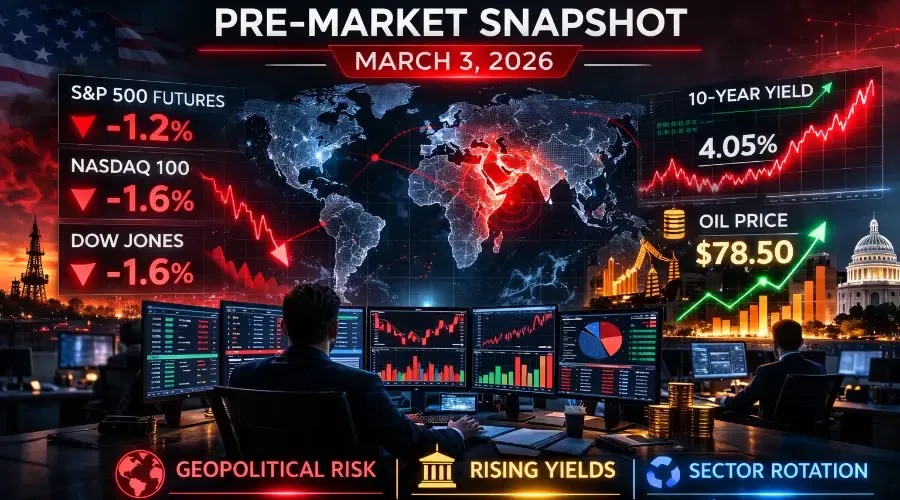
Pre-Market Snapshot - March 3, 2026
U.S. equity futures are under meaningful pressure ahead of the open. S&P 500 futures (ES) are down approximately 82 points (-1.2%) to 6,780. Nasdaq 100 futures (NQ) are leading to the downside at -390 points (-1.6%) to 24,600. Dow Jones futures (YM) are off 800 points (-1.6%).
The plain-English translation: risk appetite is contracting simultaneously across large-cap equities, tech, and industrials, while energy and utilities are absorbing defensive flows.
The one-line takeaway: this is a rotation session dressed as a sell-off - energy and defense are bid, tech and financials are offered, and the driver is a geopolitical shock overlaid on a rising-yield environment.
Overnight Moves: Asia Splits, Europe Extends Losses
Asia closed with a divided picture. The Nikkei 225 fell -1.4% and the Hang Seng dropped -2.1% on U.S.-Iran escalation driving energy supply fears across import-dependent economies. The Shanghai Composite was the outlier, gaining +0.5% on commodity resilience - China as a net beneficiary of energy repricing is a dynamic worth tracking separately from the broader risk-off narrative.
European markets extended the risk-off tone at the open. The DAX is down -2.46% to 24,661, the FTSE 100 is down -1.8%, and the CAC 40 is off -2.1%. European banks and industrials are absorbing the hardest selling, reflecting the dual pressure of higher energy import costs and yield repricing on rate-sensitive balance sheets.
Why it matters: When Asia and Europe both sell off before the U.S. open, it removes the possibility of a gap fill from overnight support. The session opens into already-established selling pressure, not fresh uncertainty - a structurally different starting condition.
The 10:00 AM JOLTS Release: Key Intraday Catalyst
What is being released and when: JOLTS Job Openings for January will print at 10:00 AM ET. Consensus is 5.37M, up from the prior 5.29M reading in December. This data point measures the gap between labor demand and available workers - a key variable in the Federal Reserve’s assessment of whether the labor market is cooling sufficiently to inform rate policy.
Transmission mechanism: JOLTS data - labor market tightness assessment - Fed rate path expectations - Treasury yield movement - equity multiple re-pricing, most acutely for high-duration assets in tech and growth sectors.
If JOLTS comes in weaker than 5.37M:
Labor demand is softening more than expected.
Rate expectations may ease modestly at the margin.
Treasury yields could stabilize or pull back from the morning’s elevated 4.05%.
Traders watch whether QQQ holds the $475 support zone and whether NQ futures begin to recover through the 10:30 AM window.
If JOLTS surprises stronger above 5.50M:
Labor market tightness reinforces the Fed’s current posture.
Rate expectations shift hawkish at the margin.
Higher-multiple tech names face additional pressure as the discount rate narrative firms.
Focus turns to whether SPY can hold the $537 support level and whether VIX continues expanding above 24.
First reaction at 10:00 AM often shapes mid-morning momentum. Follow-through after 10:30 AM matters more than the headline print - particularly in sessions where a geopolitical catalyst is already driving primary flows and JOLTS functions as a secondary confirmation rather than the primary driver.
Key Levels to Watch - Reference Areas
Think of these as behavioral zones, not magic lines. Price behavior at these levels tells you something about conviction and positioning - it does not guarantee any outcome.
SPY:
Holding above $543 (yesterday’s close) into the open suggests the futures gap is being absorbed rather than extended. Acceptance below $537 (5-day EMA region) indicates sellers are in control through the morning session and that rotation rather than recovery is the dominant dynamic. A reclaim above $548-550 would signal aggressive dip buying and shift the intraday narrative toward absorption.
QQQ:
Support at $475 is the key behavioral zone - the 20-day SMA region where buyers have provided structural support in prior sessions. Breakdown and acceptance below $472 without recovery suggests the tech selling is distribution-driven rather than panic-driven. Reclaim above $480 (yesterday’s close) with volume would suggest the overnight futures move was disproportionate to the fundamental catalyst.
How Different Portfolios Might Think
These are examples of positioning logic, not instructions.
Tech-Heavy Portfolio:
Today’s setup - rising yields, Nasdaq futures down -1.6%, and a risk-off macro backdrop - represents exactly the kind of binary catalyst environment where pre-open exposure review becomes relevant. A tech-heavy portfolio might consider whether existing positions were sized for a calm session or for elevated volatility. If JOLTS prints hawkish and QQQ breaks $475, the question is whether that move reflects price discovery or sentiment overreaction - a distinction that typically only becomes clear after the 11:00 AM hour when institutional order flow stabilizes. Reacting to every futures gap is a different process than responding to confirmed intraday structure.
Tech-Light or Defensive Portfolio:
A portfolio already tilted toward energy, utilities, or value has a different set of considerations this morning. XLE is +1.5% pre-market, XLU is holding. The risk for this positioning is that a geopolitical de-escalation headline reverses energy flows faster than the equity session can adjust - Hormuz tension has historically produced sharp single-day energy spikes followed by partial reversals. Patience and confirmation on whether the geopolitical premium is durable through the first hour is the key variable.
Balanced Portfolio:
A balanced exposure means the portfolio is absorbing cross-currents rather than amplifying them. Gradual tilt adjustments - watching sector ETF relative performance through the first hour rather than reacting to pre-market signals alone - is a more disciplined approach than large pre-market repositioning on uncertain geopolitical news. Sector rotation awareness - energy and defense bid, tech and industrials offered - provides a cleaner signal than index-level moves when the drivers are this regime-specific.
The common thread across all three frameworks is exposure calibration and capital preservation. Today’s session is about understanding what the market is pricing and whether that pricing is durable.
Three Intraday Structures to Prepare For
These are structural possibilities, not predictions.
Structure 1: Gap and Continue - Sellers in Control
Trigger: JOLTS prints at or above 5.37M, reinforcing the rate-hawkish narrative. Geopolitical premium holds through the morning session.
How it unfolds: SPY opens at or below futures levels, fails to reclaim yesterday’s close by 10:30 AM, and drifts lower through midday. Energy and defense outperform; tech and financials continue to lag. VIX expands above 25.
Professional focus: Whether sector rotation into energy is durable or simply a gap-fill trade that reverses into the afternoon.
Structure 2: Gap Fill and Stabilise - Absorption
Trigger: JOLTS comes in below 5.20M, easing the rate narrative at the margin. Geopolitical headlines do not escalate further before or during the open.
How it unfolds: Futures gaps are partially absorbed in the first 30 minutes. SPY attempts to reclaim $543. QQQ tests $478-480 resistance. Volume is moderate, suggesting institutional sellers are not aggressively offering into the early strength.
Professional focus: Whether the reclaim holds through the 11:00 AM hour - a failed reclaim often produces the session’s lowest print in the early afternoon.
Structure 3: Volatile Chop - No Directional Resolution
Trigger: JOLTS is mixed relative to the geopolitical driver. Earnings reactions from TGT, AZO, and BBY produce conflicting sector signals that offset each other at the index level.
How it unfolds: SPY oscillates in a $537-545 range with no sustained directional momentum. High intraday range, low follow-through. VIX holds elevated but does not expand or contract meaningfully.
Professional focus: End-of-day close relative to the opening range - the directional resolution of a chop session often arrives in the final 30 minutes when positioning flows create a clean directional signal.
Other Events to Monitor
Earnings - Pre-Market:
CrowdStrike (CRWD, +2.1% on Piper Sandler upgrade), Target (TGT), AutoZone (AZO), and Best Buy (BBY, +5.2% on earnings beat) all reported before the open. Individual stock reactions create intraday sector rotation signals running independently of the macro backdrop - retail and cybersecurity sector ETF behavior in the first hour reflects these results, not just futures direction.
After-Hours Earnings - Ross Stores (ROST):
ROST reports after the close tonight. After-hours events of this magnitude influence the next session’s retail sector setup more than today’s intraday flow.
Redbook YoY at 8:55 AM ET provides a secondary consumer spending read, contextualised against Target’s comp sales commentary from this morning’s earnings call. No Fed speakers are scheduled today - the rate narrative is driven entirely by data.
Bottom Line
Today is about process, not prediction.
The setup is unusually complex: an active geopolitical shock (U.S.-Iran, day 4), a major labor market data print (JOLTS at 10:00 AM), five significant earnings reports, and cross-asset signals - yields, dollar, VIX - all moving simultaneously in the same direction. Each element would be sufficient to drive a meaningful range session on its own. Together, they create conditions where cause-and-effect relationships between catalysts are difficult to isolate in real time.
The two behavioral zones that matter most are QQQ $475 and SPY $537. How price behaves at those levels through the 10:30 AM window - after JOLTS data is absorbed into the existing geopolitical backdrop - will provide a cleaner read on session direction than pre-market futures levels alone.
Gradual exposure adjustments and capital preservation take priority over positioning for a specific outcome in sessions with this level of simultaneous catalyst complexity. Energy and defense outperformance may persist, or it may reverse on a single headline - that asymmetry is exactly why confirmation before conviction is the institutional standard.
Focus on structure. Let price confirm the narrative. Today’s advanced focus is Federal Reserve policy transmission - JOLTS feeds directly into rate path expectations, and understanding that connection separates reactive pattern-watching from structured preparation.
Disclaimer
This briefing is produced by BreakoutBulletin for educational purposes only. All content is designed to teach pre-market analytical frameworks using live market data as a case study. Nothing in this briefing constitutes investment advice, a recommendation to buy or sell any security, or a solicitation of any investment decision. All futures levels, consensus figures, yield data, and sentiment indicators referenced are sourced from publicly available market data as of pre-market March 3, 2026, and are subject to change.
Rotation-not-selloff framing: The snapshot deliberately teaches the distinction between a uniform risk-off session and a rotation session. XLE +1.5% while XLK -2.2% is not a market in panic; it is capital moving with purpose. That distinction changes how every portfolio type should think about the morning.
JOLTS as secondary confirmation: The catalyst section is framed with the geopolitical shock as the primary driver and JOLTS as the confirmation or contradiction signal - which is the correct analytical hierarchy given the news flow. A JOLTS miss in a calm session is the lead story; a JOLTS miss on day 4 of a U.S.-Iran conflict is a modifier.
Three-structure scenario section: Chop is included as a genuine third structure, not filler. On a 10/10 intensity day with five simultaneous drivers, a directionless range session is a structurally plausible outcome and professional traders prepare for it explicitly.