
Breakout Bulletin · Pre-Market Briefing · May 27, 2026
Here's what's moving before the US open and what it may mean for how today plays out.
Quick Snapshot – Key Levels Right Now
| Asset | Level | What to Watch |
|---|---|---|
| DXY (US Dollar) | 104.6 | A break above 105 could pressure commodities and non-US markets further |
| US 10Y Yield | ~4.49% | Near the top of its 52-week range (3.95%–4.69%) |
| Gold | $4,510/oz | Down 0.5% today, down ~2.3% over the past month |
| VIX | ~20 | Put/Call ratio at 0.75 – traders are hedging more than usual |
| S&P 500 Futures (ES) | +0.1% | Modest bounce after yesterday's lower close |
| Nasdaq Futures (NQ) | +0.3% | Mid-24,000s is the key level to hold |
| Russell 2000 Futures (RTY) | +0.5% | Leading the bounce – worth paying attention to |
All figures as of pre-market May 27, 2026.
The Big Picture – What's Driving Markets Today
Yields Are Still in Charge
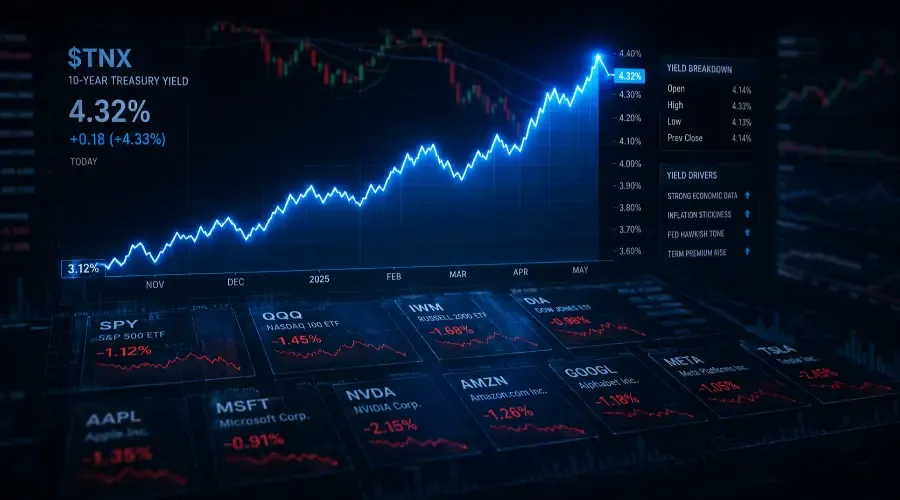
The most important thing to understand going into today is that the US 10-year yield sitting near 4.49% is what's shaping everything else. That level is close to the high end of where yields have traded over the past year, and it matters because higher yields tend to make growth stocks less attractive while giving a relative boost to sectors like banks and energy.
Markets are pricing in the idea that the Fed is in no rush to cut rates. Fed speakers from the Dallas Fed are scheduled today, and traders will be listening closely for any shift in tone – though none is expected. There's no major economic data (no CPI, no jobs report) on the calendar today, so Fed commentary and the weekly balance sheet update at 4:30 PM ET are likely to be the main macro events.
If yields were to pull back toward 4.30%, that could provide some relief for tech and growth stocks. But for that to happen, something would need to change in the inflation or Fed narrative – and that catalyst isn't visible today.
Why Gold Is Fading Despite Geopolitical Tension
Gold at $4,510/oz might seem high given that it's down 0.5% today and about 2.3% over the past month. The reason it's struggling is straightforward: when real yields are elevated and the dollar is firm, gold tends to lose its appeal as a safe haven. Middle East tensions are still in the background, but rate expectations appear to be the stronger force right now. If the dollar breaks above 105, gold could come under additional pressure.
What Overnight Markets Are Telling Us
Asia came in mostly lower, with major indices like the Nikkei and Shanghai Composite down between 0.4% and 1.0%. Higher US yields and a stronger dollar tend to weigh on Asian markets, and that dynamic was on display overnight. Some energy and commodity-related names showed relative strength.
Europe is also under modest pressure, with major indices like the DAX, CAC, and FTSE 100 down roughly 0.5%–1.0%. Energy and financials are holding up better than the broader market there as well.
No major central bank actions happened overnight. The general theme from the Fed, ECB, and Bank of Japan is the same – rates are staying higher for longer until inflation is clearly under control.
Futures – What the Pre-Market Numbers Are Saying
S&P 500 and Nasdaq: Bounce Attempt, But Not a Clear Recovery Signal Yet
S&P 500 futures are up about 0.1% and Nasdaq futures are up around 0.3% in early pre-market. That's a modest bounce after yesterday's lower close – but it may not mean much on its own.
For the S&P 500, traders are watching the area around last week's swing low as near-term support and prior record highs as resistance. A move that holds above the swing low could suggest the selling pressure is easing. If it breaks below, the recent downtrend may continue.
For the Nasdaq, the mid-24,000 area is the key line to watch. NQ bouncing while yields remain near 4.50% is not unusual, but the structural headwind from rates hasn't gone away. Any significant rally in tech-heavy names may continue to attract selling from investors rotating out of long-duration growth.
Russell 2000: The Most Interesting Move Pre-Market
RTY futures up 0.5% – outperforming both the S&P and Nasdaq – is the most useful signal in the pre-market right now. Small-cap companies tend to have more domestic revenue and lower sensitivity to interest rate duration than megacap tech, which may explain why they're getting a relative bid when yields are elevated.
This pattern typically suggests that some institutional money is rotating toward domestically oriented, economically sensitive names. The Russell 2,600 level is worth watching – if RTY can hold above that, it would be a reasonable sign that the cyclical rotation has some follow-through. If it fails there, the bounce could stall.
Sector Rotation – Where Capital May Be Moving
Sectors That Could Hold Up Better Today
Energy has been showing relative strength, supported by elevated crude oil prices and ongoing Middle East supply concerns. Oil and gas equities have outperformed the broader market in recent sessions, and that trend could continue as long as the geopolitical risk premium stays in crude.
Financials tend to benefit from higher yields because wider interest rate spreads can improve bank profit margins. Recent commentary has pointed to banks gaining ground ahead of their next earnings cycle. This sector has been among the stronger performers as the rate environment stays elevated.
Industrials and cyclicals are also seeing some rotation interest as investors move away from long-duration tech. Companies in this group may be better positioned to pass on higher costs to customers, which makes them somewhat more defensible in the current environment.
Sectors That May Continue to Face Pressure
Technology and semiconductors are the most rate-sensitive part of the market because their value depends heavily on future cash flows – and future cash flows are worth less when discount rates are high. Until yields show a credible move lower, tech rallies may continue to attract selling.
Utilities and REITs typically behave like bonds in the equity market. With the 10-year yield near 4.49%, the dividend income these sectors offer looks less attractive by comparison. They could stay under pressure as long as yields remain elevated.
Rate-sensitive consumer and communication services names are also underperforming as investors shift toward value and cyclical factors.
Volatility – Elevated but Not Alarming
VIX is sitting around 20, which is higher than the calm conditions of late 2025 but well below the panic zone it reached above 30 in March. This suggests markets are in a cautious, two-sided state – not in free fall, but not complacent either.
The put/call ratio at 0.75 (compared to about 0.58 a year ago) means traders are buying more downside protection relative to upside speculation than they typically would. That's a sign of defensive positioning, not panic – and it often shows up when markets are grinding through a period of macro uncertainty rather than trending cleanly in either direction.
The VIX term structure – where implied volatility is priced higher for future months than for the immediate term – is consistent with ongoing uncertainty, but doesn't signal any near-term systemic concern.
Earnings – What Recent Results Are Telling Us About Factor Rotation
Today's earnings slate is light on major names, so the macro backdrop (yields, dollar) is likely to drive more of the action than individual stock reports. That said, recent results continue to shape how capital is being positioned across sectors.
| Ticker | Catalyst Metrics | Market Position | Institutional Flow & Volatility Flags |
|---|---|---|---|
| GM | Beat EPS & Revenue; Raised FY26 guidance on strong auto demand & cost controls. | +5% post-print | Cyclical Beta Resilience: Auto demand is absorbing macro rate headwinds. Monitor EV margin mix and forward capital expenditure revisions. |
| KO | Beat EPS & Revenue; Confirmed strong pricing power and global volume growth. | +2% post-print | Low-Beta Defensive Bid: Inflow trends remain structurally intact on earnings support. Monitor FX headwinds and raw input cost margins into H2. |
| UPS | Mixed; Slight revenue beat but issued cautious outlook on softer global parcel volumes. | −3% post-print | Macro Transport Drag: Acts as a leading diagnostic for global trade velocity. Deterioration here may signal broader softness in logistics and supply chains. |
| ORCL | Disappointment vs. elevated AI expectations; Revenue roughly in-line. | −3% to −5% | Growth Factor Overhang: Triggered a positioning unwind in the crowded AI complex. Capex intensity vs. near-term monetization is a potential sector-wide cap on NQ upside. |
The pattern across these prints is fairly clear: cash-generative cyclicals with solid guidance (GM, KO) are being rewarded. Tech and AI names where expectations got ahead of results (ORCL) are being sold. That dynamic is likely to continue influencing sector flows today.
5. Corporate Actions – Two Stories Worth Tracking
Sun Pharmaceutical Agrees to Acquire Organon for ~$11.75B
This is a significant healthcare deal. Sun Pharma's acquisition of Organon in specialty pharma and women's health could generate flows into related sector ETFs, affect credit spreads in healthcare, and prompt re-rating of comparable companies in the space. For traders watching pharma names, it's worth checking whether adjacent specialty pharma stocks see any unusual activity as investors try to identify the next potential consolidation target.
The deal is also part of a broader trend of Indian pharma companies making large acquisitions in US and global specialty drug assets – a theme worth monitoring if you follow cross-border M&A flows.
AI Deal Blocked by Regulators – Caps Mega-Platform Upside
Chinese regulators have blocked a major US tech firm's attempt to acquire an AI startup. This is part of an ongoing pattern of cross-border AI deal scrutiny from regulators globally. The practical effect is that large tech platforms may have fewer M&A options to accelerate their AI capabilities, which pushes them toward building organically – and heavy organic capex spending is exactly what spooked Oracle investors. Smaller AI competitors may benefit from reduced consolidation pressure.
Analysts have broadly trimmed price targets on long-duration growth names in recent weeks, while raising or initiating positive views on energy, financials, and cyclicals. Those repositioning flows appear to still be working through the market.
Key Levels to Monitor Today
- DXY 105 – A sustained break above could add pressure to commodities and non-US risk assets
- US 10Y 4.30% – A pullback here would provide relief for tech and rate-sensitive sectors; no clear catalyst for this today
- RTY 2,600 – Whether Russell holds this level may indicate how much conviction there is behind the cyclical rotation
- NQ mid-24,000s – Key pivot for trend-following flows in tech
Breakout Bulletin publishes market analysis for independent traders. All content is for educational and informational purposes only and does not constitute investment advice.